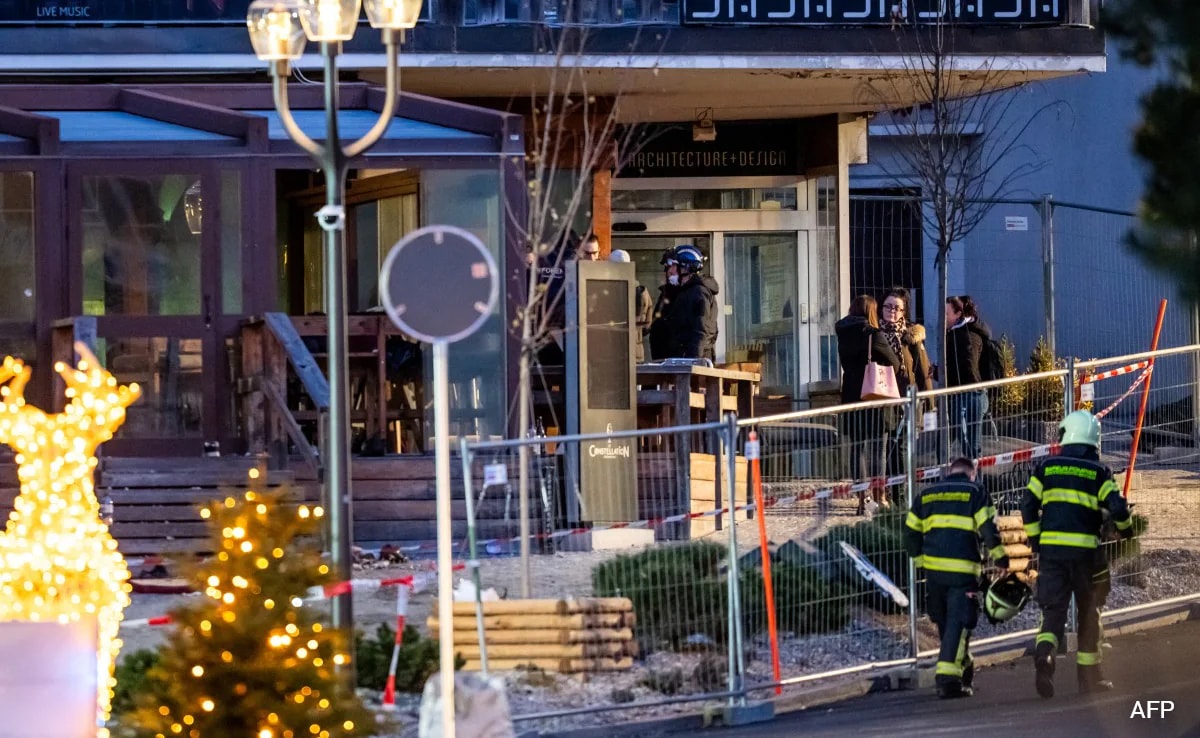
The air in the Alps at night doesn't just feel cold; it feels sharp. It is an environment of absolute beauty and absolute indifference. On a late winter evening in a high-altitude resort town, that beauty evaporated into a roar of orange and black. When the timber-framed luxury of a mountain getaway meets an electrical short or a kitchen mishap, the result is a vertical furnace.
People scrambled. Some jumped. Others breathed in the toxic soup of melting insulation and ancient wood varnish before they could even find the door. By the time the sirens began to wail, cutting through the thin mountain air, the fire was no longer a property dispute. It was a biological emergency.
The ambulances arrived, their blue lights bouncing off the snow banks. But as the stretchers were loaded, a secondary, invisible fire began to burn. This one wasn't fueled by oxygen and wood, but by bureaucracy and ledgers. The fire happened near the border—that jagged, invisible line where Italy ends and Switzerland begins. As the victims were rushed to the nearest specialized burn units, the question wasn't just "Will they live?" but "Who is going to pay for the miracle?"
The Geometry of a Crisis
Imagine a woman we will call Elena. She is a seasonal worker, or perhaps a tourist who saved for three years for this one week in the sun and snow. She is currently sedated, her skin a map of trauma, lying in a high-tech bed in a Swiss clinic because that clinic was twenty minutes closer than the nearest Italian equivalent.
To Elena, the border is a ghost. To the administrators in Rome and Bern, it is a steel wall.
The recent friction between these two nations over the costs of treating resort fire victims has laid bare a grim reality. Switzerland, with its precision-engineered healthcare system and staggering price points, expects prompt reimbursement. Italy, tethered to a sprawling national health service under constant fiscal pressure, views the Swiss invoices with a mixture of sticker shock and resentment.
The numbers are not small. A single day in a top-tier Swiss intensive care unit can cost as much as a mid-sized sedan. When you add the specialized grafting, the round-the-clock nursing, and the complex pharmacology required to keep a severe burn victim stable, the bill doesn't just grow. It explodes.
When Sovereignty Meets Life Support
We like to think of Europe as a seamless map, a place where the Schengen Agreement and modern diplomacy have smoothed over the rough edges of nationalism. But healthcare remains one of the final redoubts of the nation-state.
The dispute centers on a specific, ugly word: "Disgraceful."
That was the term leveled during the heated exchanges between regional officials. The Italians argue that the Swiss are profiteering from tragedy, charging rates that reflect a luxury market rather than a humanitarian necessity. The Swiss retort is simpler and colder: we provided the best care in the world on a moment’s notice, and our taxpayers should not foot the bill for your citizens’ misfortunes.
Consider the mechanics of a burn. When the dermis is destroyed, the body loses its ability to regulate temperature and retain fluids. It is a systemic collapse. In those first "golden hours," a helicopter pilot doesn't check a passenger's passport to decide which valley to land in. They fly to the best chance of survival.
But the "golden hour" is followed by the "leaden months" of administrative warfare. Italy’s public health system, the Servizio Sanitario Nazionale, operates on a philosophy of universal coverage, but it is a system calibrated for Italian costs. When it meets the Swiss private-public hybrid model, the gears grind and smoke.
The Invisible Stakes of the Après-Ski
There is a bitter irony in the location of these disputes. Alpine resorts are playgrounds for the global elite and the hardworking middle class alike. They are zones of perceived safety and curated adventure. We pay for the lift ticket, the insurance, and the gear, assuming that the infrastructure of civilization is as solid as the granite beneath the permafrost.
But the safety net is actually a patchwork of bilateral agreements that are currently fraying.
The tension isn't just about the money already spent; it’s about the precedent. If Italy successfully negotiates a "discount" on emergency care, does that devalue the Swiss medical model? If Switzerland refuses to budge, does Italy start instructing its emergency dispatchers to take the long way around, bypassing Swiss hospitals even if it costs minutes of life?
This is the hidden cost of the mountains. We see the majestic peaks, but we don't see the ledger books being slammed shut in offices in Milan and Zurich.
The Human Ledger
Let’s go back to the bedside.
A nurse in a Swiss hospital adjusts an IV drip. She speaks a different dialect than the patient’s family. She is focused on the heart rate monitor, the oxygen saturation, the signs of infection. For her, the "disgrace" isn't the bill. The disgrace is the fire itself—the faulty wiring or the lack of sprinklers that turned a vacation into a nightmare.
But the administrators are not in the room. They are looking at spreadsheets where Elena is not a person, but a "case file" with a disputed valuation.
Italy's frustration stems from a feeling of being bullied by a wealthier neighbor. There is a cultural gap here that is wider than any crevasse. The Italian side points to a "European spirit" of mutual aid. The Swiss side points to the "Rule of Law" and the sanctity of contract.
It is a collision between a culture of "we'll figure it out" and a culture of "it is already written."
The Ghost of Future Emergencies
What happens the next time the sky turns orange over a mountain pass?
The danger of this rhetorical escalation is the "chilling effect." In the world of emergency response, hesitation is a killer. If a regional coordinator has to pause for even sixty seconds to wonder if a cross-border transfer will trigger a year-long legal battle, the system has failed.
We are witnessing a breakdown in the fundamental trust that allows border regions to function. These mountain communities are deeply interconnected. People live in Italy and work in Switzerland. They share the same weather, the same risks, and the same rescue frequencies. To see their governments bickering over the price of a life saved is a reminder that even in the most civilized corners of the planet, the "every man for himself" instinct is only one invoice away.
The "disgrace" isn't just the cost. It's the fact that the cost has become the story.
A Price Tag on the Peak
The reality of modern medicine is that it is a miracle that requires a massive, constant infusion of capital. The machines that kept the resort fire victims alive are masterpieces of human engineering. The surgeons who rebuilt their faces are among the most highly trained individuals on Earth.
None of that is free.
But there is a point where the pursuit of fiscal balance becomes a form of secondary trauma. When a nation calls another nation's conduct "disgraceful" over the price of emergency surgery, the message to the survivors is clear: your life is a line item.
As the snow continues to fall on the border, covering the charred remains of the resort, the lawyers are just getting started. They will argue over VAT, over "customary rates," and over jurisdiction. They will exchange sharp letters on expensive stationery while the people who actually felt the heat of the flames try to learn how to walk again.
The fire is out. The embers are cold. But the bitterness is just beginning to settle in the valleys, a thick fog that no amount of alpine sun can burn away.
The mountain doesn't care who pays the bill. It only cares that it eventually gets its due, one way or another. Under the flickering fluorescent lights of a neutral hospital ward, the only thing that is truly certain is that the border has never felt more real, or more heartless.