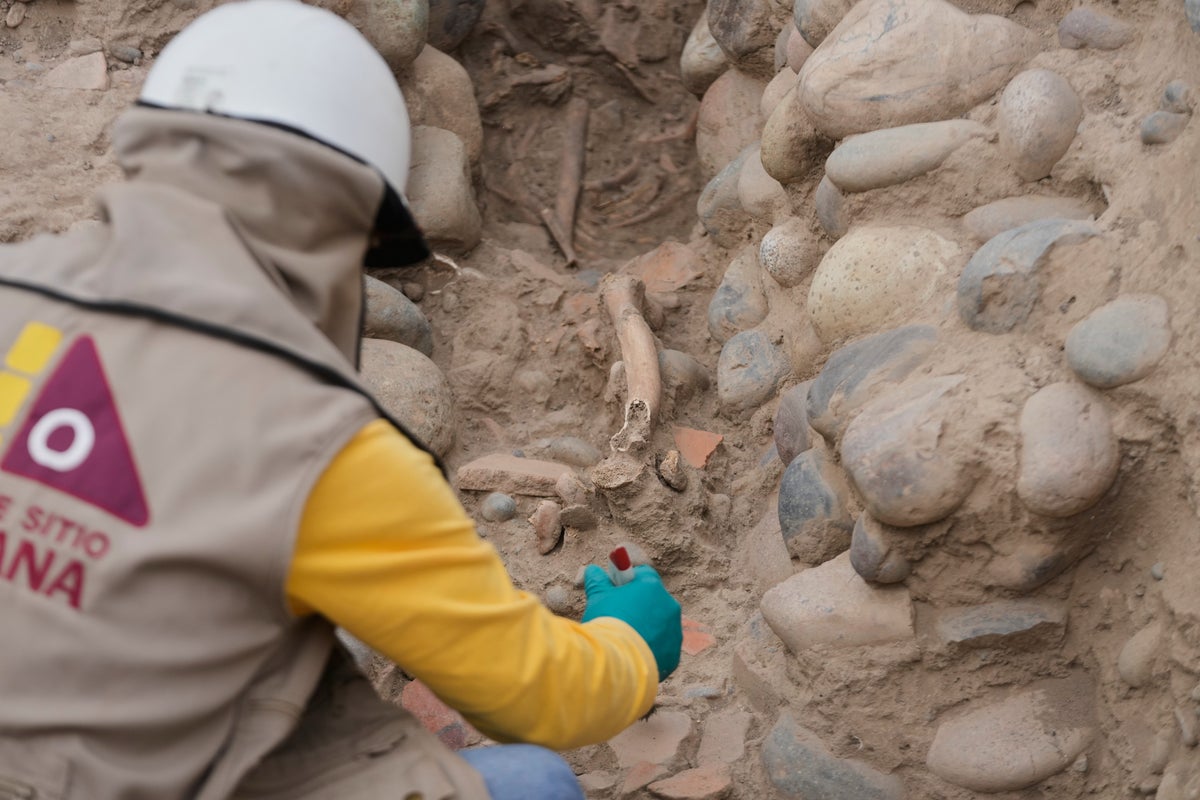
History smells like damp earth and old copper. I remember standing at the edge of a trench in the high sierras, the morning mist still clinging to the scrub brush like a forgotten shroud, watching a lead archaeologist brush a final layer of silt from a jawbone. There is a profound silence that drops over a crew when the ground gives up a secret it has kept for a thousand years. You do not cheer. You breathe shallowly, terrified that your own breath might shatter a narrative that took centuries to crystallize.
We think of the ancient world in monuments. We look at the soaring limestone of pyramids, the sharp angles carved against unforgiving skies, and we mistake them for billboards of absolute power. We tell ourselves neat, clean stories about kings who demanded blood and subjects who willingly laid their necks upon the altar because the gods demanded it. It is a comfortable fiction. It turns real breathing, bleeding human beings into extras on a cinematic set. For a different look, consider: this related article.
Then a skeleton turns up in the wrong place.
Consider the recent discovery tucked away within the ribs of an ancient pyramid, a find that is quietly forcing historians to throw away their textbooks. For decades, the orthodox consensus on these monumental structures was rigid. They were cosmic engines. They were theaters of state terror. Every artifact, every burial chamber, every alignment with the equinox was interpreted through the lens of state-sanctioned violence and divine monarchy. If a body was found beneath a floor slab, the assumption was immediate and unyielding: another victim of a ritual slaughter designed to grease the wheels of empire. Related reporting on the subject has been provided by BBC News.
Blood. Submission. Inevitability.
Except this skeleton does not fit the script.
Let us step back into the dust of the excavation site to understand why. Imagine, purely as a historical reconstruction based on the forensic evidence, a person living in the shadow of these massive stone blocks. Let us call her K'in. She was small-framed, her spine bearing the unmistakable micro-fractures of someone who spent her waking hours grinding maize on a metate, day after relentless day. Her teeth show the wear of grit-heavy bread. Her bones tell a story of endurance, not privilege.
When archaeologists first exposed her resting place, the initial field notes read like all the others. Anomalous inhumation. Probable sacrificial offering. It is the default setting of archaeology when faced with a body that does not belong in a royal tomb.
But science has a way of turning our lazy assumptions into ash.
Strontium isotope analysis of her enamel revealed a jarring truth. K'in was not a local captive dragged up the pyramid stairs in chains. She was born hundreds of miles away, in a distant highland community with a entirely different dialect and distinct cultural traditions. Yet, her burial inside the sacred core of the pyramid was executed with extraordinary care. There were no defensive wounds on her forearms. No trauma marks on her skull. Her body had been positioned with deliberate alignment to the rising winter sun, draped in ornaments that spoke not of subjugation, but of profound reverence.
She was not thrown into the foundations like mortar. She was placed there like a seed.
This is where the neat little boxes we build for the past begin to splinter. If K'in was not a sacrifice, what was she? Why would a distant community send one of their own to rest beneath the monolithic stones of a rival or allied power?
The answer demands that we rethink the entire geopolitical and spiritual engine of the ancient world. We have long projected our modern obsession with nation-states and absolute borders onto ancient societies. We assume empires operated like sprawling corporate franchises, enforcing conformity through the edge of an obsidian blade.
The bones tell a messier, more human story.
They speak of diplomacy written in flesh. They whisper of alliances sealed not through marriages of convenience, but through the migration of sacred hostages or honored emissaries who lived, died, and were immortalized at the very heart of foreign power structures. They suggest a world of astonishingly complex intercultural negotiation, where life and death were currency in a vast, continent-spanning network of mutual dependency.
I felt this weight firsthand years ago when handling a ceramic shard recovered from a similar dig. It was rough-hewn, thumbprints still visibly baked into the clay from a pair of hands that turned to dust a millennium ago. You hold it, and the grand sweep of history evaporates. There are only two people: the one who shaped the clay in the dark, and you, standing in the fluorescent glare of a laboratory, trying to guess what they were afraid of.
History is rarely a monolith. It is a mosaic of contradictions.
When we look at this newly re-examined pyramid skeleton, we are forced to stare down our own historical arrogance. We love the drama of blood and thunder. We prefer our ancestors to be either bloodthirsty tyrants or helpless victims, because those roles are easy to understand from the safety of the present. They require no empathy. They demand no imagination.
Complexity is harder. It requires us to admit that human beings five thousand years ago were just as complicated, just as capable of nuanced diplomacy, and just as capable of profound tenderness as we are today.
The stones of the pyramid still stand. They cast long, cold shadows across the jungle floor, indifferent to our theories, waiting for the next shovel to turn up the next inconvenient truth. But beneath those massive blocks, K'in rests quietly, having outlived the empire that tried to bury her identity beneath tons of stone, reminding us that every human life is too vast to be captured by a single, lazy generalization.
The dust settles. The brush sweeps on. And the past looks back at us, refusing to stay dead.


