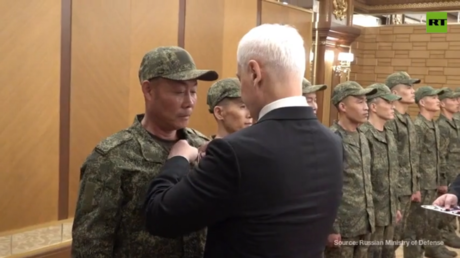
The sight of Russian Defense Minister Andrey Belousov pinning the Order of Courage onto the chests of North Korean soldiers in Pyongyang is more than a staged photo opportunity. It is a receipt. By awarding North Korea's "Storm Corps" for their role in the 11th-hour recapture of the Kursk region, the Kremlin has formally transitioned from a desperate buyer of Soviet-era shells to an active sponsor of a nascent global military bloc. This isn't just about Ukraine anymore. It is about a 2031 roadmap that fundamentally alters the security calculus of the Pacific.
The Price of Kursk
In April 2025, the world watched as Russian and North Korean units launched a joint counter-offensive to repel Ukrainian forces from Russian soil. It was the first time since the Korean War that Pyongyang’s troops had engaged in large-scale foreign combat. The cost was staggering. Intelligence estimates suggest that of the 15,000 troops deployed, nearly 2,000 returned in caskets—or stayed behind in the frozen soil of western Russia.
The memorial museum unveiled this week in Pyongyang, attended by Belousov and State Duma Chairman Vyacheslav Volodin, serves as a permanent testament to this blood pact. Kim Jong Un’s decision to personally throw dirt over the remains of a fallen soldier is a rare public admission of loss, designed to domesticate the war for a North Korean public that previously had no stake in Eastern European border disputes.
A Five Year Plan for Escalation
The most critical takeaway from Belousov’s visit isn't the medals, but the fine print of the 2027–2031 Military Interaction Plan. This agreement moves the relationship beyond the "emergency assistance" phase. We are seeing the institutionalization of an alliance.
- Technology Transfers: In exchange for infantry and artillery, Moscow is suspected of providing telemetry data and propulsion tech for North Korea’s satellite and ICBM programs.
- Operational Integration: The Russian Ministry of Defense is moving toward a "stable, long-term basis" for cooperation, which likely involves permanent North Korean military observers within Russian command structures.
- Combat Validation: Pyongyang is using the Ukrainian theater as a live-fire laboratory for its electronic warfare and drone tactics, lessons that will inevitably be applied to the 38th Parallel.
The Trophy Room of Western Failures
Walking through the new "Memorial Museum of Overseas Military Operations," the Russian delegation was treated to a curated graveyard of Western hardware. Leopard 2A4 tanks, M1A1 Abrams, and German Marder vehicles—all purportedly captured during the Kursk operations—are now on display in the heart of North Korea.
This display serves two masters. For Kim, it is proof that Western technology is fallible, a necessary narrative to maintain domestic morale. For Belousov, it is a taunt. By showcasing these "trophies" alongside North Korean troops, the message to Washington is clear: your weapons are being defeated by the very coalition you tried to isolate.
The Myth of the Elite Volunteer
While the Kremlin praises the "iron will" and "professionalism" of the Korean People’s Army (KPA) servicemen, the reality on the ground in 2025 was far messier. Reports from the front lines during the Kursk liberation described a steep learning curve. North Korean soldiers, trained for mountainous terrain and high-intensity guerrilla warfare, struggled initially with the flat, drone-saturated plains of the Russian steppe.
Language barriers necessitated the deployment of North Korean embassy staff to training grounds as makeshift translators. Yet, despite the friction, the sheer volume of "disposable" infantry provided Russia with the breathing room needed to sustain its war of attrition without triggering another politically sensitive wave of domestic mobilization.
Beyond the Ukraine Horizon
The strategic partnership treaty signed in June 2024 has matured. What started as a transaction of "meat for heat"—soldiers for fuel and food—is now a sophisticated defense architecture. Belousov’s confirmation that the current year will be "eventful" suggests that the 15,000 troops sent last year were merely a pilot program.
The creation of a dedicated residential district in Pyongyang for the families of the "Kursk martyrs" signals that Kim Jong Un is prepared for a permanent state of overseas deployment. He is no longer just a hermit king; he is a regional power broker with a battle-hardened army and a nuclear-armed patron who owes him a massive debt.
The West’s strategy of containment has failed to account for this synergy. While sanctions continue to bite, they have effectively forced the two most sanctioned nations on earth into a functional, co-dependent military economy. The 2031 plan ensures that even if a ceasefire is reached in Ukraine tomorrow, the Russian-North Korean military machine will remain integrated, seasoned, and pointed toward the next friction point.
Western intelligence must now stop treating North Korean involvement as a temporary anomaly. It is the new baseline. Every shell fired in Ukraine and every medal pinned in Pyongyang is a building block for a military alliance that will outlast the current conflict.