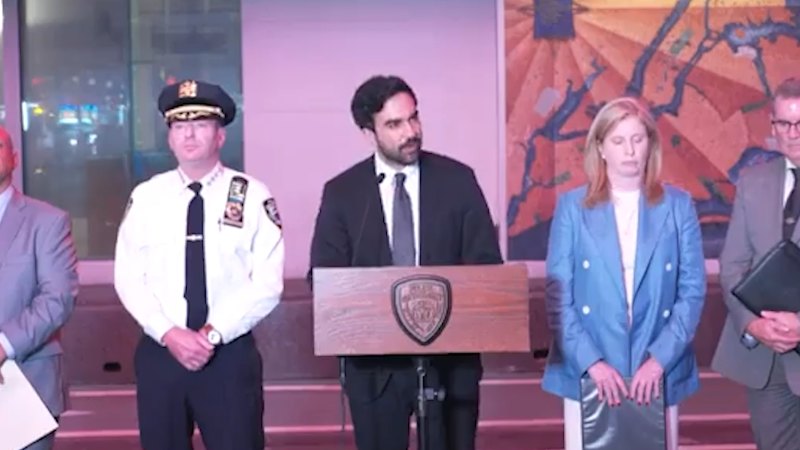
Another violent flashpoint. Another frantic smartphone video captured beneath the flashing neon billboards of Broadway. Another knee-jerk chorus of outrage demanding heads roll because a police officer used deadly force against a knife-wielding individual in the heart of Manhattan.
The standard media narrative writes itself before the body camera footage even finishes uploading. You know the script by heart. The establishment press paints a picture of a tragic avoidable accident, framing split-second survival decisions through the absurdly comfortable lens of Monday morning quarterbacking. They ask why the officer didn't shoot the weapon out of her hand. They ask why a taser wasn't deployed against a charging blade at close quarters. They ask questions designed not to uncover truth, but to feed an emotional mob. For another look, consider: this related article.
I have spent years studying tactical use-of-force dynamics and crisis intervention architecture. I have watched committees of desk-bound bureaucrats pick apart life-or-death milliseconds from the safety of carpeted boardrooms. Let us stop pretending that policing an armed, volatile suspect in a densely crowded public square is an exercise in de-escalation theater.
The lazy consensus treats violent encounters as customer service disputes where a polite conversation can fix a psychotic break or a lethal threat. That mindset is not just naive. It is actively lethal to the officers on the ground and the innocent bystanders trapped in the crossfire. Related reporting on this matter has been provided by BBC News.
The Physics of the Tueller Drill Everyone Ignores
Let us talk about the cold, unforgiving math of close-quarters combat. Every competent firearms instructor teaches the Tueller Drill. The underlying principle is simple and brutal: an assailant with a knife can close a distance of twenty-one feet and inflict fatal trauma before a trained officer can draw holstered hardware and fire an accurate defensive round.
Now, strip away the pristine laboratory conditions of a firing range and drop that reality into Times Square on a bustling afternoon.
You have thousands of pedestrians surging past. You have noise, chaos, obstructed lines of sight, and a moving target wielding an edged weapon. When a suspect ignores repeated lawful commands to drop a knife and advances, the luxury of time evaporates instantly.
The armchair critics screaming about leg shots or non-lethal alternatives live in a cinematic fantasy world. A human leg contains the femoral artery. A missed shot in a crowded urban corridor means a stray bullet ricochets off concrete and enters the chest of a tourist standing ten feet away. Center-mass firing is not chosen out of malice; it is chosen because human physiology under acute adrenaline dictates gross motor skill survival mechanics.
When you introduce a knife into a dense public square, the officer's job is not to act as a social worker or a martial arts master. The job is to neutralize an immediate threat to human life before body counts multiply.
The Myth of the Perfect Non-Lethal Alternative
We need to dismantle the dangerous fixation on tasers as magical wands that solve every violent confrontation.
Tasers rely on two barbed probes making solid contact with a subject's clothing and skin to complete an electrical circuit that locks up the nervous system. In the real world, heavy winter coats, loose clothing, leather jackets, or simple adrenaline spikes render tasers ineffective up to forty percent of the time. If a taser fails against someone charging with a knife, the officer is dead before the cartridge can be reloaded.
Expecting a lone officer or a small responding unit to gamble human lives on a single-shot electronic device against an active edged-weapon threat is criminally irresponsible. Yet, every time an officer relies on standard ballistic protocols instead of rolling the dice on a malfunctioning gadget, the media treats it as an execution rather than a grim necessity forced by the assailant.
Imagine a scenario where emergency responders are stripped of their firearms in these exact environments. Picture the absolute carnage that would unfold if police were forced to retreat or negotiate while a knife-wielding attacker carves a bloody path through a crowded transit hub. The critics do not want better training or better equipment. They want a world where police simply absorb violence until the attacker grows tired.
The Real Crisis is Downstream
The genuine systemic failure here has nothing to do with standard operating procedures in the NYPD. The breakdown happens long before a blade is drawn in Midtown Manhattan.
We have constructed a society that shuttered psychiatric bed capacity, hollowed out institutional support networks, and decided that leaving severely mentally ill or dangerous individuals to fend for themselves on the streets represents compassion. It is not compassion. It is institutional abandonment disguised as civil liberties progress.
When a person experiencing a profound psychotic episode is allowed to deteriorate on public transit or major thoroughfares armed with a weapon, a violent collision with law enforcement is not a question of if, but when.
We throw police officers into the absolute vacuum left by failed healthcare, broken mental health systems, and non-existent social safety nets. Then, when the inevitable tragedy occurs, the architects of those very social failures point their fingers at the cop who pulled the trigger, screaming about brutality. It is a convenient sleight of hand designed to protect the political class from accountability.
Stop Demanding Impossible Perfection
Examine the commentary surrounding these high-profile incidents. The underlying demand is always structural perfection. We expect officers to diagnose psychological trauma in three seconds, calculate ricochet vectors in their sleep, and execute martial arts disarms while dodging a blade.
No other profession faces this standard. Not surgeons. Not pilots. Not politicians who draft the very policies that create urban chaos.
If you want fewer police shootings involving knife-wielding individuals, the fix does not lie in prosecuting officers who make split-second decisions to preserve innocent life. The fix requires rebuilding an institutional commitment to involuntary commitment for severe mental illness, securing our public spaces, and accepting that human beings armed with lethal weapons pose an immediate existential threat that cannot be negotiated away with kind words.
Until we summon the courage to address those uncomfortable truths, the bleeding heart outrage industry will keep churning out hollow condemnations, sacrificing common sense on the altar of viral headlines.
Next time you watch a 10-second clip of a tragedy in Times Square, stop looking for someone to blame for the outcome and start asking why we allowed the danger to walk onto the platform in the first place.