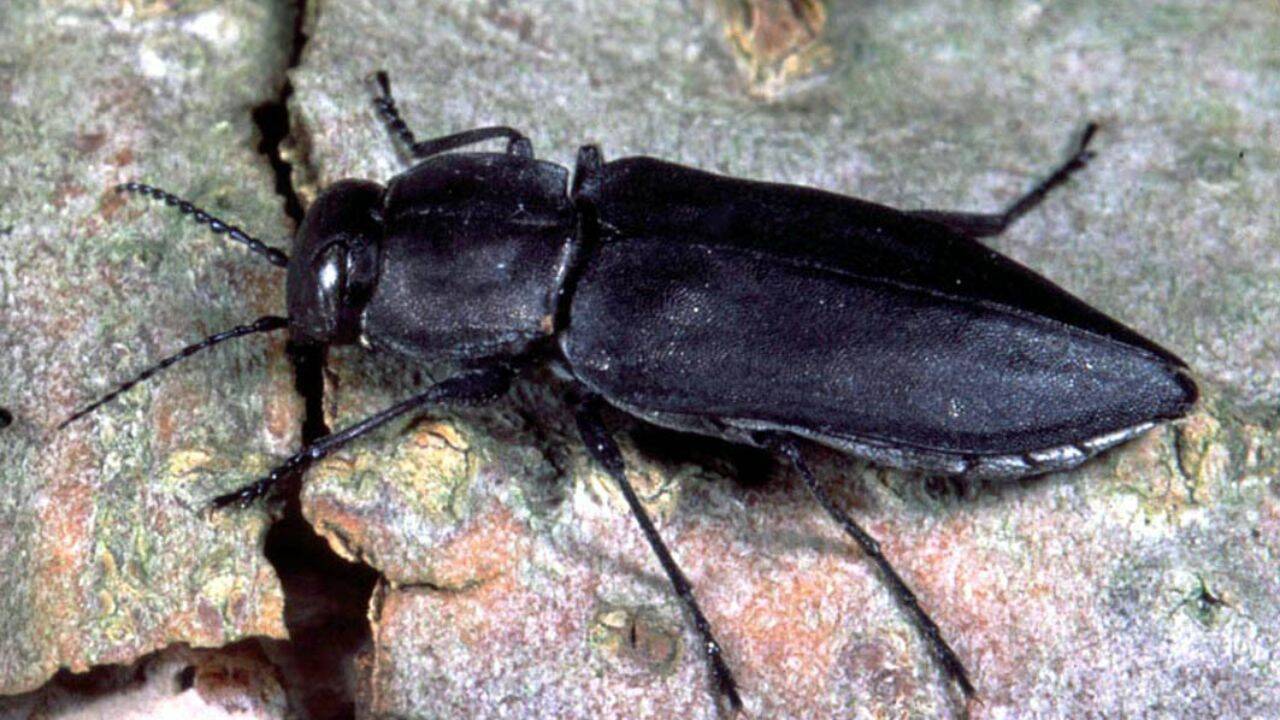
Most creatures flee from raging forest fires. They run, they fly away, or they dig deep into the soil to escape the heat. But the black pine jewel beetle does the exact opposite. It flies straight toward the flames.
Why? Because death for an entire forest means dinner and nursery space for this remarkable insect.
Forest fires clear out competing vegetation. They weaken trees and kill off predators. For the black pine jewel beetle, a burning pine tree acts as a glowing beacon of opportunity. Yet finding a fire miles away requires senses far beyond human comprehension. These insects don't just happen to stumble upon burning timber. They hunt it down across vast distances using specialized anatomy that sounds like science fiction.
Let's break down how these beetles track down destruction and why their survival strategy teaches us a lot about evolutionary adaptation.
The Infrared Vision Advantage
Normal insect eyes work great for sunlight, movement, and spotting predators in daylight. When a forest catches fire, standard vision isn't enough through thick smoke and darkness. Enter the specialized mechanoreceptors and infrared organs tucked away on the beetle's body.
Scientists found that Melanophila acuminata—the scientific name for this pyrophilous beetle—possesses pit organs on its thorax. These microscopic pits contain spherical sensilla that act as biological infrared detectors. They sense radiant heat from kilometers away without needing direct contact.
Think about how a pit viper hunts mice in the dark using thermal heat pits. The black pine jewel beetle uses a similar mechanism, but on a massive scale. It detects the specific thermal signature of a burning pine tree. While the air might be cool miles downwind, infrared radiation pierces right through the atmosphere. The beetle intercepts these invisible waves and locks onto the source long before emergency crews even spot the smoke.
Smoke Tracking And Chemical Cues
Heat alone isn't enough to guide a beetle to the right spot. Thousands of things emit heat. Wildfires have a very specific chemical signature, and the beetle's antennae serve as chemical analyzers.
When pine resin burns, it releases specific aromatic compounds like guaiacol and other phenols. The black pine jewel beetle smells these molecules at shockingly low concentrations. Combine that scent trail with the thermal tracking from the infrared organs, and you get a dual-tracking guidance system.
They smell the smoke first. Then they cross-reference it with the infrared heat signal. It basically gives them GPS coordinates for catastrophe.
The Race Against Time
Arriving at a burning forest requires precise timing. If a beetle shows up too early, the heat will incinerate it. Show up too late, and other competing insects have already claimed the best spots.
They wait at a safe distance while the crown fires rage. As the fire dies down into smoldering embers, they make their move. Females land on still-hot bark that would blister human skin. They march across charred wood while it's still warm to the touch.
Why rush into a smoking ruin? Competition is low. Wood-boring beetles lay eggs under the bark of stressed or dying trees. Larvae hatch and feed on the phloem. Because fire kills the tree's natural defense mechanisms—like sticky resin flows that usually trap and drown invading insects—the larvae can feed in peace. The tree is dead anyway. The beetles just speed up the decomposition process.
What Human Engineering Learned From Bugs
Nature often solves complex engineering problems millions of years before humans invent the tools. Aerospace engineers and fire safety researchers spent years studying the infrared sensors of the black pine jewel beetle.
Early satellite systems struggled to detect forest fires early because existing sensors were prone to false alarms from sun glare or hot rocks. By mimicking the structure of the beetle's pit organs, scientists developed better infrared sensors for early wildfire detection satellites.
When you look at how modern infrared cameras spot hot spots in dense brush, you can trace part of that technology back to these tiny insects. They solved a thermal detection problem using biological hardware that weighs less than a gram.
Survival In A Changing Climate
Wildfires happen more frequently now. Dry conditions and shifting weather patterns mean more timber goes up in smoke across North America and Eurasia. You might assume this boom in fires creates a paradise for the black pine jewel beetle.
Not quite. While they thrive on disturbance, extreme habitat destruction fragments their populations. If a fire burns too hot or wipes out entire regional ecosystems without leaving any unburned corridors, local populations struggle to bounce back. They need the burned trees, but they also need neighboring healthy forests to complete their life cycles over multiple generations.
Evolution gave these beetles an incredible toolkit for disaster. They don't fear the burn. They ride the wave of destruction, turning tragedy into the next generation. Next time you think about the sheer resilience of nature, remember the beetle that flies toward the fire while everything else runs away.