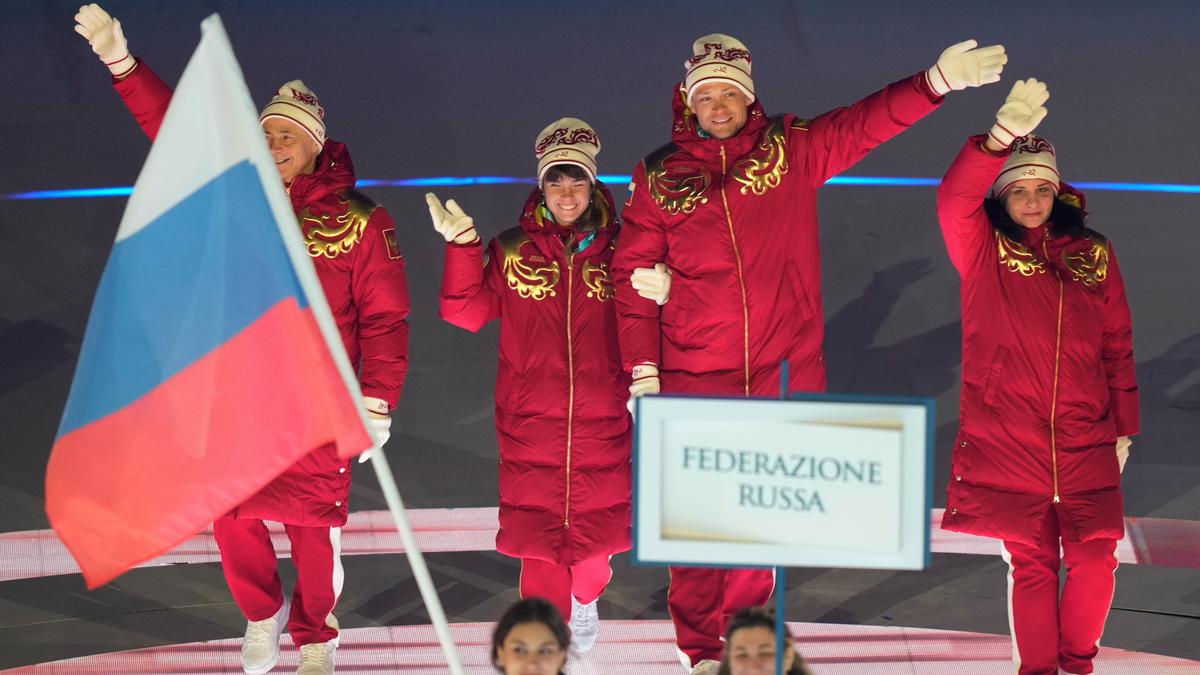
The opening ceremony of the Milan Cortina Winter Paralympics was supposed to be a celebration of human resilience. Instead, it has become a masterclass in geopolitical tension. As athletes from around the globe gathered in Italy, the spectacle was overshadowed by a series of high-stakes diplomatic crises that have effectively ended the era of the "apolitical" Olympics. The return of the Russian flag, coupled with a widening conflict involving Iran and a wave of national boycotts, has turned the snow-covered slopes into a diplomatic minefield.
For years, the International Paralympic Committee (IPC) attempted to walk a razor-thin line between inclusion and accountability. That line has snapped. The decision to allow Russian and Belarusian athletes to compete under their national colors—rather than as neutral entities—marks a seismic shift in international sports governance. This isn't just about a flag. It is about the total collapse of the consensus that kept the Games functioning as a separate entity from the theater of war.
The Russian Return and the Price of Inclusion
The decision to restore the Russian flag was not a sudden act of grace. It was the result of a grueling legal and political lobbying effort that exposed the fractures within the IPC’s voting block. For months, member nations were divided. On one side stood the traditional Western powers, demanding a total ban until the cessation of hostilities in Ukraine. On the other side, a growing coalition of nations from the Global South and the East argued that punishing individual athletes for the actions of their governments is a violation of the fundamental human right to compete.
When the secret ballot results were announced, the reality was clear. The "neutral athlete" experiment failed to provide the long-term solution the IPC desperately needed. By allowing the flag to return, the committee has essentially bet the farm on the idea that visibility is better than a lingering, bitter exclusion. However, this bet has come at a staggering cost. Several nations, led by the Nordic countries and the Baltic states, have already pulled their funding and their dignitaries from the event. The result is an opening ceremony that feels less like a global union and more like a fractured caucus.
The Iran Crisis Spills Onto the Ice
While the Russian presence dominated the headlines, the escalating conflict in the Middle East has introduced a more volatile variable into the Milan Cortina Games. The involvement of Iran in a widening regional war has triggered a secondary wave of protests and security concerns. Unlike previous years, where Middle Eastern conflicts remained largely peripheral to the Winter Games, the current scale of the violence has forced the IPC to implement unprecedented security measures.
The friction is visible in the athletes' village. Security details have tripled. Sources within the Italian organizing committee suggest that the cost of policing the Games has now exceeded the original budget by nearly 35 percent. This isn't just about keeping the peace between athletes. It is about preventing the Games from being used as a platform for state-sponsored propaganda or, worse, a target for kinetic retaliation. The presence of Iranian officials in the VIP boxes, mere seats away from representatives of nations currently sanctioning them, has created a palpable, vibrating tension that no amount of Italian hospitality can mask.
The Failure of the Neutrality Doctrine
The central myth of the Olympic movement is that sport can remain "neutral." This concept is dead. In the current global climate, neutrality is viewed by activists as complicity and by governments as a strategic weakness. When an athlete stands on a podium, they are no longer just an individual with a physical disability who has overcome incredible odds. They are a proxy for their nation’s soft power.
We are seeing the rise of a "Cold War 2.0" in the sporting world. During the original Cold War, boycotts were massive, coordinated efforts, like the 1980 Moscow and 1984 Los Angeles Games. Today, the boycotts are more surgical. They are "diplomatic boycotts," where athletes are sent to compete, but their flags are lowered, their anthems are silenced, or their government officials refuse to attend. This halfway house of protest satisfies no one. It leaves the athletes in a state of limbo, where their achievements are permanently asterisked by the politics of the day.
The Logistics of a Fractured Event
The sheer logistical nightmare of hosting these Games cannot be overstated. Italian organizers have had to manage:
- Segregated Housing: Discreetly ensuring that delegations from warring nations are housed in separate wings or even different satellite villages.
- Media Blackouts: Strategic censorship of the "mixed zone" where athletes talk to the press, in an attempt to prevent political statements from going viral.
- Sponsor Flight: A quiet but steady withdrawal of major corporate sponsors who fear being associated with an event that looks increasingly like a political rally.
The financial burden of these adjustments is being passed on to the Italian taxpayers. Milan and Cortina d'Ampezzo were sold a dream of economic revitalization. What they received was a geopolitical headache that has deterred the casual tourists who usually fill the hotels and restaurants during a Paralympic cycle.
A Systemic Crisis in Sports Governance
The IPC and the International Olympic Committee (IOC) are currently operating with a playbook written for the 1990s. They rely on the idea that globalism is an unstoppable force and that sport is the ultimate universal language. That language is currently being mistranslated.
The governing bodies are trapped. If they ban Russia and Iran, they are accused of being puppets of Western foreign policy. If they allow them in, they lose the support of the very nations that provide the majority of the Games' funding and infrastructure. It is a zero-sum game. The current model of a "Global Games" is built on a foundation of international cooperation that simply no longer exists in the real world.
The Human Cost of the Diplomatic Crossfire
Lost in the shuffle of flags and boycotts are the athletes themselves. The Paralympics were designed to showcase the pinnacle of human adaptability. Instead, these competitors have become pawns in a game they didn't sign up to play. An athlete from a boycotted nation faces a double tragedy. They have spent four years training in sub-optimal conditions, often in war-torn regions, only to arrive at the world stage and find themselves treated as pariahs.
The tension in Milan is not a temporary glitch. It is a preview of the new normal. We are moving toward a future where international sports will likely split into regional blocks. We may see the end of the unified Olympic and Paralympic movement as we know it, replaced by smaller, more ideologically aligned competitions.
The return of the Russian flag in Milan is not a return to normalcy. It is a signal that the old rules are gone. When the fireworks faded over the opening ceremony, they didn't leave behind a sense of unity. They left behind a thick cloud of smoke, hiding a future where the podium is just another front in an endless global conflict.
Governments must now decide if they are willing to fund an international sporting movement that is fundamentally broken, or if it is time to build something entirely different from the wreckage of the old ideals.