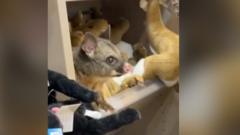
The presence of a live common brushtail possum (Trichosurus vulpecula) within the retail perimeter of an Australian airport terminal is not a viral curiosity but a significant breach of biocontainment and operational security. While digital media focuses on the visual incongruity of a marsupial perched among plush toys, a structural analysis reveals a failure in the Pest Exclusion Barrier (PEB). This incident exposes the vulnerability of sterile airport zones to "hitchhiking" fauna, which poses specific risks to aviation safety, infrastructure integrity, and public health.
To understand how a wild animal bypasses multiple layers of high-traffic security, we must analyze the incident through three distinct frameworks: the Architecture of Permeability, the Economic Cost of Biological Contamination, and Mitigation through Integrated Pest Management (IPM).
The Architecture of Permeability
Modern airport terminals are designed for high-volume human throughput and climate control, yet they often feature structural "leakage" points. The common brushtail possum is a semi-arboreal generalist, capable of navigating vertical surfaces and squeezing through apertures as small as 10 centimeters.
Entry Vectors
Infiltration typically occurs via one of three primary vectors:
- The Logistics Chokepoint: Cargo bays and baggage handling systems (BHS) provide direct, often unsealed conduits from the tarmac to the terminal interior.
- Roof-to-Ceiling Cavities: Expansion joints, HVAC ducting, and cable trays serve as "superhighways" for urban-adapted wildlife.
- Landside-to-Airside Transitions: Automatic sliding doors and service entrances lack the physical barriers necessary to deter non-human entrants.
The specific presence of the animal on a retail shelf suggests it traveled through the Plenum Space—the area between the structural ceiling and the suspended tiles used in retail outlets. This space is rarely monitored by motion sensors, which are calibrated to detect human-sized heat signatures (Passive Infrared) at floor level, effectively creating a blind spot for small biological actors.
The Economic Cost of Biological Contamination
The proximity of a wild animal to consumer goods—specifically plush toys—introduces a liability chain that extends beyond simple cleanup.
Inventory Degradation
Bio-organic contamination involves more than just physical presence. Brushtail possums mark territory using scent glands located on their chests. This results in the deposition of oils and pheromones that render porous materials like textiles (plush toys) unsalable. From a retail management perspective, the entire "shelf zone" must be treated as contaminated. This necessitates a Total Loss Write-off for the affected SKUs to prevent the transmission of zoonotic pathogens to the end consumer, particularly children.
Infrastructure Risk
The primary technical threat is mastication damage. Possums, like many urban mammals, have a propensity for gnawing on the polymer insulation of electrical wiring. In an airport environment, the cost of a "short circuit" is not merely the price of a wire, but the potential downtime of flight information displays, security scanners, or emergency lighting systems.
- Direct Costs: Professional wildlife extraction, sanitization of retail space, and replacement of damaged inventory.
- Indirect Costs: Potential delays if the animal migrates into the BHS or sensitive avionics bays.
- Reputational Friction: While the public perceives the event as "cute," it signals a lack of environmental control to regulatory bodies and high-value tenants.
Taxonomy of the Common Brushtail Possum in Urban Infrastructure
Understanding the adversary is essential for containment. The common brushtail possum is not a passive visitor; it is an opportunistic scavenger with high cognitive flexibility.
- Nocturnal Activity Cycles: Their peak activity occurs when terminal foot traffic is lowest, allowing them to explore and expand their territory within the building without detection.
- Dietary Versatility: They can survive on discarded food waste found in airport food courts, reducing their need to exit the building once entry is achieved.
- Adaptive Nesting: The insulation materials found in airport ceilings provide an ideal thermal environment, leading to long-term residency if not aggressively managed.
Failure of the Sterile Zone Logic
The "Sterile Zone" in aviation security is designed to exclude prohibited items—weapons, explosives, and unauthorized personnel. However, it is fundamentally ill-equipped for biological exclusion.
Standard security protocols utilize X-ray and CT scanners for baggage, and metal detectors for people. None of these systems are designed to detect a biological entity moving through the "back of house" infrastructure. This creates a Security Asymmetry: while a human cannot carry a bottle of water through a checkpoint, a 4-kilogram mammal can bypass the checkpoint entirely by utilizing the structural voids of the building.
Strategic Mitigation and Integrated Pest Management (IPM)
To prevent a recurrence, airport facility managers must shift from reactive "capture and release" to a proactive Structural Hardening strategy.
1. Thermal Perimeter Mapping
Use Forward Looking Infrared (FLIR) cameras to conduct night-time audits of the terminal. This identifies heat leaks—where internal warmth escapes—which act as beacons for wildlife during colder months. Mapping these "thermal signatures" allows maintenance teams to identify and seal entry points.
2. Ultrasonic Deterrents and Pheromone Masking
Deploy high-frequency acoustic devices in plenum spaces. These frequencies are inaudible to humans but create a "noise-hostile" environment for marsupials. Additionally, the use of synthetic predator scents (e.g., dingo or large owl) can discourage nesting behavior in sensitive retail or technical zones.
3. Structural Hardening of the BHS
The Baggage Handling System is the most vulnerable link. Installing heavy-duty strip curtains or high-speed automated doors at the point where conveyors enter the building creates a physical barrier that is difficult for animals to penetrate without stopping the flow of luggage.
4. Retail Hygiene Protocols
Airport retailers must be mandated to use "lidded" storage for all stock. Open-shelf displays, while effective for sales, are the primary attractant for biological intruders.
The Zoonotic Variable
The presence of wildlife in a high-density international transit hub introduces the risk of disease transmission. Brushtail possums are known carriers of Mycobacterium ulcerans (which causes Bairnsdale ulcers) and various enteric pathogens like Salmonella. In an environment where passengers from multiple continents converge, the "Vector-Human" interface must be minimized. The sanitation process following an extraction must use hospital-grade virucidal and bactericidal agents to neutralize the area before it is reopened to the public.
Technical Limitations of Current Solutions
Physical relocation of the animal, while ethically mandated in many Australian jurisdictions, is often a temporary fix. Possums are highly territorial and possess strong homing instincts. Unless the Structural Breach is identified and closed, the ecological niche remains open, and a new individual will inevitably occupy the vacuum.
The current reliance on opportunistic sightings by passengers or staff is a reactive "fail-late" system. A "fail-early" system requires the integration of IoT-based pest monitoring—smart traps and motion-activated cameras in non-public service corridors—to provide real-time alerts before the animal reaches the retail floor.
The incident at the Australian airport serves as a diagnostic marker for a larger systemic issue: the underestimation of urban wildlife as a factor in critical infrastructure management. Facility directors must treat biological infiltration with the same rigor as a cybersecurity breach, recognizing that "The Plenum" is a vulnerable network that requires constant monitoring and physical patching.
Implement a mandatory 48-hour "biosecurity sweep" of the ceiling voids in all airside retail blocks, coupled with the installation of stainless steel mesh over all HVAC intake vents to eliminate the primary transit routes for arboreal mammals.
Would you like me to develop a comprehensive Biological Exclusion Protocol (BEP) template for airport facility managers?