The turf smells different when the sidelines pull inward by twenty yards.
For a professional football player in Canada, spatial awareness is a religion etched into muscle memory. You learn to read a field that stretches 110 yards long and 65 yards wide. You calculate momentum against end zones so deep they feel like small provinces. For decades, the Canadian Football League built its identity on that vastness—a game of massive motion, pre-snap movement, and sprawling, high-octane geometry.
Then someone places a flag belt around your waist, paints lines on a field that feels no larger than a backyard patio, and tells you to sprint for Olympic gold.
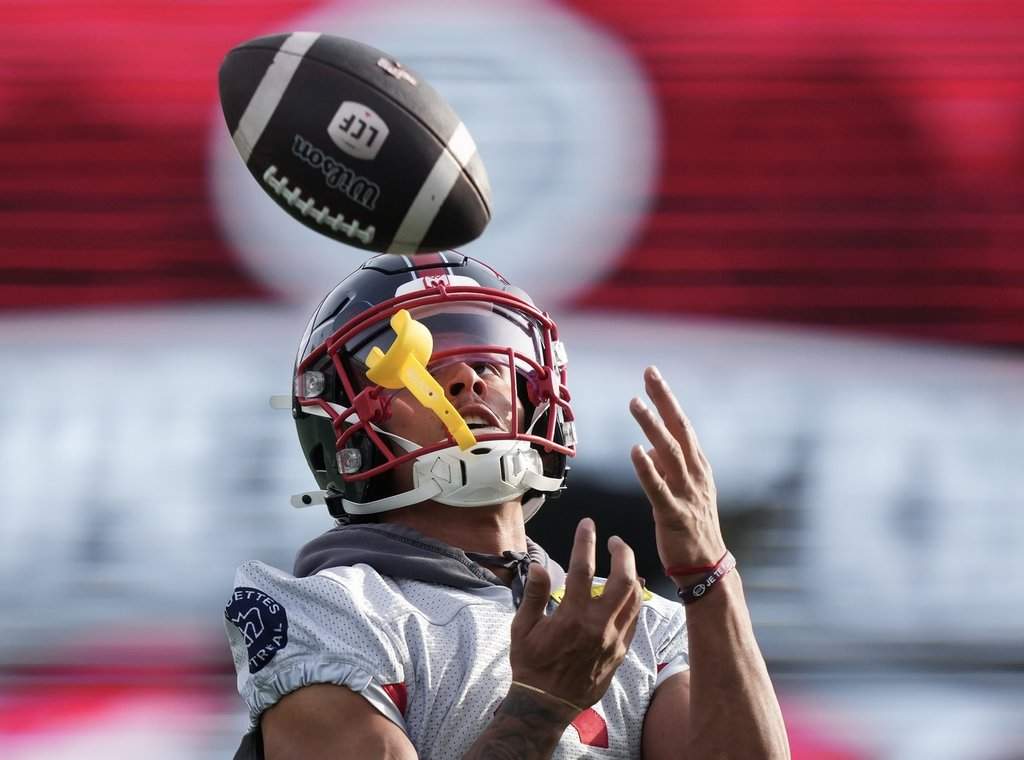
That is the quiet, seismic transition currently unfolding inside elite Canadian athletics. Football Canada recently opened its doors to a specialized national team selection camp, inviting a select group of CFL veterans and elite domestic talent to audition for the Canadian men's flag football roster. On paper, it sounds like a novelty—a weekend tryout for a modified version of a childhood game. In reality, it marks the opening salvo of a radical transformation in international sport.
With flag football officially locked into the program for the Los Angeles 2028 Olympic Games, the stakes have transformed overnight. What was once considered a recreational weekend pastime has morphed into a high-stakes arena where professional gridiron stars must dismantle everything they know about collision, space, and speed.
The Physics of Stripping Away the Armor
Imagine driving a muscle car your entire adult life. You know how to lean into the weight. You understand how to use your shoulders to clear a path, how to absorb an impact, and how to use momentum to push forward for those brutal, necessary two extra inches.
Now, take away the car's body panels. Take away the power steering. Strip the engine down to pure, unadulterated acceleration, and tell the driver that if any two vehicles make contact, both are disqualified.
That is the culture shock waiting for a traditional tackle football player entering five-on-five flag.
In traditional CFL play, collision is a tool. A defensive back uses his hands to jam a receiver at the line of scrimmage, disrupting timing through controlled violence. Linebackers fill gaps with their sternums. Receivers brace for the hit, tucked tight, accepting the physical toll as the price of admission for a first down.
Flag football strips that armor away, both literally and tactically.
Without pads, helmet, or physical contact, the game reverts to pure physics and raw kinetic chess. There are no offensive linemen to buy a quarterback four seconds of patience. There is no blocking downfield. The field contracts to fifty yards long and twenty-five yards wide. The play clock ticks down with aggressive brevity.
If a quarterback hesitates for a fraction of a heartbeat, a blitzing defender—starting seven yards back and moving at top speed the moment the ball is snapped—will defuse the play before a route can even break.
Consider a hypothetical defensive back making his first appearance at this national camp. Call him Marcus. For six seasons in the CFL, Marcus made his living by closing space and punishing receivers who dared to catch the ball over the middle. His brain is hardwired to hit.
At flag camp, Marcus tracks a receiver cutting across the turf. Every instinct honed over fifteen years of tackle football commands him to lower his pad level and drive his shoulder through the target's hip.
Instead, he has to suppress that deeply ingrained survival instinct. He must decelerate rapidly, keep his balance centered, and pinpoint a small strip of fabric fluttering at the receiver’s waist—all while moving at twenty miles per hour. Miss the flag by an inch, and the receiver is gone. Make physical contact, and the whistle blows for a penalty.
It requires a level of micro-fine motor control under maximum cardiovascular distress that few mainstream sports ever demand.
The Olympic Magnet
Why would professional athletes, many of whom have built stable careers playing in front of tens of thousands of fans in Grey Cup contenders, volunteer for the grueling friction of a flag camp?
The answer sits on the horizon in 2028.
The inclusion of flag football in the Los Angeles Olympics changed the gravity of the sport permanently. For generations, American football players faced a hard ceiling on their international ambitions. You played high school, you played college, and if you were among the elite fraction of one percent, you played professionally. But you never stood on a podium. You never watched your nation's flag rise while gold rested against your chest.
The Olympics offer a currency that professional sports contracts cannot buy: immortality on a global canvas.
Football Canada recognizes this shift. By extending invitations to CFL players, the governing body is attempting to bridge a vast tactical gap. Canada possesses some of the most gifted football minds and refined physical specimens on the planet. But talent alone does not guarantee international dominance.
The global flag football landscape has evolved rapidly over the past decade. Nations across Europe, Asia, and the Americas have cultivated flag specialists—athletes who have never worn a pair of shoulder pads, but whose agility, flag-pulling precision, and short-area quickness are tuned to perfection.
A CFL receiver might possess world-class straight-line speed, but if he cannot execute a zero-step lateral cut without slipping, a seasoned flag specialist will evade him every single time.
The national camp is not merely a showcase; it is a laboratory where two distinct football subcultures are forced to collide and synthesize.
The Invisible Stakes of a Changing Game
The narrative surrounding flag football often suffers from a fundamental misunderstanding. Critics who have never stood on the sideline of a competitive five-on-five tournament often dismiss it as "soft" or consider it an informal drill stripped of real football's grit.
They fail to see the brutal cardiovascular tax.
Because there are no stoppages for heavy personnel changes, no long huddles, and no rest periods while an injured lineman walks off the field, the tempo of elite flag football is suffocating. Players sprint continuously. Routes are non-stop bursts of acceleration, deceleration, and directional change.
In tackle football, a player might execute six to eight full-speed efforts per drive, interspersed with twenty-second recovery windows. In flag, the heart rate spikes and stays locked near the redline for twenty minutes straight.
TACKLE FOOTBALL vs. FIVE-ON-FIVE FLAG FOOTBALL
-----------------------------------------------------------------------
Metric                 Tackle Football (CFL)      Flag Football (Olympic)
-----------------------------------------------------------------------
Field Dimensions       110 x 65 yards             50 x 25 yards
Contact Level          Full collision             Non-contact
Primary Defensive Skill Tackle / Disruption        Flag pull / Spatial coverage
Pacing                 Intermittent power bursts  Continuous high-intensity aerobic
Endurance Demand       Anaerobic power            Hybrid stamina & micro-agility
-----------------------------------------------------------------------
Beyond the physical demand lies an emotional hurdle for the athletes involved.
A professional football player's identity is tied to toughness. From pop warner leagues through the pros, players are taught to measure their worth by their willingness to sacrifice their bodies. Adopting a game where touching the opponent is forbidden requires a mental recalibration.
It demands that athletes value efficiency over brute force. It requires them to view spatial control not as a secondary element of a hit, but as the entire game itself.
When these CFL athletes strap on the flags at camp, they are putting their reputations on the line. They are stepping out of their comfort zones—where they are established, celebrated pros—and entering a space where a nineteen-year-old flag specialist from a local university might make them miss in open space and leave them grasping at air.
That takes a rare brand of athletic humility.
A Crossroads for Canadian Sport
Canada’s relationship with football has always been distinct, shaped by unique rules, wider fields, and a deep history of domestic resilience. As the global sports ecosystem shifts toward non-contact, high-accessibility games, Canada stands at a fascinating crossroads.
Flag football is growing faster at the youth level than almost any traditional team sport. It is cheap to play, accessible to all genders, minimizes brain trauma concerns, and highlights speed and spatial intelligence over sheer physical mass.
By integrating CFL stars into the national team pipeline, Football Canada is constructing a vital bridge between the sport's storied past and its Olympic future. Young players watching the national team won't just see abstract flag specialists; they will see familiar domestic heroes adapting to a new, fast-paced frontier.
The journey from a cold practice facility to the podium in Los Angeles will be long and unforgiving. The selection camp is merely the first filter in a process that will demand relentless adaptation, physical conditioning, and tactical evolution.
As the whistle blows to start another drill at camp, you can see the split-second hesitation in the veteran players' eyes—the brief, subconscious beat where their brains calculate whether to hit or to reach.
Slowly, the hesitation disappears. The hips drop lower. The hands move faster toward the waistline instead of the shoulder pads. The big field fades away, replaced by the tight, intense rectangle of the new frontier.
The pads are gone. The game remains. And for the athletes willing to master this subtle, high-speed evolution, the ultimate reward won't be a trophy carried around a stadium—it will be a medal placed around their necks before the entire world.