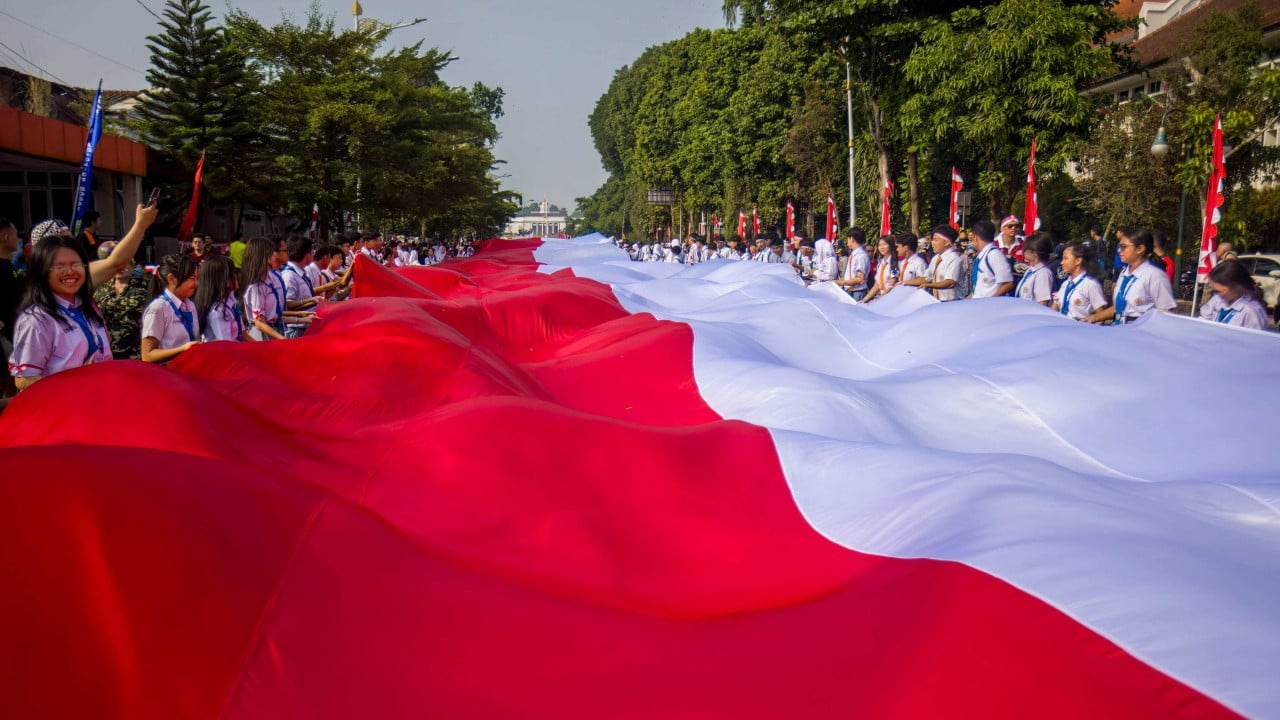
Every seventeenth of August, the air across the Indonesian archipelago sharpens with the scent of burning clove cigarettes, fried street snacks, and damp tropical earth. Sirens wail at precisely ten in the morning in Jakarta, halting traffic on highways that are otherwise choked with the relentless pulse of millions of commuters. Pedestrians freeze. Motorcyclists cut their engines. For three minutes, the megacity of more than ten million people falls into a heavy, humid silence.
This is Indonesia's National Day, known locally as Hari Kemerdekaan or simply Tujuh Belas-an. While foreign media outlets routinely reduce this massive annual observance to a colorful postcard of flag-raising ceremonies, presidential speeches, and traditional greasy-pole climbing competitions, the surface-level spectacle masks a much deeper socio-political reality. The choreographed parades in Jakarta and the local neighborhood games across thousands of islands are not merely expressions of lighthearted patriotism. They serve as a crucial pressure valve, a staging ground for national identity, and an ongoing negotiation between state authority and grassroots pluralism in the world's third-largest democracy.
Understanding why this holiday commands such absolute devotion requires looking past the pageantry and examining the structural weight of an independent republic built out of a fractured colonial footprint.
The Architecture of Independence
The Republic of Indonesia was not born out of a clean break from imperial rule. When nationalist leaders Sukarno and Mohammad Hatta proclaimed independence on August 17, 1945, they did so in the vacuum left by the sudden collapse of Japanese occupation forces, just days after the atomic bombings of Hiroshima and Nagasaki.
That declaration was a gamble written on a scrap of paper. The Dutch, who had exploited the islands for centuries under the brutal monopoly of the Dutch East India Company and later as a crown colony, had no intention of letting go of their most lucrative territorial asset. What followed was four years of bloody guerrilla warfare, scorched-earth tactics, and tense diplomatic maneuvers before the Netherlands finally transferred sovereignty in late 1949.
This historical trauma explains the hyper-vigilance surrounding the national motto, Bhinneka Tunggal Ika—Unity in Diversity. Unlike nation-states forged around a single dominant ethnicity or language, Indonesia stitches together more than thirteen thousand islands, hundreds of distinct ethnolinguistic groups, and multiple major world religions.
When citizens gather on August seventeenth, they are actively participating in a state-sponsored ritual designed to reinforce cohesion across geographic and cultural fissures. The annual flag-raising ceremony, or Upacara Bendera, performed in every government office, schoolyard, and remote village square, is a direct inheritance from both the Dutch military administration and early Republican nation-building strategies. It enforces discipline, hierarchy, and a shared civic baseline in a country that could easily fracture along ethnic or religious fault lines.
The Micro-Politics of the Neighborhood Games
While state television broadcasts the pristine, highly choreographed flag ceremony at the Merdeka Palace in Jakarta—complete with the elite Paskibraka youth flag-bearers in spotless white uniforms—the real pulse of the holiday beats in the back alleys, residential kampungs, and rural hamlets.
This is where the famous Lomba Tujuh Belasan take place. Street corners are draped in red and white banners. Makeshift stages host karaoke contests, and narrow alleys become battlegrounds for traditional games designed to foster collective endurance and humor in the face of economic hardship.
Consider the panjat pinang, perhaps the most iconic and controversial of these competitions. Teams of young men attempt to climb a slicked, greased-up palm tree trunk to reach hanging prizes like bicycles, electronics, and household goods at the top. The climb is impossible for any single individual. Success requires human pyramids, slipping, sliding, and repeated failure until the weight of bodies creates enough friction for someone to finally scramble to the summit over the shoulders of their peers.
Sociologists and anthropologists have spilled rivers of ink analyzing these games. Some view them as harmless catharsis, a day where social hierarchies are inverted and working-class urbanites reclaim public space. Others offer a sharper critique, noting how these spectacles romanticize struggle and collective endurance, effectively normalizing economic precariousness by turning poverty and lack of infrastructure into a festive team-building exercise.
When participants scramble for second-hand goods hung from a greasy pole, the metaphor for modern economic mobility in Southeast Asia's largest economy is difficult to miss. The game rewards grit, collective sacrifice, and physical attrition, mirroring the harsh realities of navigating the informal labor market that sustains the majority of the population.
Economic Realities Beneath the Banners
Beneath the fluttering red and white flags, the financial engine of the country continues to grind, but the distribution of wealth remains deeply uneven. National Day arrives each year accompanied by sweeping government announcements regarding infrastructure milestones, foreign investment inflows, and ambitious targets for the digital economy.
Yet, the gap between the booming urban middle class in Jakarta, Surabaya, and Bali, and the rural populations in eastern regions like Papua, Maluku, or parts of NTT, remains vast. While urban centers celebrate with massive shopping mall sales, drone light shows, and high-end culinary festivals, rural communities often use the holiday as a rare opportunity to demand better access to clean water, paved roads, and reliable electricity from local bureaucrats.
Local politicians are well aware of this dynamic. The weeks leading up to August seventeenth see a surge in philanthropic donations from aspiring regional heads and business magnates. Sponsoring local neighborhood games, funding community feasts, and plastering banners with smiling political portraits across every available telephone pole are standard practices in the Indonesian political playbook.
This patronage network turns the national holiday into an arena of soft influence. Citizens accept the free rice, the subsidized sound systems for the dangdut concerts, and the cash prizes for the sack races, fully cognizant of the transactional nature of the generosity. It is a delicate dance between electorate and elite, wrapped tightly in nationalist iconography.
The Changing Face of Modern Nationalism
As Indonesia navigates its third decade of the Reformasi era—the period of democratization that followed the fall of authoritarian ruler Suharto in 1998—the expression of National Day is shifting.
Gen Z and millennial Indonesians, who make up the vast majority of the electorate, are redefining how they engage with the holiday. While their parents and grandparents attended mandatory civic rallies and watched state-controlled television broadcasts, younger generations take to digital platforms like TikTok, Instagram, and YouTube to critique, parody, and celebrate national identity.
Viral videos mock the impossible physics of the greasy-pole climb with biting economic commentary. Satirical skits dissect the absurdity of local bureaucratic red tape during official municipal ceremonies. At the same time, a surge in pride surrounding local streetwear brands, independent music labels, and domestic tech startups has given rise to a new, consumer-driven nationalism.
This digital evolution does not dilute the importance of the holiday; rather, it modernizes it. The core tension remains the same: how to maintain a singular national identity across an impossibly diverse population without crushing regional autonomy or silencing marginalized voices.
When the last firecrackers fade late into the night on August seventeenth, and the red and white banners are taken down to be stored in damp neighborhood sheds until the following year, the underlying contradictions of the republic remain unresolved. The traffic returns. The economic grind resumes. But for one day, millions of people across thousands of islands paused in unison, bound by a shared history of defiance and the fragile, enduring hope of an unfinished project called Indonesia