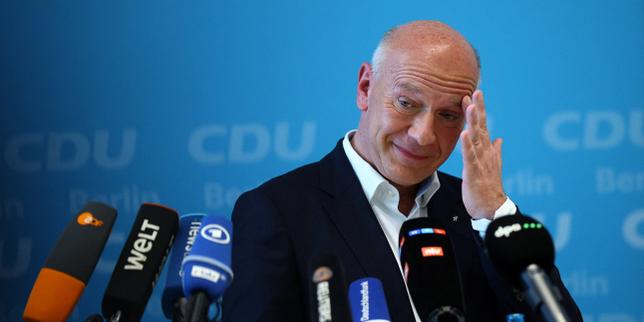
Heads are rolling in Berlin, and the media is eating it up. Mayor Kai Wegner has announced he will not seek re-election just two months before the polls open. The official narrative? A catastrophic, prolonged blackout paralyzed the capital, caused widespread public outrage, and forced a politically compromised leader to take the fall.
It is a neat, tidy story of democratic accountability. It is also entirely wrong. You might also find this related article insightful: The Real Reason Spain's Wildfires Are Becoming Fatal Death Traps.
Wegner is not a casualty of an electrical failure. He is the latest sacrificial lamb in a long-running political theater that uses infrastructure collapse to mask systemic, institutional rot. The media wants you to believe that a localized grid failure can—and should—derail a major political career. By focusing on the mayor, we are ignoring the structural decay that makes these blackouts inevitable.
The Myth of the Accountable Mayor
Let us dismantle the first layer of nonsense. A mayor does not manage grid redundancies. A mayor does not oversee the real-time load balancing of high-voltage transmission lines. As discussed in detailed coverage by The Guardian, the results are worth noting.
When the lights went out in Berlin, the failure belonged to decades of fragmented energy policy, delayed grid modernization, and a failure to integrate volatile renewable inputs with a aging distribution network. Yet, the public demand for a scapegoat requires a high-profile firing.
[Systemic Grid Fragility] ➔ [Localized Blackout] ➔ [Media Outrage] ➔ [Political Sacrifice]
This cycle repeats across Western capitals because it is easier to change the face on a campaign poster than it is to dig up thousands of kilometers of copper and replace obsolete substations. I have spent years analyzing municipal infrastructure investments, and the script never changes. When a system breaks, politicians offer a resignation instead of a shovel.
Why Resignations Fix Absolutely Nothing
- Zero Engineering Impact: Replacing Kai Wegner does not add a single megawatt of storage capacity to the Berlin grid.
- Policy Stagnation: A leadership vacuum two months before an election guarantees that no serious infrastructure decisions will be made for at least half a year.
- Perverse Incentives: Future leaders learn that public relations management is more critical than long-term capital expenditure. If you get blamed for the grid anyway, why bother spending the political capital to fix it?
The Real Culprit is Grid Starvation
The consensus view blames the blackout on an isolated technical anomaly compounded by poor crisis management. This is a fundamental misunderstanding of how modern energy systems fail.
Grid failure is rarely an isolated event. It is the predictable outcome of chronic underfunding and ideological energy transitions that outpace physical reality. Germany’s aggressive push toward decarbonization is a noble goal, but operating a green grid requires massive, upfront investments in transmission infrastructure and dispatchable backup power.
Instead, Berlin has treated its grid like an infinite resource that requires zero maintenance. The city's infrastructure has been squeezed to fund short-term social programs and balance municipal budgets.
"An energy transition without infrastructure investment is just a slow-motion blackout."
When the system finally snapped, Wegner’s political opponents pounced, framing a deep-seated structural crisis as a personal failure of the executive office. It is a brilliant tactical move, but a disastrous strategy for the city's future.
Stop Asking Who is to Blame and Start Asking Where the Capital Went
The standard post-blackout autopsy always asks: Who failed to respond effectively during the crisis?
This is the wrong question. The correct question is: Why was the grid operating without a safety margin in the first place?
The Fragility of Modern Municipal Budgets
To understand why Berlin went dark, look at the capital expenditure accounts, not the mayor's press releases.
| Metric | Historical Standard | Current Allocation |
|---|---|---|
| Grid Reinvestment Rate | 4.5% of asset value | Less than 2% |
| Emergency Storage Capacity | 72 hours minimum | Fragmented / Localized |
| Regulatory Approval Time | 12 months | 36+ months |
The numbers do not lie. Berlin has been running its infrastructure hot for over a decade. The blackout was not an act of God; it was a mathematical certainty. Wegner’s resignation is merely a smokescreen to protect the bureaucratic apparatus that defunded the grid in the first place.
The Danger of the Quick-Fix Fallacy
The immediate reaction to Wegner's exit will be a flurry of promises from incoming candidates. They will promise "smart grids," digital monitoring, and rapid-response teams.
Do not buy it.
These are superficial fixes designed to appease voters who want reassurance before the next election cycle. A truly resilient grid is boring, expensive, and takes years to build. It requires concrete, steel, deep transformers, and unpopular construction projects that disrupt traffic.
If the next administration focuses on optics rather than raw physical capacity, Berlin will be dark again before the decade is out. The contrarian truth is uncomfortable: Berliners should care less about who sits in the Rotes Rathaus and far more about the capital deployment strategy of their utility providers.
Wegner's departure changes nothing. The wires are still old. The transformers are still overloaded. The structural deficit remains untouched. The mayor is gone, but the darkness is just waiting for the next peak load.