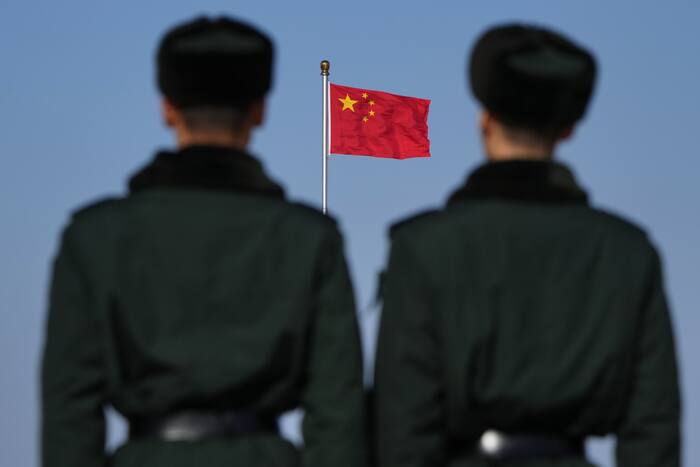
Every time Beijing announces a death sentence for an official caught leaking state secrets, Western media runs the exact same script. They treat it like a Cold War thriller. They frame it as a clean, surgical win for Chinese counterintelligence against the CIA or MI6.
They are completely missing the point. Expanding on this topic, you can find more in: The Mechanics of Munitions Disposal Why the Iowa Lead Azide Detonation Exposed Systemic Risk Tradeoffs.
If you read the standard wire reports on China sentencing an official to death for espionage, you get a tidy narrative: a greedy bureaucrat sold classified files to a foreign handler, got caught by the Ministry of State Security (MSS), and paid the price. That story is comfortable. It fits neatly into the "spy vs. spy" box that editors love. It is also a massive misreading of how power actually works inside the Chinese Communist Party.
Publicized espionage executions in China are rarely about neutralizing a foreign threat. When an intelligence agency catches a genuine, high-value asset working for an adversarial power, they do not put out a press release. They turn the asset. They feed disinformation back down the pipe for years. They quietly extract the network. Experts at BBC News have provided expertise on this situation.
The moment the state puts a spy’s name on the front page and hands down a capital sentence, the intelligence value of that case is already dead. The announcement itself is a domestic political weapon, not a counterintelligence victory.
The Lazy Consensus on Chinese Espionage Cases
The mainstream coverage suffers from a fundamental misunderstanding of the Chinese legal and security apparatus. Western observers look at a headline about "leaking national secrets" through the lens of the U.S. Espionage Act. They assume a narrow, technical definition of classified defense data—submarine blueprints, troop movements, cryptographic keys.
In China, "state secrets" is an elastic, weaponized category. Under the Law on Guarding State Secrets—which Beijing significantly expanded in 2024—almost anything can be classified retroactively. Macroeconomic data, internal party debates, supply chain vulnerabilities, corporate due diligence reports, and even unapproved historical archives can fall under the umbrella of national security.
I have spent over a decade advising multinational executives and risk analysts on cross-border compliance in East Asia. I have watched companies blow millions of dollars building elaborate cybersecurity walls to protect proprietary tech, completely blind to the fact that their local compliance officers were walking into a buzzsaw simply by compiling routine market research. When you treat Beijing’s espionage announcements as mere spy-catching, you miscalculate the entire risk environment.
The Real Audience Is Inside the Party
To understand why Beijing executes an official for spying, stop looking at Washington and start looking at Zhongnanhai.
Capital punishment for espionage serves three distinct internal functions that have nothing to do with stopping foreign intelligence services.
1. The Ultimate Loyalty Test During Factional Purges
In Chinese politics, corruption charges used to be the standard tool for removing political rivals. You accuse a bureaucrat of taking bribes, parade them on state television, and dismantle their patronage network.
The problem with corruption charges is that everyone knows the game. In a system where wealth and political power are deeply intertwined, accusing an official of graft makes them look like a player who lost, not a traitor. Espionage changes the moral calculus entirely. Branding a purged official as a foreign spy destroys their legacy, isolates their family, and makes it political suicide for any former ally to defend them. It turns a factional dispute into an existential defense of the motherland.
2. Deterrence Through Terror for the Bureaucracy
When economic growth slows and elite dissatisfaction rises, the center’s greatest fear is not a CIA case officer in a Beijing coffee shop. It is horizontal communication among domestic elites. It is mid-level officials venting to foreign journalists, diplomats, or business consultants about policy failures.
By executing an official for leaking secrets, the MSS sends an unmistakable message to millions of civil servants: Any unauthorized contact with the outside world is treason. You do not need to pass missile schematics to end up on death row. Passing an internal economic briefing to a foreign think tank—or being accused of it—is enough to end your life. This chills elite dissent far more effectively than an anti-corruption campaign ever could.
3. Justifying the Expansion of the Security State
The Ministry of State Security has undergone a massive transformation over the last decade. Once a shadowy, low-profile intelligence service, the MSS now runs an aggressive public relations machine on WeChat, regularly publishing comic strips and dramatic case studies warning citizens about foreign spies.
High-profile death sentences validate their budget and their expanding mandate. When the MSS brings down a "traitor," it justifies sweeping raids on foreign consultancy firms, tighter exit bans on business executives, and deeper surveillance of domestic academia. Fear is the fuel that keeps the national security apparatus growing.
Defining the Terms the Media Gets Wrong
If you want to read these announcements like an intelligence professional rather than a casual news consumer, you have to strip away the Western legal definitions and look at the exact mechanics of the Chinese system.
- Espionage (Jiandie Zui): Under Article 110 of China’s Criminal Law, joining an espionage organization or accepting a mission from one carries a sentence of ten years to life, or death if the harm to the state is "particularly serious." Crucially, the law does not require the information passed to be military in nature.
- Illegally Providing State Secrets Overseas: Under Article 111, anyone who steals, spies on, buys, or illegally provides state secrets or intelligence to an organization or person outside the country faces the same maximum penalty. Notice the word intelligence (qingbao). In Chinese legal practice, "intelligence" can mean non-public information that a foreign entity finds useful—even if it was never stamped "Top Secret."
- Suspended Death Sentence (Sihuan): Many headlines scream "sentenced to death," omitting the two-year reprieve that frequently accompanies these verdicts. A suspended death sentence typically commutes to life imprisonment after two years of good behavior. The state gets the terrifying headline of a death sentence while retaining the leverage of keeping the prisoner alive for further interrogation.
What People Actually Ask About These Executions
When these stories break, the public asks predictable questions driven by Cold War tropes. Let’s dismantle the flawed premises behind them.
"Does this mean Western intelligence networks in China are collapsing?"
This assumes the networks were built on the kind of mid-level bureaucrats who get publicly executed. While the CIA notoriously suffered a catastrophic compromise of its human intelligence network in China between 2010 and 2012—a failure documented extensively by investigative journalists and former intelligence officials—modern intelligence collection relies heavily on signals intelligence, technical collection, and deep-cover assets whose exposure would never be announced in a press release. Public executions usually involve lower-hanging fruit: retired engineers, disgruntled academics, or mid-level officials who got sloppy for cash.
"Why doesn't China trade these spies in prisoner swaps like Russia does?"
Russia plays a transactional game with hostages and spies because Moscow views intelligence arrests as diplomatic currency. Beijing views treason through a historical lens of national humiliation. Trading a Chinese citizen who betrayed the state to a foreign power would violate the core ideological narrative of national rejuvenation. Foreign nationals caught in China—like the two Canadian Michaels—can be traded. Ethnic Chinese officials who "sell out" the country are made into permanent examples.
"Are foreign business executives actually at risk of this?"
Not of execution, no. Beijing is ruthless, not suicidal; executing a Western CEO would trigger an immediate capital flight that the Chinese economy cannot afford. However, foreign executives are routinely caught in the blast radius. When a local partner, researcher, or joint-venture executive gets swept up in an espionage probe, the foreign firm’s data is seized, its local staff are detained, and its executives hit an exit ban at the airport. You do not need to be the target to become collateral damage.
The Downside of the Contrarian View
To be intellectually honest, viewing every Chinese espionage case purely as domestic political theater carries its own blind spot.
The reality is that foreign intelligence services are aggressively targeting China. As Beijing’s military modernization accelerates and its technological ambitions threaten Western dominance in semiconductors, artificial intelligence, and aerospace, the intelligence war has never been hotter. Real spies are getting caught. Real secrets are being stolen.
If you dismiss every MSS announcement as pure propaganda, you underestimate the genuine paranoia and competence of China’s counterintelligence apparatus. The MSS is not inventing every case out of thin air. Often, they are taking a real, low-level intelligence breach and weaponizing the publicity to serve broader domestic political goals. The truth is a hybrid: real counterintelligence operations wrapped in political theater.
How to Operate When "Secrets" Are Everywhere
If you are doing business, conducting research, or managing geopolitical risk involving China, waiting for the headlines to make sense is a losing strategy. You have to adjust your operational posture to account for a system where information itself is treated as a national security asset.
- Stop commissioning "gray zone" due diligence. Hiring local investigators to pull non-public corporate registries, interview former government officials, or gather supply chain data on sensitive sectors (semiconductors, rare earths, defense-adjacent manufacturing) is no longer standard business practice. In the eyes of the MSS, that is indistinguishable from intelligence collection. Stick strictly to verified, open-source public filings.
- Assume all cross-border data transfers are monitored. Under China’s Data Security Law and Personal Information Protection Law, moving data out of the mainland requires strict security assessments. Treat any internal market report, pricing model, or customer list generated in China as potentially classifiable. Keep Chinese data on isolated local servers and share only aggregated, sanitized summaries with global headquarters.
- Watch the timing, not the charges. When Beijing announces a high-profile espionage verdict, look at the political calendar. Does it coincide with a major Party plenum? A downturn in foreign direct investment? A tense diplomatic summit? The timing tells you who the real target is. If the announcement drops right before an economic policy meeting, the message is aimed at domestic skeptics, not foreign embassies.
- Audit your local partnerships for political exposure. When a Chinese official goes down for spying, the purge radiates outward. Anyone who had a business relationship, consulting contract, or academic tie with that official becomes an immediate person of interest. Vet your local advisors not just for competence, but for their proximity to politically vulnerable factions.
Read the Signal, Ignore the Noise
The next time a headline flashes across your screen announcing that Beijing has sentenced another official to death for leaking state secrets, resist the urge to picture trench coats and dead drops.
You are not watching a spy movie. You are watching an authoritarian system maintain internal discipline by turning one man’s life into a warning flare for ninety-nine million Party members. Stop asking what secrets he stole, and start asking who in Beijing needed to be reminded of what happens when you talk out of turn.