Forty-two thousand empty aluminum seats make a very specific sound when the California sun goes down over Pasadena. They tick. As the metal cools in the Arroyo Seco dusk, it contracts, producing a hollow, rhythmic clicking that sounds suspiciously like a clock running out on a dynasty that never quite arrived.
If you have loved UCLA football over the last quarter-century, you know that sound by heart. You know the long, dusty walk back to the golf course parking lot after another November afternoon where the talent was obvious, the uniforms were gorgeous, and the scoreboard told a story of polite irrelevance. You learned to guard your optimism like a fragile heirloom. You stopped buying the preseason hype. You became an expert in the art of emotional hedging. You might also find this related article insightful: Why Bruno Fernandes Hit the Brakes on Manchester United Contract Talks.
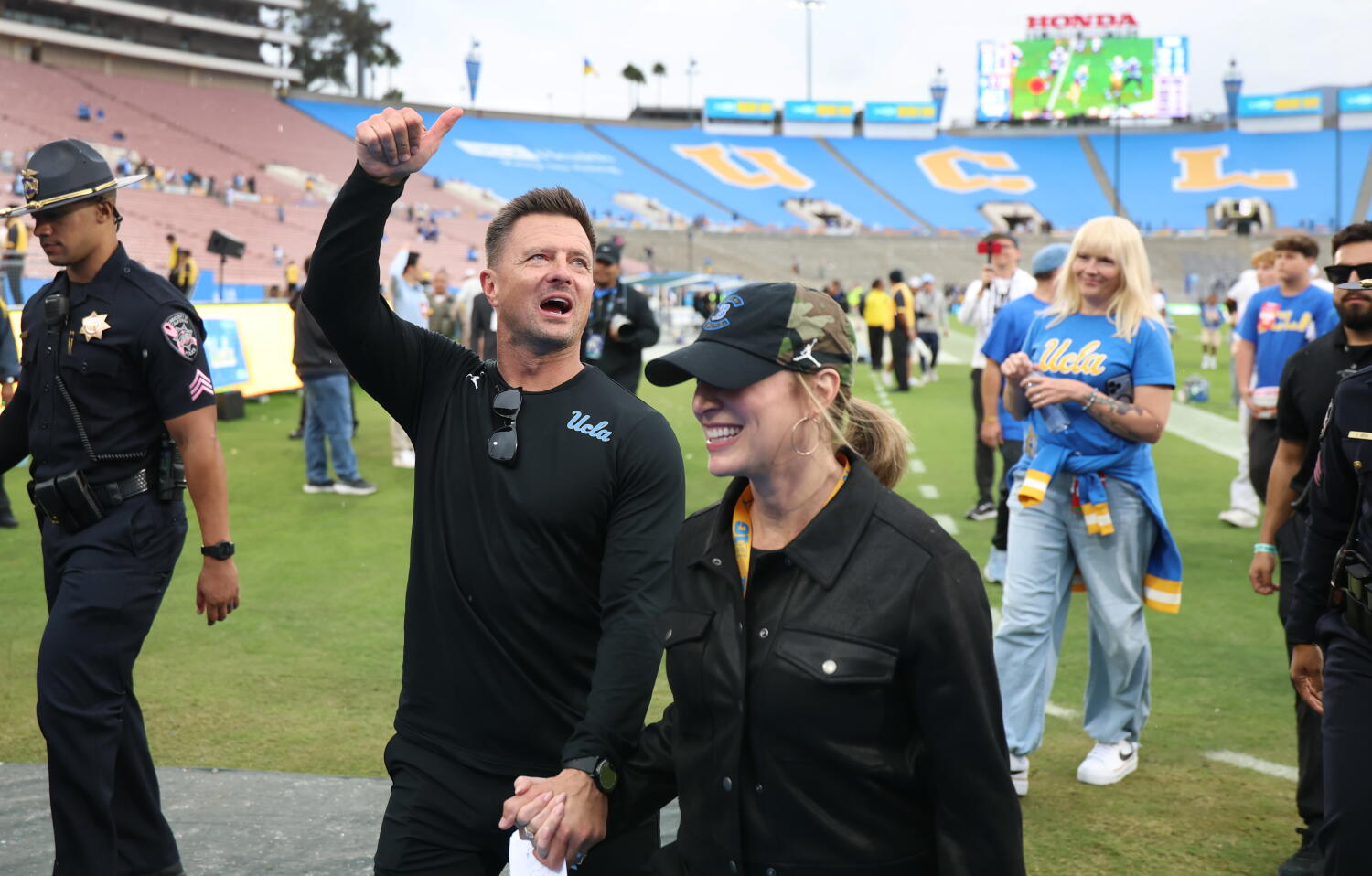
Then Bob Chesney walked into the Wasserman Football Center, and suddenly, the armor started to crack.
The buzz rattling through Westwood and echoing across alumni group chats from Manhattan Beach to New York City isn't the usual springtime mirage. Something real is happening with UCLA football, and it has a name, a whistle, and an unsettlingly familiar intensity. Bob Chesney—the relentless architect who turned Assumption, Holy Cross, and James Madison into giant-killers—is "on brand" in a way the Bruins haven't seen since Terry Donahue patrolled the sidelines in a powder-blue sweater. As extensively documented in latest coverage by Yahoo Sports, the implications are widespread.
Alums are fired up. Donors who spent the past decade sitting on their hands are suddenly reaching for their checkbooks. Yet beneath the roaring excitement sits a quiet, gnawing dread that nobody at the tailgate wants to say out loud.
If Bob Chesney actually fixes UCLA, how on earth do the Bruins keep him?
The Ghost in the Rose Bowl
To understand why a 40-something coach from rural Pennsylvania has hardened, cynical UCLA boosters acting like freshmen on move-in day, you have to understand the specific flavor of misery that has defined this program.
Consider a hypothetical Saturday in Westwood—let’s call him Marcus, a class of '98 alum who still keeps his Cade McNown jersey folded neatly in the back of his closet. For twenty years, Marcus has watched UCLA hire variations of the same archetype. There were the splashy celebrity hires who treated the job like a semi-retirement gig in Bel-Air. There were the cerebral offensive geniuses who seemed allergic to recruiting high schoolers in the Inland Empire. There were the nice guys who preached culture while getting shoved around at the line of scrimmage by physical teams from the Midwest.
Every hire felt like an attempt to market Los Angeles rather than win a football game. The pitch was always lifestyle. Palm trees. Movie stars on the sidelines. Sunset over the San Gabriel Mountains.
It was gorgeous, and it was soft.
Chesney arrived with zero interest in the Hollywood brochure. Watch five minutes of his spring practice and the difference hits you in the chest. He doesn't stand back with a play sheet tucked under his arm like a tenured professor. He sprints from drill to drill. His voice is ragged by nine in the morning. When a linebacker takes a lazy angle in a non-contact period, Chesney doesn't wait for the film session; he stops the entire field, gets inches from the kid’s facemask, and demands an immediate correction—not out of cruelty, but out of an almost religious obsession with detail.
To an alumni base starved for grit, this isn't just coaching. It is oxygen.
What "On Brand" Actually Means
When people around the program call Bob Chesney "on brand," they aren't talking about social media graphics or uniform reveals. They are talking about a rare, intoxicating alignment between a coach’s DNA and a university’s forgotten identity.
UCLA is supposed to be the intellectual underdog with a chip on its shoulder. Historically, the Bruins thrived when they were faster, sharper, and meaner than the blue-blood bullies across town. John Wooden built a cathedral out of fundamental obsession. Donahue built a Rose Bowl machine out of toughness and discipline.
Chesney’s entire career is a monument to that exact blueprint. Look at the historical trail he left behind before ever setting foot in Southern California:
- Salve Regina (2010–2012): Inherited a losing Division III program and delivered three straight winning seasons.
- Assumption (2013–2017): Took a perennial Division II doormat to three consecutive NCAA playoff appearances.
- Holy Cross (2018–2023): Won five straight Patriot League titles and pushed FBS powers to the brink, turning Worcester, Massachusetts, into a legitimate FCS powerhouse.
- James Madison (2024–2025): Stepped into a program gutted by coaching departures and transfer portal raids, and immediately kept the Dukes winning at an elite clip in the Sun Belt.
Notice the pattern. Chesney has never been handed the keys to a Ferrari. Every single time, he has walked into a garage full of spare parts, rolled up his sleeves, and built a drag racer that embarrassed guys driving twice the budget.
In Westwood, where the transition into the Big Ten brutalized a roster that lacked physical depth, Chesney’s blue-collar urgency landed like a lightning bolt. Players who used to coast through Tuesday practices are suddenly competing like their scholarships depend on it. Former players—men who played in the NFL and stopped coming around because the atmosphere felt sterile—are showing up at practice again, grinning like kids.
They recognize the standard. For the first time in decades, the building feels alive.
The Stepping-Stone Trap
Here is where the euphoria hits a brick wall.
In modern college football, competence is a double-edged sword. You cannot hide a great coach anymore. The moment Bob Chesney turns UCLA from a Big Ten punching bag into an eight- or nine-win threat, the vultures will begin circling over the 405 freeway.
Think of college football’s coaching market like an ecosystem of apex predators. Right now, UCLA is a mid-tier carnivore—strong enough to hunt, too slow to defend its kill when a giant wanders into the clearing. If Chesney goes 9-3 in year two and knocks off a top-ten opponent in the Rose Bowl, the phone calls won't come from mid-majors. They will come from Penn State. They will come from Ohio State or Michigan if an unexpected vacancy opens. They will come from SEC programs with bottomless oil money, private jets on standby, and 100,000-seat stadiums that sell out in February.
And Chesney is an East Coast guy through and through. Born in Kulpmont, Pennsylvania. Played his college ball at Dickinson. Spent nearly his entire adult life coaching in New England and Virginia.
Let’s be honest about the geography of the human heart. Los Angeles is intoxicating, right up until you realize your kids are three thousand miles away from their grandparents and your tax bracket just devoured half your raise. If a powerhouse program in Pennsylvania or the Midwest comes calling with a ten-year, $100 million offer and a direct flight home, loyalty to Westwood becomes a very expensive virtue.
Why UCLA Has Always Struggled to Hold On
To understand if UCLA can keep him, we have to look honestly at the structural rot that has held the athletic department back for years. This isn't about whether the school wants to keep a winning coach. It’s about whether the institution is built to fight in the modern arms race.
For years, UCLA operated under an unspoken assumption that the four letters on the helmet were enough of a discount. Why pay top-of-the-market salaries for assistant coaches when they get to live near Santa Monica? Why pour tens of millions into Name, Image, and Likeness collectives when you have the UCLA brand?
That arrogance nearly buried the football program.
While programs in the SEC and Big Ten built massive, vertically integrated football factories—complete with nutritionists, massive recruiting staffs, and eight-figure NIL war chests—UCLA often operated like a high-end boutique. By the time the Bruins joined the Big Ten, they were bringing a knife to a drone strike.
Keeping Bob Chesney requires more than a fat buyout clause in his contract. A buyout is just a price tag; to a desperate booster club in Tuscaloosa or State College, a $15 million buyout is a rounding error.
If UCLA wants to turn Westwood into a destination rather than a launchpad, three brutal realities have to change immediately:
- The Assistant Pool Must Explode: Chesney is brilliant, but he wins because he surrounds himself with elite evaluators and developers. If UCLA cheaps out on coordinator salaries, bigger programs will poach his staff every winter until he’s forced to rebuild from scratch every spring.
- The NIL Floor Has to Rise: Chesney can out-coach people on Saturdays, but nobody out-coaches a massive talent deficit over twelve Big Ten games. The alums who are currently celebrating his hiring have to translate their emotional energy into recurring, institutional financial backing. Cheers don't buy five-star offensive tackles.
- Institutional Friction Must Vanish: From admissions hurdles for transfer portal prospects to bureaucratic slow-walking on facility upgrades, UCLA’s administration has historically treated football like a tolerated guest rather than an economic engine. Chesney thrives on speed and agility. Red tape will suffocate him.
The Gamble Every Fan Must Take
I caught myself falling into the trap just last week. Watching a clip of Chesney celebrating a red-zone stop during spring ball—veins bulging in his neck, chest-bumping a third-string safety like they had just won the Rose Bowl—I felt that old, familiar warmth creep back into my chest. The part of my brain that swore off UCLA football after another fourth-quarter collapse against an unranked opponent suddenly started doing math. If the offensive line holds up, and the transfer quarterback clicks, maybe by November...
It is terrifying to care again. When a program is hopeless, you are safe. Nothing can hurt you because you expect nothing.
Bob Chesney has stolen that safety from UCLA fans. He has made the Bruins worth watching, worth talking about, and—most dangerously of all—worth believing in.
Maybe he stays for ten years, builds a statue outside the Wasserman Center, and proves that a relentless grinder from Pennsylvania can turn Los Angeles into a blue-collar football town. Or maybe he wins twenty-five games in three years, restores the pride of the four letters, and hops on a charter flight back east to take a blue-blood job that UCLA simply couldn't match.
Even if the worst happens, the alternative was a slow, quiet death in front of forty thousand ticking aluminum seats.
You don't refuse to fall in love just because the person might eventually break your heart. You open the door, you turn up the volume, and for as long as the music plays, you enjoy the fact that Westwood finally has a pulse again.