The air did not just warm; it mutated.
Imagine standing beneath a July sky in southwestern France, watching the horizon turn the color of an old bruise. Near the commune of Saumos, a wildfire had been chewing through pine forests and dry scrubland since July 22. For days, it behaved like a traditional enemy. Firefighters tracked its advance, anticipated the wind shifts, and cut firebreaks in the sandy soil of the Gironde department. They understood how to fight a fire driven by weather. If you found value in this post, you might want to look at: this related article.
They did not know how to fight a fire that made weather.
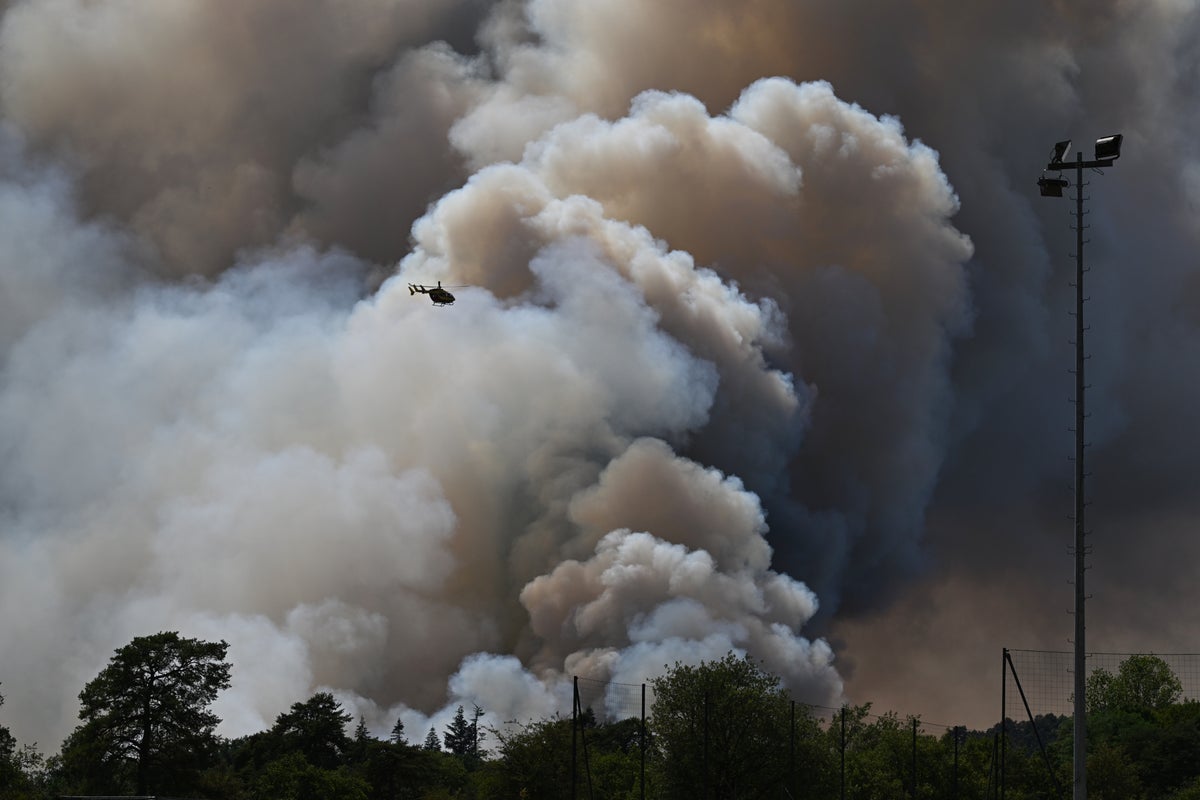
At precisely 6:20 p.m. on a Friday, two days after the initial spark, the regional rescue service logged an atmospheric milestone that no one wanted to witness. The towering column of smoke rising from the canopy stopped behaving like smoke. Heated by trillions of BTUs, the air rushed upward with explosive violence, carrying ash, soot, and moisture miles into the troposphere. As that buoyant column climbed into sub-freezing altitudes, water vapor condensed around ash particles, forming ice crystals and separating electrical charges. For another look on this event, refer to the latest update from TIME.
A thunderstorm was born out of pure malice.
This was a pyrocumulonimbus, a pyroCb—a phenomenon more frequently associated with the apocalyptic fire seasons of North America and Australia, but entirely unprecedented in modern French records. France’s national firefighters federation confirmed the grim reality: they had never seen a cloud like this at home.
The beast had grown lungs.
To understand why this shift breaks the rules of emergency response, consider the mechanics of a feedback loop. Normally, weather dictates how a fire moves. But when a pyroCb forms, the monster reverses the equation. The towering black anvil cloud sitting atop the inferno begins to dictate its own atmospheric rules. As Theodore M. Giannaros, a fire meteorologist at the National Observatory of Athens, notes, the intense thermal energy creates a closed ecosystem of destruction.
The cloud pulls ferocious winds directly toward the heart of the flames, feeding oxygen to the beast. Then, it punches violent downdrafts back down to the surface. These erratic blasts do not just push the fire forward; they fracture it. Flames split into multiple frantic fronts, racing sideways, backward, and outward.
Worst of all is the electricity.
Within the belly of the dark, electrified cloud, ice crystals collide and build colossal static charges. Lightning arcs downward—not from a passing rainstorm, but from the smoke itself. During the Gironde crisis, these lightning bolts began striking the unburned parched earth miles ahead of the primary frontline, igniting brand-new fires faster than ground crews could pivot.
Escape routes vanished in minutes. Firefighters who thought they were positioned safely behind a natural barrier suddenly found themselves flanked by spot fires ignited by bolts from their own enemy's sky. Over 220,000 people were forced to evacuate as the blaze ultimately consumed more than 420 square kilometers of land and pulverized over 240 homes.
The scale defies easy comprehension, yet the human cost is measured in localized terror. Imagine a family packing a single suitcase, loading pets into the backseat, and driving down a highway where the sky ahead is pitch black at mid-afternoon and the lightning strikes are landing in the adjacent fields. This is what happens when a landscape primed by chronic drought meets a thermal engine capable of spawning fire whirls—dust devils made entirely of spinning flame and lethal heat.
Historically, Europe watched these atmospheric monsters from afar, tracking Canadian record-breaking seasons where over a hundred pyroCbs form in a single summer. No longer. As global temperatures creep upward and dry spells deepen, the atmospheric ingredients required for dry thunderstorms—scorching air at the surface paired with cold layers above—are becoming an unwelcome European staple.
Scientists are scrambling to catch up with the changing physics of the planet. Research initiatives like Europe's ROSETTA project are attempting to map out why these fire-generated storms are crossing geographic boundaries, searching for long-term trends in data that we simply have not had time to collect.
Yet data offers little comfort to the crew standing on a smoky ridge in southwestern France, watching the horizon glow with an internal, electric fury. When the sky starts throwing lightning born of its own consumption, the old playbook burns to ash. The fire is no longer just something we try to put out. It is something we have taught how to fight back.


