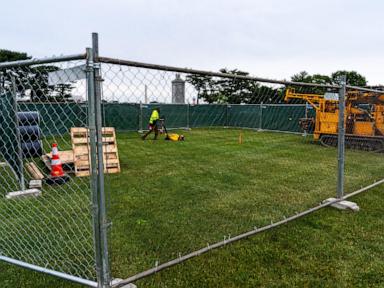
On a humid Monday morning in May 2026, the quiet symmetry of Washington’s Memorial Circle was broken by the mechanical thrum of geotechnical drills and the sharp flutter of pink survey flags. This isn't just another routine maintenance project for the National Park Service. It is the first physical footprint of the most controversial architectural undertaking in the capital since the Vietnam Veterans Memorial. The Trump Triumphal Arch, a 250-foot-tall behemoth designed to commemorate the nation’s 250th anniversary, has officially moved from the realm of executive sketches to reality.
This project is more than a monument; it is a fundamental shift in the aesthetic and political identity of the American seat of power. Standing at more than double the height of the Lincoln Memorial, the arch would dominate the horizon between the Arlington National Cemetery and the National Mall. For supporters, it is a grand tribute to the "American spirit" in time for the Semiquincentennial. For critics, including a vocal coalition of veterans and historians, it is an illegal intrusion that threatens to shatter the somber, intentional sightlines that have defined the city’s core for over a century.
Engineering the Imperial Image
The technical specifications of the arch reveal an ambition that dwarfs almost everything nearby. At 250 feet, it is intended to be the tallest ceremonial arch in the world. The structure is capped by a 60-foot gilded figure of Lady Liberty holding a torch, flanked by two massive gold eagles. Four golden lions are set to guard the base. It is a design that leans heavily into the neoclassical grandiosity of Ancient Rome, filtered through a modern, maximalist lens.
Building a structure of this mass on the Potomac’s marshy edge is a nightmare of civil engineering. The survey work currently underway is focusing on the geotechnical stability of the human-made island near Memorial Bridge. Engineers must determine if the soil can support the thousands of tons of stone and gilding without sinking or shifting. If the bedrock is too deep, the costs for the foundation alone could spiral into the hundreds of millions.
The Legal Quagmire and Congressional Bypass
While the U.S. Commission of Fine Arts—composed entirely of presidential appointees—gave the concept a green light, the project faces a wall of legal challenges. The Public Citizen Litigation Group, representing a coalition of plaintiffs, argues that the administration is bypassing the Commemorative Works Act. This law requires specific congressional authorization for any new monument in the "Reserve," the central cross-axis of the Mall where no new structures are supposed to be built.
The administration’s defense rests on a technicality. They claim the survey work does not constitute "construction" or "demolition," but rather preliminary data gathering. Yet, legal experts note that once the geotechnical holes are drilled and the data is processed, the momentum toward a "final agency action" becomes nearly unstoppable. This is a classic bureaucratic maneuver: establish facts on the ground while the court cases move at a glacial pace.
A Disrupted Heritage
The primary argument from the opposition focuses on the "sacred" sightline. Since the McMillan Plan of 1901, Washington has been designed as a series of open vistas meant to represent transparency and democracy. The line from the Lincoln Memorial to Arlington House is a symbolic bridge between the Great Emancipator and the reconciliation of the post-Civil War era.
A 250-foot arch would physically sever this connection.
- The Lincoln Memorial: Stands at 99 feet. It would be made to look like a miniature by the new arch.
- The Washington Monument: At 555 feet, it remains the tallest, but the arch would claim the title of the most intrusive structure in the West Potomac Park area.
- Arlington House: The historic home of Robert E. Lee, now a memorial to the nation’s complicated history, would be effectively hidden from Mall visitors.
The Business of Memorialization
Behind the marble and gold lies a complex network of private contractors and federal agencies. The National Park Service (NPS) is currently managing the procedural prerequisites, but the actual funding for the project remains a point of contention. While the administration points to the 250th anniversary as the justification, critics question whether public funds are being diverted from a backlog of maintenance across other national parks—a backlog that currently sits in the billions.
There is also the matter of the Lincoln Memorial Reflecting Pool. Simultaneously, the President has proposed "renovating" the iconic pool by coating it in an industrial-grade blue substance, reportedly a suggestion from a private pool contractor. This move toward using non-traditional materials in historic preservation has set off alarm bells among preservationists who fear the Mall is being treated like a private development rather than a public trust.
A City Caught Between Eras
Washington is a city built on the idea of permanence. The stone is meant to outlast the politicians who order its cutting. However, the current survey work indicates a desire for speed that is rarely seen in federal monument building. The goal is clearly to have the structure—or at least the most visible parts of it—standing by July 4, 2026.
This timeline is nearly impossible by traditional standards. The World War II Memorial took nearly two decades from conception to completion. The Martin Luther King Jr. Memorial took more than twenty years. Attempting to plant a 25-story stone arch in a traffic circle in under two years is an act of sheer political will.
The pink flags in the grass at Memorial Circle are more than markers for a surveyor’s transit. They are the frontline of a battle over what the American capital should look like in its third century. Whether the arch rises to its full 250 feet or remains a stalled excavation depends entirely on the outcome of a federal judge's ruling in the coming weeks. For now, the drills keep turning, and the skyline of the capital hangs in the balance.
Inside the Trump Triumphal Arch Controversy
This video provides an in-depth look at how the proposed Triumphal Arch and other recent architectural changes are reshaping the historic landscape of Washington, D.C.