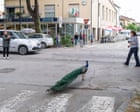
The quiet coastal town of Punta Marina, nestled on the Adriatic coast near Ravenna, is currently under siege by an ornamental bird that has overstayed its welcome. What began as a handful of peacocks escaping from a nearby estate has spiraled into a population explosion that local infrastructure and patience can no longer sustain. This is not a quaint story of nature returning to the streets. It is a case study in how invasive species management fails when biological reality is ignored in favor of optics.
Local authorities are now scrambling to implement a relocation plan as the census of these birds reaches critical mass. Residents face a daily reality of property damage, noise pollution, and health concerns that the tourism brochures conveniently omit. The peacocks have moved from being a novelty to a genuine municipal crisis.
The Mathematical Inevitability of a Population Crash
Biological systems do not care about human sentiment. When a species with no natural predators is introduced into an environment with abundant food—in this case, the lush gardens and discarded waste of a tourist town—the growth curve is predictable. The peacocks in Punta Marina have entered the exponential phase of that curve.
A single peahen can lay dozens of eggs over a breeding season. In the wild, foxes or birds of prey would keep these numbers in check. In the paved streets of a seaside resort, the only thing checking their growth is the front bumper of a car. This has created a vacuum where the birds are outstripping the carrying capacity of the urban environment.
It is a basic ecological principle. When you remove the checks and balances of a natural habitat, you aren't creating a sanctuary. You are creating a powder keg. The birds are now competing for limited nesting space, leading them onto rooftops and into private balconies where they are not just unwelcome, but destructive.
Property Damage and the Hidden Costs of Ornamental Wildlife
To a visitor, a peacock is a symbol of nobility and grace. To a homeowner in Punta Marina, it is a twenty-pound wrecking ball with feathers. These birds possess powerful claws designed for scratching and foraging. On a forest floor, this is harmless. On the hood of a high-end sedan or a terracotta roof, it is an expensive disaster.
The damage is not limited to scratches. Peacock droppings are voluminous and acidic, capable of eating through paint and stone over time. The town’s maintenance budget is being redirected to deal with the sanitation issues posed by bird waste in public squares. This is money that should be going toward beach replenishment or road repair.
- Vehicle Repairs: Insurance claims for scratched paintwork have spiked.
- Roof Integrity: The weight and activity of the birds damage traditional Italian tiling.
- Gardening Losses: Ornamental plants, often expensive to maintain in a salty coastal climate, are being decimated.
There is also the matter of the "scream." Anyone who has lived near peacocks knows their call is not a song. It is a piercing, metallic shriek that carries for miles, particularly during the early morning hours of the mating season. For a town that relies on the "peace and quiet" of the Adriatic to sell hotel rooms, this is a direct threat to the local economy.
The Failure of Passive Management
For years, the local government took a "wait and see" approach. They hoped the population would stabilize or that the birds would migrate back to the pine forests of the nearby Po Delta. It was a failure of leadership. By the time the town council realized the scale of the problem, the birds had become habituated to humans.
Habituation is the death knell for effective wildlife management. Once an animal loses its fear of people, it becomes aggressive. There have been increasing reports of peacocks intimidating elderly residents and children, particularly when food is involved. This is no longer a matter of coexistence. It is a matter of public safety.
The current relocation plan involves trapping the birds and moving them to remote areas or fenced sanctuaries. However, this is an expensive and logistically nightmare. Every bird must be caught, tested for disease, and transported. The cost per bird is staggering, and it is a cost being footed by the taxpayer because of years of indecision.
The Ethical Trap of Relocation
Moving the birds is the "humane" option, but it is often a death sentence in disguise. Peacocks are highly social and territorial. Dumping a group of urban-habituated birds into a wild forest or a crowded sanctuary often leads to high mortality rates due to stress or conflict with existing populations.
The animal rights lobby has been vocal in Punta Marina, preventing more decisive culling measures that are standard in other parts of the world facing invasive species. This has created a stalemate where the birds suffer through poor urban living conditions, and the humans suffer through the consequences of their presence.
True animal welfare isn't about letting a species run wild in a parking lot. It is about maintaining a balanced ecosystem where every creature has the resources it needs to thrive without infringing on the safety of others. Punta Marina is currently the opposite of that balance.
Economic Ripple Effects on the Tourism Sector
Punta Marina isn't Portofino. It thrives on middle-class families looking for a predictable, safe vacation. When the primary feedback on travel sites begins to focus on "aggressive birds" and "noise at 4:00 AM," the brand of the town takes a hit.
Hoteliers are reporting a trend of shorter stays. Families who used to stay for two weeks are now cutting their trips short. The "peacock invasion" might make for a colorful headline in a national newspaper, but for the waiter whose tips are down because the terrace is covered in bird droppings, it is a financial crisis.
We are seeing a shift in the demographic of the town. The quiet, affluent retirees who used to dominate the shoulder seasons are being replaced by "nature tourists" who come for a day to take photos and leave without spending significant money in the local shops. This shift in commerce is subtle, but over a decade, it can hollow out a seaside community.
Lessons from the Adriatic Front
The situation in Italy is a warning to other municipalities that use "charismatic megafauna" as a low-cost tourist attraction. Whether it’s wild boars in Rome or peacocks in Ravenna, the result is always the same. If you do not manage the population from day one, the population will eventually manage you.
Effective management requires data. The town needs a precise count, a mapping of nesting sites, and a clear understanding of the food sources sustaining the flock. It also requires the political will to ignore the loudest voices in the room in favor of the most scientific ones.
Relocation is a temporary fix. Unless the environmental factors that allowed the peacocks to thrive are addressed—specifically the ease of access to human food and the lack of physical barriers in nesting areas—the birds will return, or a new species will take their place.
The Adriatic coast is a fragile environment. It is a strip of land caught between the rising sea and increasing urban sprawl. Adding a displaced, aggressive population of large birds to this mix was an experiment destined for failure. The only question remaining is how much more the residents of Punta Marina are expected to pay for the mistake of treating a wild animal like a lawn ornament.
Local officials must move beyond the trapping phase and begin a comprehensive urban redesign that discourages nesting. This includes netting on historic buildings and strict ordinances against feeding wildlife. Without these structural changes, the relocation effort is merely a revolving door.
The birds are beautiful. The situation is ugly. It is time to stop pretending that a town square is a zoo. For Punta Marina to regain its identity, the peacocks have to go, and they have to go permanently. This is the hard truth of environmental management in the modern world. Sentimentality is a luxury that this town can no longer afford.