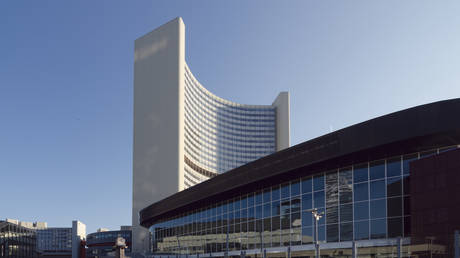
Every time Washington slams a bureaucratic door in the face of an adversary, cable news anchors treat it like a masterclass in geopolitical strategy. When the United States blocks an Iranian nuclear chief from stepping foot inside a United Nations watchdog meeting, the narrative writes itself. Western media frames the move as a decisive strike against proliferation, a bold enforcement of global standards, and a tangible penalty for non-compliance. It feels good. It looks tough on a chyron. And it is completely, utterly meaningless.
International relations are governed by hard physical pressure, material supply chains, and intelligence assets on the ground. They are not decided by who gets a visitor badge to a Vienna conference center. Treating a visa denial or a credential revocation as a substantive diplomatic win is the geopolitical equivalent of unfriending someone on social media and calling it a military victory. It is self-soothing theater designed for domestic political consumption while the actual physics of nuclear enrichment continue uninterrupted miles away.
I have spent years watching policymakers substitute administrative posturing for actual strategy. Whenever diplomatic channels break down, the default reflex of Western bureaucracies is to retreat into exclusion. If we cannot convince them, we will refuse to look at them. If we cannot stop their centrifuges, we will stop them from drinking lukewarm coffee in a UN hallway. This is not statecraft. It is toddler logic dressed up in expensive suits.
The fundamental misconception underpinning all of this is that the International Atomic Energy Agency is a courtroom where bad actors are put on trial and denied entry when they misbehave. It is not. It is an inspection and verification mechanism. The entire purpose of having Iranian nuclear officials in the same room as international monitors is not to bestow honor upon them or validate their regime. The purpose is to interrogate data, demand access, and maintain channels of direct technical friction where miscalculation can be spotted before it sparks a regional conflagration.
When you bar the chief nuclear official from the room, you do not blind them. You do not slow their progress. You simply remove one more layer of friction and replace it with total opacity. You trade messy, confrontational diplomacy for an insulated vacuum where both sides can retreat into maximalist propaganda without contradiction.
Let us look at the mechanics of how enrichment programs actually operate. Uranium enrichment does not depend on UN accreditation. Centrifuges do not spin faster or slower based on whether a bureaucrat has a valid Schengen visa. The technical parameters of a nuclear program are dictated by engineering capabilities, feedstock acquisition, cascade configuration, and indigenous technological mastery.
For decades, the conventional wisdom among foreign policy hawks has been that isolation breeds compliance. Cut off trade, deny visas, expel diplomats, and the targeted regime will inevitably collapse under the weight of its own isolation or sue for peace out of sheer administrative exhaustion. History offers a blistering indictment of this theory. North Korea is the most isolated nation on earth, completely locked out of international forums, starved of legitimate trade, and buried under layers of sanctions. Has that isolation dismantled their nuclear ambitions? Quite the opposite. Isolation has given their regime total internal consolidation, removing any domestic political friction that might have arisen from external engagement.
When you deny a nuclear chief entry to a meeting, you validate every hardline narrative the regime uses to maintain internal control. You hand their state television a perfect broadcast clip. You prove to their domestic populace that the West is not interested in negotiation, but in humiliation. You make compromise politically fatal for anyone inside that regime who might actually favor de-escalation.
Diplomacy requires talking to people you despise. That is the entire job description. If diplomacy only involved inviting agreeable allies to pleasant conferences, we would not need diplomats at all. The impulse to sanitize international organizations by expelling difficult actors turns those institutions into echo chambers. An echo chamber feels safe, but it provides zero early warning when a crisis is brewing.
Consider the alternative scenario. Imagine a room packed with hostile delegations, technical experts arguing over enrichment percentages, safeguards inspectors slamming dossier pages onto mahogany tables, and adversaries forced to look each other in the eye while defending indefensible policies. That environment is uncomfortable. It is tense. It produces shouting matches and diplomatic walkouts. But it also forces accountability. It requires officials to field direct technical questions from people who know their exact industrial footprint.
When you remove those officials from the room, you eliminate accountability. They do not go home and dismantle their facilities out of embarrassment. They go home, expand their cascades, and ignore the resolutions passed by empty chairs.
The West operates under the comforting illusion of institutional gatekeeping. There is this persistent belief that global governance bodies like the United Nations belong exclusively to the club of liberal democracies, and that membership is a privilege to be granted or revoked based on good behavior. This is a category error of monumental proportions. The UN was never a country club. It was designed as a fire escape. It was built specifically to house nations you cannot negotiate with anywhere else.
By treating UN forums like exclusive lounges where bad behavior results in revoked club memberships, Western capitals are actively dismantling the architecture of crisis management. You cannot deter someone by locking them out of the building where you were supposed to be negotiating with them.
Let us examine the economic and industrial realities that underpin this entire dynamic. The Iranian nuclear infrastructure is distributed, redundant, and deeply integrated into subterranean facilities that were built to withstand conventional and targeted disruption. A visa denial does not scratch the surface of this architecture. The technical know-how is homegrown. The centrifuge designs have been iterated for decades. The supply chains have been undergrounded and sanctioned-proofed by necessity.
When foreign ministries focus their energy on diplomatic symbolic gestures like blocking credentials, they are revealing a profound lack of actual options. It is a symptom of exhaustion. When hard military action is politically unpalatable, and comprehensive economic sanctions have already hit their point of diminishing returns, governments reach for the only tool left in the administrative drawer: petty exclusion.
They deny visas. They downgrade delegations. They issue sternly worded press releases about diplomatic decorum. And then they call a press conference to announce how hard they are being on the adversary.
It is time to be brutally honest about why this happens. Bureaucracy loves performative actions because they are cheap, risk-free, and instantly measurable for public relations purposes. You do not need congressional approval to deny a visa. You do not risk military escalation. You do not have to explain complex intelligence failures to the public. You simply stamp denied on a piece of paper, post it on social media, and collect your applause from pundits who confuse motion with progress.
The cost of this performative exclusion, however, is extraordinarily high. Every time you shut down a direct channel, you increase the probability of miscalculation. In high-stakes geopolitical standoffs, war rarely starts because two leaders wake up and decide to launch missiles. Wars start because of cascading misunderstandings, unverified intelligence, missed signals, and the complete absence of reliable communication backchannels.
During the Cold War, the United States and the Soviet Union maintained diplomatic contact channels even at the absolute height of ideological hostility and proxy warfare. They did not do this because they liked each other. They did not do it out of moral clarity. They did it because raw survival demanded that enemies be able to talk directly to one another without intermediaries interpreting every syllable.
Today's foreign policy establishment has forgotten this hard-earned lesson. They have traded the gritty, necessary work of adversarial management for moral vanity. They prefer the clean aesthetic of exclusion over the messy reality of engagement.
If Western governments actually wanted to alter the trajectory of Iran's nuclear program, they would be flooding every available room with inspectors, demanding more access, forcing technical debates into the open, and keeping delegations pinned down under the microscope of relentless international scrutiny. You do not put pressure on an adversary by telling them to stay home. You put pressure on them by cornering them with facts, data, and unanswerable technical demands in broad daylight.
By shutting the door, you let them off the hook. You allow them to claim they were silenced while they continue their work in the dark.
Look closely at how intelligence agencies actually evaluate state actors. They do not look at attendance records at UN assemblies. They look at procurement networks, electrical consumption signatures around enrichment plants, satellite telemetry over heavy water production sites, and telemetry data from missile tests. A bureaucrat sitting in a Vienna boardroom has zero bearing on the physical outputs of a centrifuge cascade in Natanz or Fordow.
When politicians pretend that denying a conference badge alters these physical realities, they are engaging in willful deception. They are selling the public a comforting fiction because admitting the limits of Western power is politically toxic. It is much easier to tell voters that we punished the regime by keeping their officials off an airplane than it is to explain that centuries-old nation-states cannot be bullied into submission through administrative paperwork.
Furthermore, consider the dangerous precedent this sets for global multilateralism. If every host nation decides to weaponize visa approvals and delegate credentials to exclude governments they dislike, the entire multilateral architecture collapses into retaliatory petty tribalism. Today it is an Iranian nuclear chief. Tomorrow it is a delegation from another rival power locked out of a climate summit or a global health assembly. When institutions abandon universality in favor of ideological purity tests, they cease to be global forums and devolve into regional echo chambers.
The architects of the post-war international order understood this risk. They knew that the League of Nations failed precisely because it tried to be a moral club rather than a universal theater of conflict resolution. The United Nations was built on the stubborn premise that you must talk to your worst enemies under a shared roof, precisely because the alternative to talking is shooting.
By eroding that principle for short-term domestic political theater, Western leaders are undermining the very institutions they claim to defend. They are trading long-term stability for a fleeting headline.
The next time you see a headline about a foreign official being barred from an international conference, do not applaud. Ask yourself what problem that action actually solves. Does it dismantle a single centrifuge? Does it enrich a single kilogram of uranium less? Does it improve intelligence visibility by even a fraction of a percent?
The answer to every single one of those questions is a flat no. It changes nothing. It is diplomatic cotton candy: it looks substantial from a distance, but the moment you bite into it, there is nothing there.
Stop confusing petty bureaucracy with strategy. Stop pretending that locking someone out of a conference room is the same as stopping their program. And above all, stop celebrating policies that feel good in Washington or Brussels while achieving precisely zero in the real world. Real security is built in the harsh, uncomfortable arena of direct confrontation, not in the sanitized comfort of empty chairs.


