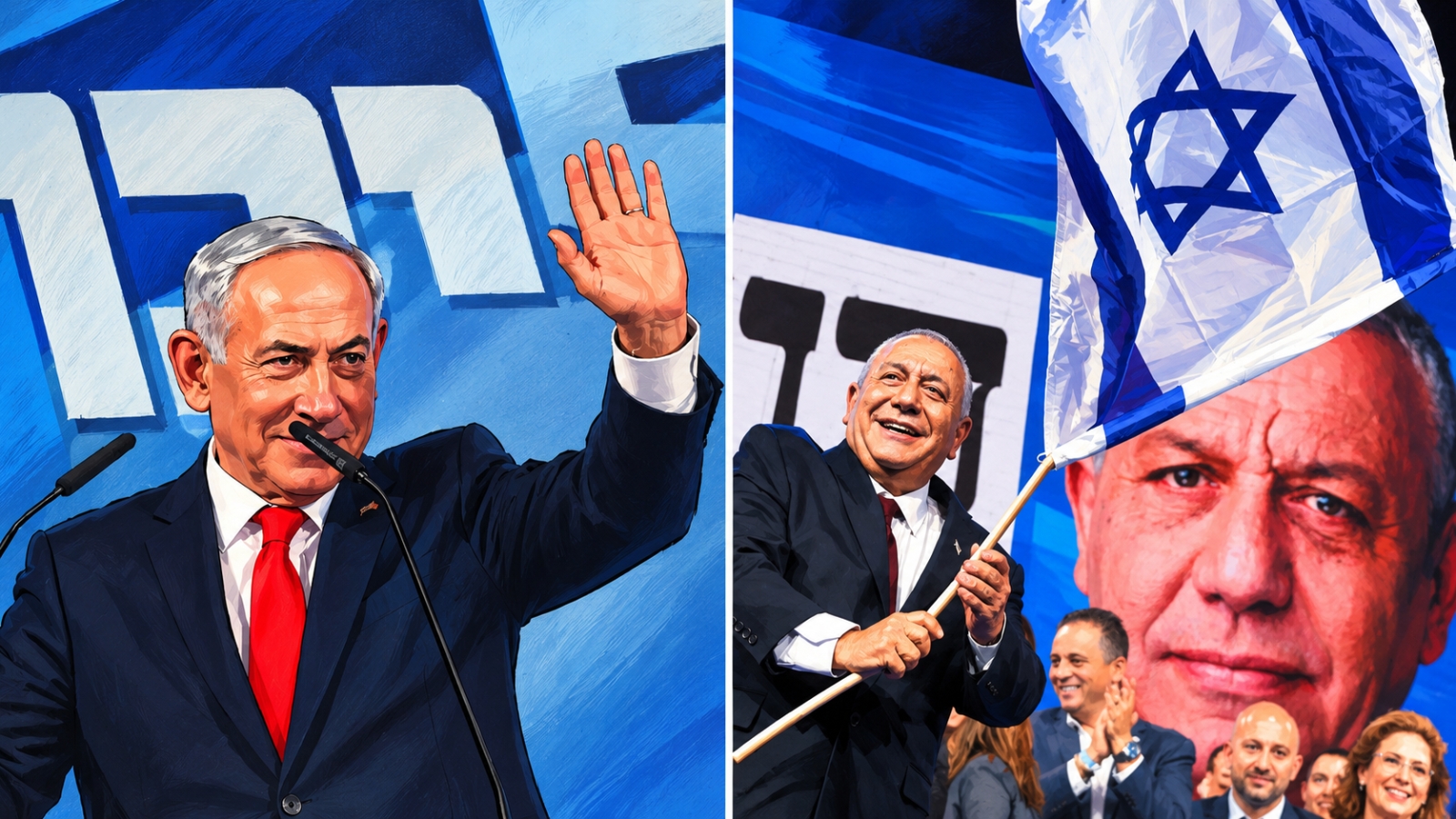
Every election cycle, the political commentary class falls for the exact same illusion. They look at the latest Israeli election results, see a fractured opposition rallying behind a decorated former military chief, and immediately declare the end of the Benjamin Netanyahu era.
This time, the anointed savior is Gadi Eisenkot. The prevailing narrative is simple, neat, and completely divorced from how Israeli coalition arithmetic actually functions. Pundits want you to believe that uniting behind a steady, centrist ex-IDF Chief of Staff is the magic formula to oust Netanyahu, and that the only remaining obstacle is a minor logistical squabble over whether to include Arab parties in the governing coalition.
That diagnosis gets the disease entirely backward.
The split over Arab parties isn't a minor friction point that Eisenkot can smooth over with backroom diplomacy. It is the central, unsolvable contradiction of the anti-Netanyahu bloc. By pretending that a leadership swap solves a structural ideological chasm, mainstream analysts are repeating the exact mistakes that doomed the 2021 "Change Government" before its ink was even dry.
The Myth of the Military Savior
Israeli politics has an addiction to generals. Whenever the center-left and moderate right feel overwhelmed by Netanyahu’s political durability, they reach for a former Chief of Staff. It happened with Ehud Barak. It happened with Benny Gantz. Now, it is happening with Gadi Eisenkot.
The logic seems sound on paper. Eisenkot brings impeccable security credentials, personal integrity, and a calm demeanor that contrasts sharply with the chaotic theatrics of the current political establishment. Voters tired of constant crisis look at a guy like Eisenkot and see an adult in the room.
Here is the problem: leadership style does not change Knesset seat math.
In Israel’s proportional representation system, you do not win by being the most likable candidate. You win by cobbling together at least 61 seats out of 120 without your partners tearing each other apart over fundamental questions of national identity.
I have watched political strategists burn through millions of shekels running focus groups that prove a general polls well among undecided suburbanites in central Israel. Those strategists always miss the obvious catch. A candidate who is palatable to everyone in the center is rarely inspiring enough to pull ideological voters away from the right-wing base, nor does his presence erase the red lines of the factions he needs to govern.
The 61-Seat Trap Nobody Wants to Admit
Let’s look at the cold, hard geometry of the Knesset. Without the ultra-Orthodox (Haredi) parties—who remain tightly bound to Netanyahu’s bloc by decades of shared political culture and budgetary alignment—the opposition cannot reach 61 seats using only Zionist parties.
Read that again. The math simply does not exist.
To form a government without Netanyahu and without the Haredi parties, an Eisenkot-led opposition has only two choices:
- Form a formal coalition with Arab parties (such as Mansour Abbas’s Ra'am or the Hadash-Ta'al alliance).
- Rely on the outside support of Arab parties to pass a confidence vote and sustain a minority government.
Neither option survives contact with reality.
If Eisenkot brings Arab parties directly into the cabinet, the right-wing flank of his own opposition—figures like Avigdor Liberman or Gideon Sa'ar, or the voters who recently defected from Likud—will bolt. Their entire political brand rests on hawkish security policies that clash directly with the core demands of Arab legislators regarding Palestinian statehood, military operations, and the Nation-State Law.
Conversely, if the opposition tries to rely on passive outside support from Arab Knesset members, they recreate the exact nightmare of the Bennett-Lapid government in 2021-2022. That coalition lasted barely a year because every single legislative vote became a hostage negotiation. One rogue member from either side could—and eventually did—collapse the entire enterprise.
Why the "Just Not Bibi" Glue Always Dissolves
Competitor analyses treat the opposition's unity around Eisenkot as a sign of political maturity. In truth, it is a symptom of ideological bankruptcy.
For years, the anti-Netanyahu camp has operated under a single organizing principle: Rak Lo Bibi ("Anyone But Bibi"). While hatred of a political rival is a fantastic tool for mobilizing protesters in the streets of Tel Aviv, it is a catastrophic foundation for running a country.
When your only shared value is removing one man from office, you have no mechanism for resolving actual policy disputes once you take power. Consider the fault lines currently hidden beneath the surface of the "pro-Eisenkot" consensus:
- Economic Policy: The bloc contains free-market technocrats alongside socialist-leaning remnants of the Labor movement.
- Religion and State: Secularists demanding public transportation on Shabbat and mandatory military conscription for the ultra-Orthodox must sit alongside modern-Orthodox nationalists who want to preserve the religious status quo.
- The Judicial System: While everyone agrees on halting the most extreme elements of the government's judicial overhaul, there is zero consensus on how much power the Supreme Court should actually wield.
Imagine a scenario where Eisenkot successfully navigates the post-election negotiations, gets sworn in as Prime Minister, and sits down for his first cabinet meeting. Within forty-eight hours, a crisis erupts over judicial appointments or a military operation in the West Bank. Because the coalition is held together by spite rather than a shared vision, every disagreement becomes an existential threat to the government's survival.
Netanyahu knows this. He doesn't need to beat Eisenkot in a head-to-head debate over security credentials. He just needs to sit back, keep his own bloc disciplined, and wait for the opposition's internal contradictions to detonate.
Dismantling the Wrong Questions
When voters and analysts look at these election results, they tend to ask the wrong questions entirely. Let’s tear down the three most common misconceptions driving the current news cycle.
Can Gadi Eisenkot convince right-wing voters to abandon Likud?
No. And trying to do so is a waste of resources. Likud voters do not support Netanyahu because they think he is a flawless human being. They support him because he represents their cultural identity, their skepticism of Israel's traditional elite, and a worldview that prioritizes hard power over diplomatic concessions. Putting a polite, establishment general at the top of the opposition ticket doesn't appeal to those voters—it reinforces their suspicion that the old guard is trying to retake control through the back door.
Will Arab parties compromise their demands just to get rid of Netanyahu?
Why would they? Arab lawmakers answer to their own constituents, not to the strategic desires of Tel Aviv centrists. In 2021, Mansour Abbas took a historic gamble by joining a Zionist coalition in exchange for massive infrastructure and anti-crime budgets for Arab municipalities. The result? When the government fell, Arab voter turnout plummeted, and Abbas took brutal criticism from within his own community for legitimizing a government that still conducted military raids in the West Bank. Arab leaders will not sign a blank check for Eisenkot without concrete, high-cost political concessions that his right-wing partners will never approve.
Is the opposition finally learning from its past mistakes?
Backing Eisenkot proves they have learned nothing. In 2019 and 2020, they rallied behind Benny Gantz with the exact same talking points: he’s a former Chief of Staff, he’s clean, he’s unifying, he can bridge the divide. Gantz ended up splitting his own party and handing Netanyahu a lifeline during the COVID-19 pandemic. Changing the face on the campaign poster while keeping the exact same broken coalition model isn't strategy. It’s repetition.
The Uncomfortable Truth About What Actually Works
If the opposition actually wants to break Netanyahu’s grip on power, they have to abandon the fantasy of a broad, ideological rainbow coalition led by a consensus general. That model is dead.
There are only two viable paths to a stable, non-Netanyahu government in Israel, and both require ruthless political discipline that the current opposition refuses to stomach.
Path 1: Peel Away the Haredim
Instead of trying to bridge the unbridgeable gap between hawkish secularists and Arab nationalists, the opposition must target the actual linchpin of Netanyahu’s power: the ultra-Orthodox parties, Shas and United Torah Judaism.
Historically, the Haredim were pragmatic coalition partners who sat comfortably with Labor governments in the 1990s. They are tied to Netanyahu today largely because the secular opposition has made Haredi military conscription and budget cuts the centerpiece of their campaigns.
To break the deadlock, an Eisenkot-led bloc would have to make a painful, deeply unpopular compromise: drop the aggressive anti-Haredi rhetoric, offer guaranteed funding for religious institutions, and negotiate a gradual, consensus-based framework for military service. It would infuriate secular voters in central Israel. It would also instantly give the opposition a stable, 65-seat Zionist majority that doesn't rely on Arab parties at all.
Path 2: Build an Explicit, Ideological Left-Arab Bloc
If the opposition refuses to compromise with the ultra-Orthodox, they must stop pretending they are a center-right movement and embrace a genuine partnership with Arab citizens.
This means bringing Arab parties into the coalition not as silent, embarrassed partners hidden in the back room, but as full stakeholders with real ministerial portfolios and agreed-upon policy goals. Yes, this would immediately alienate right-wing defectors like Liberman. It would likely mean losing the next election cycle while the bloc builds a cohesive voter base.
However, it would create something Israel has lacked for twenty years: an actual ideological alternative to the right-wing bloc, rather than a temporary alliance of convenience.
The Downside of Facing Reality
Of course, both of these paths carry massive political risks.
Courting the Haredi parties risks triggering a massive backlash among the opposition's secular core, who view the military draft issue as a non-negotiable moral line—especially following years of grueling multi-front conflict that placed an immense burden on reserve soldiers. Meanwhile, building an explicit alliance with Arab parties requires an ideological shift that most mainstream Israeli politicians consider political suicide.
That is precisely why the opposition keeps defaulting to the "Gadi Eisenkot" strategy. Rallying behind a respected general allows everyone to delay the hard choices. It lets left-wingers believe they are voting for peace, right-wingers believe they are voting for security, and centrists believe they are voting for stability—all while avoiding the reality that those three goals cannot coexist under the same coalition roof.
The Verdict
Stop watching the leadership polls. Stop analyzing Gadi Eisenkot’s approval ratings or praising the opposition for finally uniting behind a single figurehead.
Until the anti-Netanyahu camp decides whether it wants to govern with the ultra-Orthodox or govern with the Arab parties, the name at the top of the ticket is completely irrelevant. You cannot build a house on a fault line and expect it to stand just because you hired a respected architect.