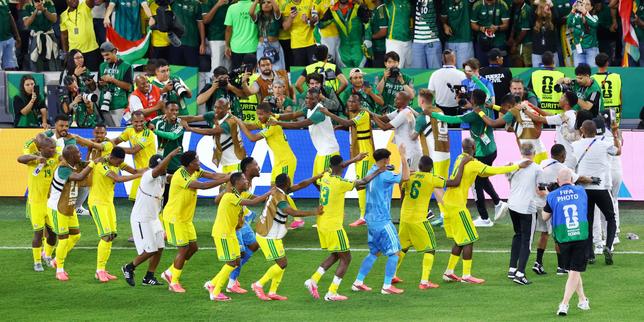
South Africa secured a historic place in the World Cup knockout rounds with a thrilling victory over South Korea, sparking nationwide celebration. This landmark achievement marks the first time a South African soccer team—men's or women's—has progressed beyond the group stage of a global tournament. While fans celebrate this unprecedented success, the triumph exposes deep systemic failures within South African sports administration. The victory belongs entirely to the players and coaching staff who overcame public disputes with their own federation, severe funding disparities, and a lack of professional infrastructure to achieve what was previously thought impossible.
Behind the euphoria lies a grim reality. Days before the tournament commenced, Banyana Banyana refused to play their final warm-up match against Botswana. They were protesting abysmal contract offers, unsafe pitch conditions at home, and a lack of financial transparency from the South African Football Association (SAFA). The federation responded by threatening to send a makeshift squad of players to the tournament instead. It took a private charitable foundation stepping in with emergency funds to resolve the bonus dispute and get the actual squad onto the plane.
This historic run was not the result of a functional development pipeline. It was a triumph achieved in spite of the system.
The Disparity in the Numbers
The financial gap between men’s and women’s soccer in South Africa remains vast. While SAFA officials frequently point to resource scarcity as an excuse, a closer inspection of budget allocations reveals a stark prioritization of Bafana Bafana, the men's national team, despite their prolonged failure to qualify for major global tournaments.
+-----------------------------------+-----------------------------------+
| Banyana Banyana (Women's National) | Bafana Bafana (Men's National)   |
+-----------------------------------+-----------------------------------+
| African Champions (WAFCON 2022)   | Failed to qualify for recent Cups |
+-----------------------------------+-----------------------------------+
| Historic World Cup Knockout Entry | Frequent early stage exits        |
+-----------------------------------+-----------------------------------+
| No fully professional domestic    | Richly funded domestic league     |
| league structure                  | (PSL) with corporate backing      |
+-----------------------------------+-----------------------------------+
The domestic Hollywoodbets Super League operates on a semi-professional basis. Many players must hold down full-time jobs or balance university studies while competing at the highest level. They do this because the match day stipends cannot sustain a basic standard of living. Contrast this with the multi-million rand contracts enjoyed by male players in the Premier Soccer League (PSL), and the structural inequality becomes impossible to ignore.
Tactical Brilliance in the Face of Chaos
On the pitch, the narrative shifted from administrative dysfunction to tactical discipline. Head coach Desiree Ellis constructed a system that maximized the squad’s blistering pace on the counter-attack while mitigating defensive vulnerabilities born from a lack of high-intensity international friendlies.
Against South Korea, South Africa did not dominate possession. They did not need to. Ellis deployed a low block that choked the spaces between the lines, forcing the technically proficient Korean midfielders into wide areas where their crossing options were limited. When possession was turned over, the transition was lethal.
The strategy relied heavily on direct, vertical passing to exploit the space behind the opponent's high defensive line. It required immense physical stamina. Players covered vast distances to plug defensive gaps before sprinting forward to join the attack, showcasing a level of conditioning that defied their disrupted preparation schedule.
The Broken Pipeline of Player Development
To understand why this knockout qualification is a minor miracle, one must examine the grassroots infrastructure in South Africa. Elite sports development requires a continuous influx of young talent supported by structured scouting, medical networks, and high-performance coaching.
In South Africa, women's grassroots soccer is largely kept alive by community volunteers and underfunded local clubs. Many regional leagues lack basic amenities. Matches are frequently played on uneven, dirt surfaces without medical personnel present. Gifted young players in rural provinces go entirely unnoticed because scouting networks are concentrated heavily around major urban hubs like Johannesburg, Pretoria, and Cape Town.
Schools are failing to bridge this gap. The decline of competitive sports programs within public schools means that unless a young girl attends an elite private institution or is spotted by an independent academy, her chances of entering a structured development pathway are virtually non-existent. The national team is drawing from an incredibly shallow pool of resources, making their international competitiveness a statistical anomaly.
Commercial Apathy and Corporate Blind Spots
Corporate sponsorship reflects a similar reluctance to invest in women's sports, often hiding behind the excuse of low television viewership. This creates a circular problem. Broadcasters refuse to commit prime-time slots to women's matches because of a perceived lack of public interest, and sponsors refuse to invest because of the lack of broadcast visibility.
Banyana Banyana’s success blows this justification apart. Public viewing areas across South Africa were packed during the group stage matches, despite the unfavorable kickoff times. The digital engagement metrics shattered previous national records for women's sports content.
Corporate entities that routinely pour millions into struggling men's franchises have largely ignored the African champions. The few brands that have stepped forward often offer short-term, campaign-based sponsorships rather than the long-term, multi-year infrastructure investments required to professionalize the sport from the ground up.
The Urgency of a Fully Professional Domestic League
The current success is unsustainable without immediate structural reform. Relying on individual brilliance and a siege mentality cannot be the default strategy for future international tournaments. European nations are professionalizing their domestic leagues at a rapid pace, creating a massive chasm in tactical execution and physical preparation that African nations will struggle to cross if they remain semi-professional.
Establishing a fully professional women's soccer league in South Africa requires three distinct actions. First, the PSL must mandate that its existing member clubs establish and fund women's sides, mirroring the model utilized effectively in Europe. Second, the government must incentivize corporate investment through targeted tax breaks for companies backing women's sports development. Finally, broadcasting rights for the women's league must be unbundled from men's packages to allow dedicated sports networks to market the game effectively to a hungry audience.
The players have delivered the ultimate proof of concept on the global stage. They have forced the doors open using sheer willpower and tactical intelligence. The responsibility now shifts entirely to the suits in the boardroom to build a structure worthy of the talent that just shocked the world.