Modern missile campaigns against heavily defended urban centers operate on a strict economic and logistical friction model. When a state actor launches a combined saturation strike consisting of ballistic, cruise, and loitering munitions, the objective extends far beyond immediate physical destruction. The strategy targets the depletion curve of scarce anti-air interceptors, forcing defenders into a high-stakes triage where every asset expended reduces total system resilience.
Understanding the structural mechanics of an overnight aerial barrage on a capital city requires analyzing the offensive vector integration, the defensive capacity threshold, and the resulting cascading failures across urban infrastructure nodes.
The Offensive Vector Integration Matrix
A complex missile barrage relies on heterogeneous munition sourcing to degrade radar tracking fidelity and overwhelm saturation limits. The coordination of high-speed ballistic missiles, low-altitude cruise missiles, and hundreds of autonomous drones creates a multi-tiered tactical problem.
The primary vector relies on ballistic missiles designed to descend at terminal velocities that test the tracking and calculation limits of local battery fire-control systems. Because these threats execute rapid vertical trajectories, interceptor windows remain compressed to seconds.
Simultaneously, cruise missiles and drones follow terrain-contour paths or pre-programmed waypoints to saturate peripheral warning grids. This forces command nodes to make rapid resource allocation choices. Deploying premium surface-to-air interceptors against low-cost drones drains finite stockpiles. Conversely, ignoring secondary vectors risks structural penetration of critical logistics hubs.
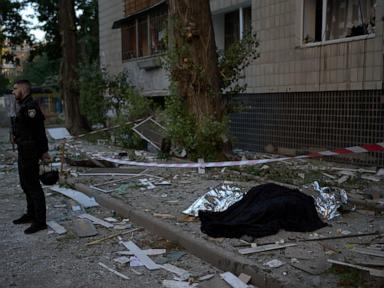
In recent large-scale operations targeting Kyiv, Russian forces combined these assets across multiple distinct vectors, striking dispersed civilian and industrial zones including the Solomianskyi, Sviatoshynskyi, and Darnytskyi districts. The distribution of impacts across twelve separate geographic locations illustrates an explicit dispersion doctrine. Rather than focusing purely on a single hardened military target, the strike pattern maximizes surface area exposure, compelling civil defense networks to fracture their immediate response capabilities across multiple active rescue sites.
The Interceptor Cost Function and Depletion Mechanics
The defensive equation governing modern urban air defense is defined by severe asymmetry. Interceptor missiles for premier platforms, such as the United States-built Patriot system, are expensive, difficult to manufacture, and chronically constrained in supply.
When an attacking force deploys mixed salvos, it forces an unfavorable economic exchange ratio. The defender must expend a scarce, high-cost asset to neutralize a lower-cost incoming threat, accelerating the exhaustion of the overall inventory.
This dynamic creates a systemic vulnerability known as capacity exhaustion. As interceptor reserves dip below operational safety thresholds, the probability of leakage increases exponentially. Leakage refers to the percentage of incoming munitions that bypass the defense grid due to insufficient interceptor availability rather than technical failure of the guidance systems.
Compounding this pressure is the restriction on domestic manufacturing licenses. Strategic reversals by international partners regarding local production rights for advanced anti-ballistic components leave defenders reliant on external supply chains that struggle to match the consumption rate of protracted conflict. Consequently, the defense strategy shifts from comprehensive area denial to selective asset protection, leaving secondary civil infrastructure exposed to terminal kinetic impacts.
Cascading Failures Across Urban Infrastructure Nodes
When defense networks experience leakage during a saturation strike, the kinetic energy is absorbed by urban infrastructure. The physical damage footprint extends well beyond the point of direct impact, initiating secondary systemic failures across municipal networks.
Direct hits on residential blocks, medical facilities, and educational institutions generate immediate rescue bottlenecks. In high-density districts, structural collapse of multi-story residential buildings traps civilians beneath debris, requiring specialized heavy extraction equipment that must operate while air raid alerts remain active. The simultaneous ignition of multiple fires across different neighborhoods forces municipal fire services to ration personnel and suppression resources.
Beyond kinetic destruction, strikes on energy transmission nodes introduce localized grid collapses. For example, high-voltage sub-station damage and distribution line disruptions can abruptly isolate tens of thousands of households from electrical supply. While utility providers often restore baseline capacity within hours through alternative routing, the interim loss of power immediately compromises water pumping stations, hospital backup generator dependencies, and traffic control networks.
This introduces friction into emergency response coordination. First responders must navigate dark intersections, communicate over disrupted local networks, and manage triage centers under conditions of severe information asymmetry. The cumulative effect transforms a localized kinetic strike into a generalized municipal stress test.
Strategic Adaptation and Long-Range Deterrence Shifts
To counter the structural imbalance of absorbing continuous aerial bombardments, defenders must target the source of the offensive capacity rather than relying solely on terminal interception. This operational necessity drives the expansion of long-range counter-strikes aimed at degrading the adversary's logistics chain, fuel storage facilities, and component manufacturing sites.
However, symmetrical retaliation remains constrained by resource disparities and geopolitical boundaries. While long-range drone and missile programs developed indigenously by Ukraine allow for deep strikes inside Russian territory targeting ammunition depots and logistics hubs, the volume of offensive production heavily favors the larger industrial base of the aggressor.
Diplomatic channels running parallel to these kinetic exchanges face structural gridlock. Proposals for peace frameworks or negotiated settlements stall because both sides view ongoing tactical escalation as a primary lever to improve their relative bargaining posture.
The strategic imperative for the defending capital centers on two competing timelines: whether domestic and international supply lines can replenish interceptor inventories faster than the attrition rate exhausts them, or whether long-range counter-campaigns can successfully disrupt the adversary's missile assembly infrastructure before urban resilience reaches its breaking point.