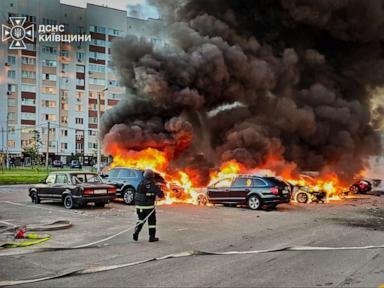
The repeated aerial saturation of the Kyiv capital region by long-range uncrewed aerial vehicles reflects an operational shift from territorial conquest to systemic economic exhaustion. Recent multi-wave drone campaigns targeting high-density residential zones and critical commercial supply chains demonstrate a calculated method of military pressure. Standard reporting often frames these events through isolated casualty counts and localized property damage. A deeper structural analysis reveals a distinct logic governing these strikes, focusing on air defense saturation, logistical fragmentation, and psychological attrition.
The Dual Objective Framework
Military strategists examining the campaign observe two concurrent objectives driving the deployment of small, jet-powered, and propeller-driven loitering munitions in waves: air defense depletion and civilian destabilization. If you liked this article, you should read: this related article.
Air defense architectures rely on resource allocation and radar tracking capacity. By deploying continuous, low-cost vectors across predictable nocturnal trajectories, an attacking force forces defenders to expend high-value interceptor missiles on low-cost assets. This creates an unfavorable economic asymmetry where the cost of defense vastly outstrips the cost of attack.
Beyond air defense wear, the targeting of commercial distribution nodes—such as major private courier sorting hubs, retail warehouses, and pharmaceutical storage facilities—serves an economic function. By systematically disrupting regional supply chains, the strategy aims to fracture the internal market coherence of the capital. When distribution centers burn, the velocity of capital and goods slows down, imposing friction on an already strained wartime economy. For another perspective on this development, refer to the latest update from TIME.
The Operational Mechanics of Urban Saturation
The execution of these strikes relies on specific tactical patterns designed to maximize disruption without requiring precision ground coordination.
- Sequential Wave Deployment: Attacks are structured in multiple temporal phases, often separated by hours, forcing extended periods under air-raid alerts. This design prevents workforce recovery and degrades municipal productivity.
- Decentralized Asset Targeting: Rather than focusing strictly on governmental or military command centers, strikes hit peripheral warehouses, multi-story residential blocks, and civilian transport arteries. This broad footprint complicates civil defense planning and stretches emergency response infrastructure.
- Acoustical and Psychological Friction: The constant operational hum of loitering munitions combined with frequent air defense engagement overhead generates high-level cognitive fatigue among the civilian population.
The physical footprint of these operations extends across multiple districts, damaging dozens of residential homes and high-rise apartment blocks alongside commercial properties. This indiscriminate scatter is not necessarily a failure of guidance systems, but a feature of an attrition model designed to make urban habitation persistently hazardous.
Economic and Logistical Ripple Effects
The destruction of commercial real estate in the Kyiv region alters the country's domestic supply chain equilibrium. Warehousing capacity within the capital zone has faced severe contraction since the escalation of hostilities. When primary fulfillment centers and sorting depots for major logistics networks sustain direct hits, the recovery timeline involves complex reconstruction and inventory relocation.
This friction cascades down to retail, humanitarian aid distribution, and consumer goods availability. Retailers reliant on centralized automated hubs must pivot to decentralized, micro-storage networks, which are less efficient and incur higher operational overhead. Consequently, the endurance of Kyiv's economy depends on the speed of adaptive logistical routing rather than static infrastructure protection.
Strategic Outlook
The continuation of multi-wave urban drone strikes highlights the limits of traditional air defense deterrence in densely populated metropolitan areas. As long as the cost function of producing and launching loitering munitions remains low relative to the cost of interception, urban centers will remain primary targets for indirect pressure campaigns. The resilience of the capital is no longer measured solely by frontline military outcomes, but by the structural capacity of its civil administration, logistics networks, and population to absorb chronic systemic friction.