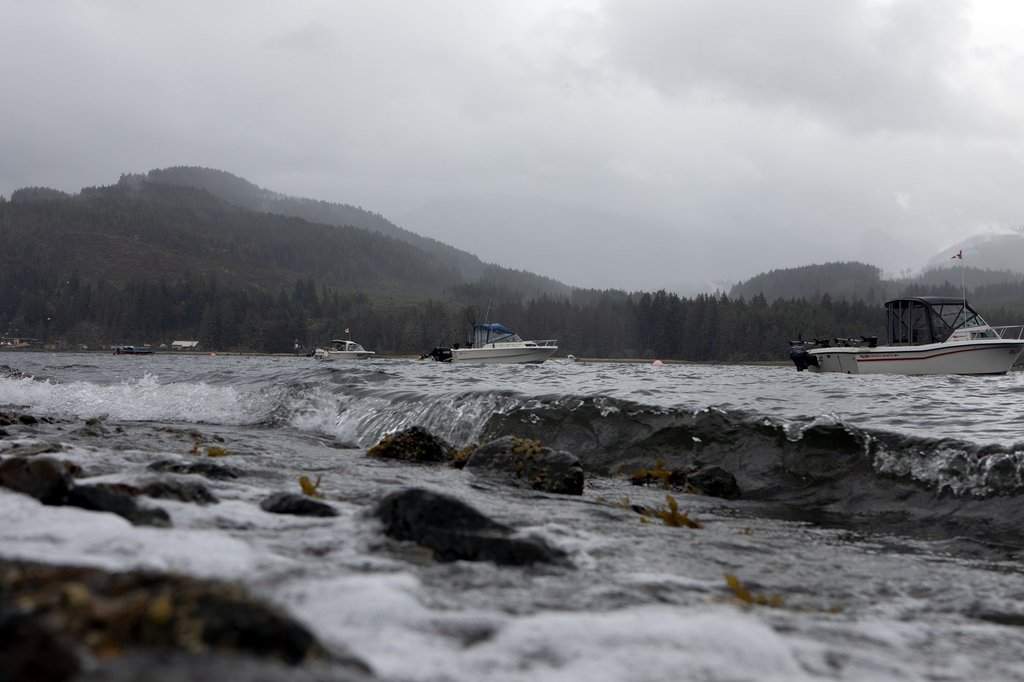
Pacific frontal boundaries impacting the British Columbia coast and Vancouver Island operate via well-defined thermodynamic mechanisms that dictate heavy precipitation and localized gale-force wind vectors. Standard meteorological reporting routinely reduces these high-energy marine events to surface-level descriptions of rain and wind, omitting the underlying pressure gradients and topography-driven amplification loops that govern actual storm severity. Evaluating how these low-pressure systems interact with coastal relief provides an accurate blueprint for predicting localized infrastructure strain, power distribution failures, and hydrological response rates.
The Thermodynamic Driver and Pressure Gradient Mechanics
The fundamental energy source for heavy weather events across the Pacific Northwest originates from deep low-pressure systems developing over the northeast Pacific. As these surface lows deepen and migrate toward the continental shelf, they generate intense baroclinic zones where warm, moisture-laden maritime air masses collide with cooler continental air.
The rate of pressure change per unit distance—the pressure gradient force—dictates initial wind velocity. When an approaching low-pressure center deepens rapidly, tight isobaric spacing translates directly into high-velocity surface winds across exposed marine areas and coastal headlands.
- Isobaric Compression: Closely packed pressure lines accelerate geostrophic winds, which then cross the coastline at acute angles.
- Frictional Convergence: Surface friction over land slows the lower boundary layer of the wind, forcing air to converge upward and fueling convective cloud bands.
- Thermal Contrast: Temperature differentials across the frontal boundary maintain buoyancy, sustaining continuous precipitation output rather than isolated showers.
Orographic Lift and Precipitation Amplification
While frontal systems carry substantial moisture independently, the rugged topography of Vancouver Island and the British Columbia mainland acts as an active physical amplifier through orographic lifting. As onshore south-to-southeast winds encounter the coastal mountain ranges, the air column is forced upward adiabatically.
This forced vertical displacement causes rapid cooling, condensation, and heavy rainfall deposition along windward slopes. The volumetric output of precipitation is directly proportional to three variables: the incoming moisture flux, the wind velocity perpendicular to the mountain barrier, and the height of the orographic barrier.
[Moist Marine Air] ---> [Coastal Mountain Barrier] ---> [Adiabatic Cooling] ---> [High-Volume Precipitation]
Lee-side rain shadows experience diminished accumulation, but windward watersheds face immediate hydrological stress. Small streams and tributaries respond to this intense water input within hours, creating flash-flood conditions well before major river basins peak.
Infrastructure Vulnerability Vectors
Severe wind and rain events expose specific vulnerabilities within coastal built environments. The interaction between saturated soil profiles and high-velocity wind loading creates a mechanical failure loop for municipal infrastructure.
- Root-Plate Destabilization: Continuous heavy rainfall saturates the upper soil mantle, reducing shear strength and matrix suction. When subsequent high-velocity gusts strike tree canopies, the leverage applied to the root system exceeds anchorage capacity, leading to widespread uprooting.
- Distribution Grid Disruption: Overhead utility corridors intersecting forested rights-of-way experience high failure rates. Tree contact with energized conductors triggers immediate circuit isolation and multi-neighborhood outages.
- Drainage Basin Sarcophagi: Urban environments rely on gravity-fed storm sewers and perimeter drains. When autumn leaf drop coincides with initial storm surges, debris acts as a physical weir, clogging catch basins and causing localized pooling regardless of main system capacity.
Hydrological Response Times and Debris Flow Triggers
The transition from steady rainfall to mass-wasting events depends on antecedent soil moisture conditions. If a region has experienced a dry summer, initial precipitation is absorbed via matrix infiltration. However, prolonged multi-day frontal passages push soils past field capacity, converting rainwater entirely into surface runoff and subsurface pore pressure.
High pore-water pressure reduces effective stress within steep colluvial slopes. Once threshold precipitation intensity metrics are crossed—often measured in millimeters per hour over a rolling 6-hour window—the risk of shallow landslides and debris flows in steep creek channels escalates sharply. Municipalities situated on alluvial fans downstream of these channels face direct exposure to hyper-concentrated sediment loads.
Prioritize structural resilience by clearing perimeter drainage pathways before seasonal baroclinic systems make landfall, ensuring that urban runoff coefficients do not exceed local conduit capacity during peak precipitation intervals.


