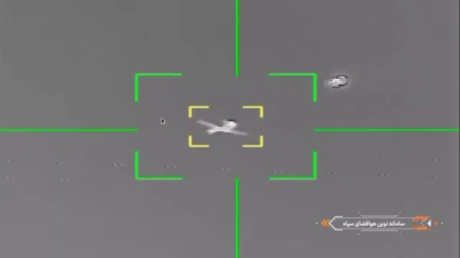
Kinetic exchanges between Washington and Tehran operate under a predictable set of game-theoretic rules, where the destruction of an unmanned aerial vehicle triggers a calibrated, non-escalatory response designed to restore deterrence without igniting a theater-wide war. When Iranian air defenses down an American drone and the United States answers with "defensive" strikes, standard media reporting treats the event as an isolated tit-for-tat incident. That framing misses the underlying operational architecture. Both actors are executing a precise doctrine of controlled escalation management, trading low-cost, high-visibility hardware and fixed infrastructure to signal resolve while keeping human casualties near zero.
To understand the strategic reality behind the strike cycle, analysts must separate tactical execution from diplomatic signaling. Standard coverage relies on official press releases that label retaliatory bombardment as "defensive" or "proportional." In military doctrine, neither term is accidental. They represent specific thresholds on an escalation ladder engineered to satisfy domestic political demands for strength while communicating clear operational limits to the adversary's command structure.
The Architecture of Unmanned Attrition
The decision to target an unmanned system—and the subsequent decision to retaliate against fixed facilities—reflects a deliberate calculation of political cost versus strategic gain.
- The Casualty Threshold: In modern US foreign policy, the loss of uniformed personnel acts as a mandatory tripwire for severe kinetic retaliation. Downed unmanned platforms, regardless of their unit cost or intelligence-gathering sophistication, bypass this tripwire. Tehran exploits this gap by targeting high-value autonomous assets—such as the RQ-4 Global Hawk or MQ-9 Reaper—to demonstrate air-denial capabilities without forcing Washington into a politically untenable position where massive retaliation becomes mandatory.
- Sovereignty and Airspace Ambiguity: Drone intercepts almost always occur in contested or ambiguous electromagnetic and geographic zones, such as international waters bordering the Strait of Hormuz or airspace over proxy-controlled territories in Iraq and Syria. This ambiguity allows Iran to frame the shootdown as a lawful defense of territorial integrity, while the US frames the flight as routine freedom-of-navigation surveillance.
- Asymmetric Cost Exchange: While a high-altitude surveillance drone costs tens of millions of dollars, the surface-to-air missile used to destroy it costs a fraction of that amount. However, the subsequent US retaliatory strike shifts the cost curve back onto Iranian infrastructure, destroying radar installations, missile batteries, or proxy logistics hubs whose replacement requires not just capital, but scarce technical expertise and sanctioned supply chains.
This dynamic creates an operational equilibrium. Iran demonstrates reach and precision; the United States demonstrates overwhelming strike capacity and intelligence dominance. Neither side crosses the threshold that requires total mobilization.
Deconstructing the "Defensive" Strike Doctrine
When the Pentagon characterizes a retaliatory bombing run as "defensive," it is invoking specific legal and operational frameworks rather than offering a semantic spin. Under Article 51 of the United Nations Charter and standard US Rules of Engagement, military action must be tied to the prevention of imminent future attacks to avoid classification as an act of aggressive war.
To satisfy this requirement while still punishing the adversary, US planners execute a three-part targeting methodology:
- Functional Degradation Over Annihilation: Strikes focus on the specific kill-chain nodes responsible for the drone loss. If a coastal radar site tracked the UAV and cued a surface-to-air missile battery, the retaliatory package targets that specific radar array and its command-and-control bunker. Destroying the sensor blinds the network without requiring the destruction of the entire regional air defense grid.
- Temporal Calibration: The interval between the drone downing and the US strike—often measured in hours rather than days—is a critical signaling mechanism. An immediate response demonstrates standing readiness and pre-approved target packages, eliminating the perception of diplomatic hesitation. Conversely, a delayed strike suggests internal friction, coalition consultations, or deliberate de-escalation through extended diplomatic backchannels.
- Deconfliction via Indirect Channels: Before munitions impact, intelligence and diplomatic networks routinely pass quiet warnings through third-party intermediaries—such as Oman, Switzerland, or Iraqi officials—ensuring that high-ranking Islamic Revolutionary Guard Corps (IRGC) officers or Russian advisors are not present at the targeted coordinates. The goal is the destruction of materiel, not the creation of martyrs.
The Intelligence Value of Retaliation
Beyond physical destruction, a retaliatory strike serves as a live-fire intelligence collection operation. Every time the US conducts a kinetic strike in the Middle East, it forces the adversary's electronic order of battle to illuminate.
When strike aircraft or cruise missiles enter contested airspace, Iranian and proxy air defense networks must activate their acquisition radars, fire-control systems, and encrypted communications links. Overhead US intelligence, surveillance, and reconnaissance (ISR) platforms—including signals intelligence (SIGINT) aircraft and low-earth-orbit satellites—record these emissions.
This process yields three distinct intelligence products:
- Frequency Mapping: Identifying the exact radar frequencies and hopping patterns used by upgraded Iranian air defense systems, such as the Sevom Khordad or Bavar-373.
- Response Latency: Measuring the exact time elapsed between border penetration and battery activation, revealing weaknesses in command-and-control integration.
- Electronic Countermeasure Validation: Testing the real-world efficacy of US electronic warfare pods and stealth coatings against active adversarial sensors.
The strike itself is secondary to the data harvested during its execution. The physical crater left behind is a temporary setback for the target; the electronic signature captured in the Pentagon's databases degrades that air defense network's survivability in any future high-intensity conflict.
Limitations of Calibrated Deterrence
Relying on proportional, telegraphing strikes carries severe structural risks. The primary flaw in controlled escalation management is the assumption of perfect information and rational execution across decentralized command structures.
First, friction in execution can instantly break the model. A precision-guided munition experiencing a guidance failure, or an intelligence error that misidentifies an occupied barracks as an empty warehouse, can turn a calibrated signal into a mass-casualty event. Once casualties mount, domestic political pressure in Tehran or Washington overrides strategic restraint, forcing the injured party up the escalation ladder regardless of its original intent.
Second, proxy autonomy introduces non-state variables into a state-level game. Iran relies on a network of regional militias—Kata'ib Hezbollah, the Houthis, and various Syrian factions—to maintain plausible deniability. While Tehran supplies the hardware and strategic direction, local commanders often operate with tactical autonomy. A rogue unit firing an unapproved salvo at a manned US base in response to a "calibrated" US strike can trigger a broader conflict that neither capital planned.
Third, deterrence erosion occurs when the cost of the retaliation becomes predictable and absorbed into the adversary's operational budget. If Iran calculates that downing a $30 million US drone will merely result in the loss of an empty warehouse or an outdated radar trailer, the deterrent value of the US response drops to zero. Predictability breeds contempt; an adversary that knows the exact ceiling of your response will routinely operate just beneath it.
Information Warfare and the Battle for the Visual Narrative
The inclusion of video footage in announcements surrounding drone shootdowns and retaliatory strikes is a core component of modern kinetic operations. Combat footage is no longer an afterthought released to satisfy media inquiries; it is a weaponized asset deployed to shape domestic morale and international perception.
Iran releases high-definition infrared tracking footage of a US drone disintegrating mid-air to achieve two objectives: proving technological parity to its domestic population and signaling to regional Gulf states that the US security umbrella is permeable. By broadcasting the kill, Tehran forces Washington to respond publicly, denying the Pentagon the option of quietly writing off the loss as a mechanical failure.
The US Department of Defense counters with monochromatic, crosshair-centered gun-camera or satellite imagery showing the precise obliteration of the targeted facility. This imagery is curated to project clinical detachment, technological superiority, and strict adherence to the laws of armed conflict—specifically by showing the absence of civilian collateral damage. The visual message is unambiguous: the US can strike any fixed coordinate at will, with absolute precision, and without risking a single American life.
Strategic Imperatives for Escalation Dominance
To break out of a reactive cycle where an adversary dictates the tempo of engagement by sacrificing cheap assets, military planners must shift from symmetric tit-for-tat responses to asymmetric, cross-domain imposition of costs.
- Decouple Retaliation from the Geographic Theater: Responding to a drone loss in the Persian Gulf by bombing a radar site in the same sector validates the adversary's chosen battlefield. Effective deterrence requires shifting the horizontal axis—responding to kinetic provocations with non-kinetic or covert disruptions against high-value assets elsewhere, such as cyber operations targeting energy export infrastructure or maritime interdictions of sanctioned logistics vessels.
- Eliminate Predictable Targeting: Abandon the practice of striking empty facilities or purely symbolic infrastructure. If deterrence is to hold, the cost function must exceed the adversary's willingness to pay. Targeting high-value command nodes, advanced drone manufacturing facilities, or irreplaceable technical stockpiles forces the adversary to weigh the propaganda value of a shootdown against the loss of strategic capabilities that take years to rebuild.
- Weaponize Ambiguity: Cease telegraphing strike windows and intentions through public statements and diplomatic intermediaries. When an adversary can calculate the exact timing, location, and scale of a retaliatory strike, they can mitigate the damage beforehand. Maintaining strategic silence while executing sudden, unannounced multi-domain operations forces the adversary into a costly, continuous state of high alert, exhausting their air defense crews and degrading their operational readiness over time.


