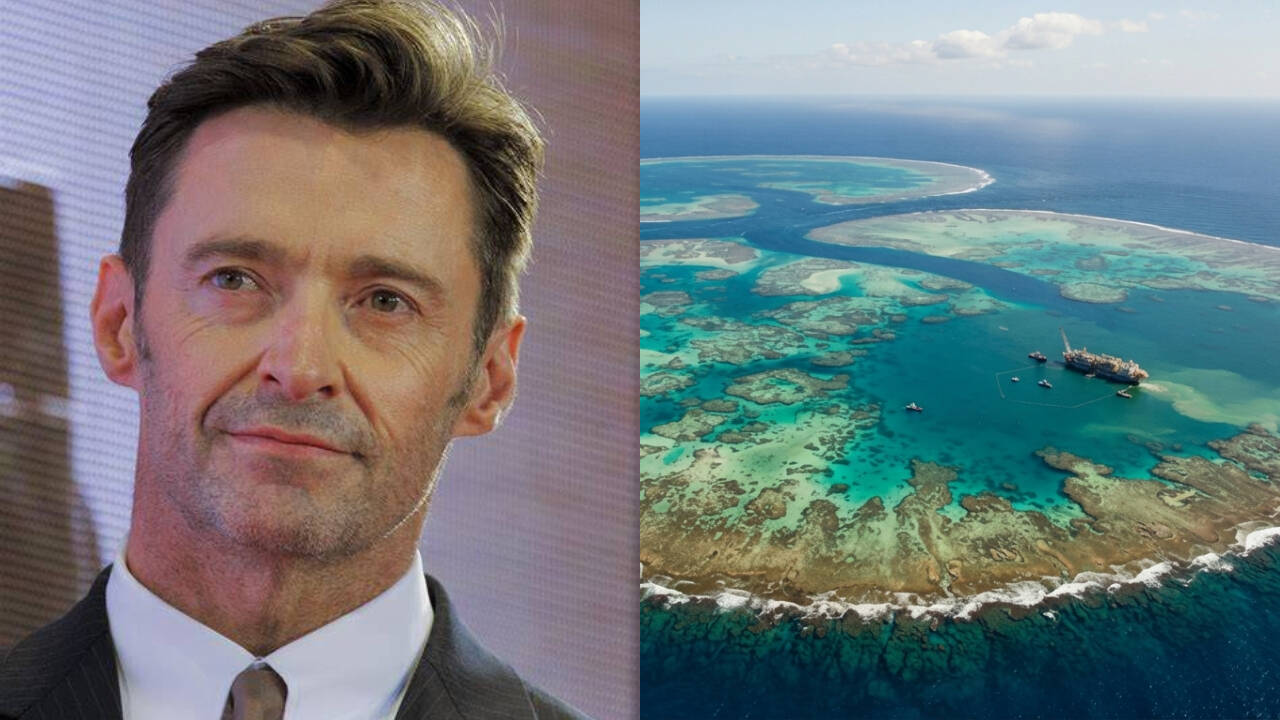
Celebrity-backed environmental campaigns rarely alter capital allocation in the energy sector unless they successfully raise a project's regulatory delay costs above its net present value threshold. The mobilization of actor Hugh Jackman alongside more than 150 Australian artists to oppose Woodside Energy's gas development near Scott Reef represents a calculated attempt to inject reputational friction into an industrial permitting pipeline. Rather than viewing this event as a simple clash between conservationists and corporate interests, analysts must evaluate it as an asymmetric collision between cultural soft power and long-horizon energy infrastructure capital.
The Structural Anatomy of the Scott Reef Dispute
To understand the mechanics of this conflict, one must separate the ecological geography from the industrial engineering. Standard media coverage conflates proximity with direct physical destruction, obscuring the actual operational and regulatory battlegrounds.
Scott Reef is an isolated, emergent coral atoll system located in the Timor Sea off the northwest coast of Western Australia. Unlike coastal reefs integrated into continental shelf tourism economies, Scott Reef functions as an offshore biodiversity reservoir. Its geographic isolation insulates it from agricultural runoff and coastal development, making thermal stress from ocean warming and localized industrial disturbance the primary vectors of ecological risk.
Woodside Energy's strategic objective involves unlocking deepwater natural gas reserves in the Browse Basin to backfill declining production at its existing onshore liquefaction facilities, specifically the North West Shelf project on the Burrup Peninsula. In offshore oil and gas economics, infrastructure utilization dictates profitability. An onshore liquefied natural gas plant represents tens of billions of dollars in sunk capital. Without new feed gas from offshore reservoirs like Browse, processing trains sit idle, destroying unit economics and forcing early decommissioning liabilities.
The friction occurs because the Browse gas reservoirs lie beneath and adjacent to the Scott Reef ecosystem. Developing these fields requires subsea wellheads, flowlines, floating production storage and offloading units, and long-distance export pipelines. The opposition coalition, amplified by high-profile figures from film, music, and visual arts, targets the regulatory approval gates required to move this project from front-end engineering design to a final investment decision.
Deconstructing the Celebrity Coalition Mechanism
Public relations campaigns featuring high-profile cultural figures operate through specific transmission channels. They do not alter the geological realities of the Browse Basin, nor do they directly change the thermodynamic efficiency of gas turbines. Instead, they manipulate the political and financial risk premiums attached to the operator.
1. Attention Arbitrage and Salience Shifting
Technical environmental impact statements run thousands of pages and remain impenetrable to the general electorate. Offshore gas extraction occurs hundreds of kilometers from major population centers, resulting in low baseline public salience. When recognizable figures like Hugh Jackman lend their names to an open letter, they execute an attention arbitrage. They transfer audience familiarity from commercial entertainment into a low-visibility regulatory dispute. This forces mainstream news desks to cover a permitting review that would otherwise remain confined to trade publications and financial wires.
2. Political Risk Escalation
In democratic jurisdictions, federal and state environment ministers possess statutory discretion over project approvals, particularly regarding conditions attached to biodiversity protection and carbon abatement. High-visibility campaigns alter the political calculus for elected officials. When a project becomes a cultural touchstone, approving it carries immediate electoral costs in urban marginal seats, even if the economic benefits accrue to state royalties and regional employment. The coalition's primary tactical goal is to make regulatory sign-off politically expensive for federal decision-makers.
3. Institutional Capital and Brand Contagion
Modern energy developers rely on global debt markets, institutional equity holders, and joint-venture partners. Large institutional investors increasingly screen portfolios for biodiversity risk alongside carbon intensity. A sustained cultural campaign threatens to turn a specific asset into a reputational liability for passive asset managers and banking syndicates. While retail boycotts rarely impact a business-to-business liquefied natural gas exporter directly, brand contagion affects recruitment, joint-venture partner alignment, and the willingness of state-backed export credit agencies to underwrite project debt.
The Three Risk Vectors in Offshore Gas Extraction
Opposition narratives frequently rely on broad generalizations about environmental ruin. A rigorous assessment breaks the operational risks at Scott Reef into three distinct technical categories, each governed by different engineering controls and failure probabilities.
- Subsurface Subsidence and Benthic Disturbance: Extracting vast volumes of hydrocarbons from deep geological formations reduces pore pressure within the reservoir rock. Over decades, this pressure drop can cause gradual compaction of the reservoir, translating into minor subsidence at the seabed. For a coral atoll system reliant on precise water depths for photosynthetic light penetration, even marginal changes in vertical elevation relative to sea level pose theoretical risks to shallow-water reef habitats.
- Acoustic and Thermal Plumes: Seismic surveying during exploration and pile-driving or subsea installation during construction generate high-decibel underwater acoustic waves. These pressure waves disrupt marine mammal migration corridors and alter fish behavior. During operational phases, floating processing facilities discharge produced water and cooling water, creating localized thermal and chemical plumes that require strict dispersion modeling to avoid stressing adjacent benthic communities.
- Loss of Well Control and Hydrocarbon Release: Though statistically low-probability compared to routine operational discharges, a subsea blowout represents a catastrophic tail-risk event. In deepwater environments, capping a ruptured well requires specialized containment vessels and relief well drilling, a process taking weeks. Currents in the Timor Sea could transport surface slicks and dispersed hydrocarbons directly across the coral reef structure, causing acute mortality across trophic levels.
Economic Trade-Offs and Energy Security Constraints
Evaluating the campaign purely through an ecological lens ignores the macroeconomic constraints governing Australian energy policy and Asian liquefied natural gas markets. Policy decisions regarding Scott Reef sit at the intersection of competing structural imperatives.
First, domestic energy security and industrial policy rely heavily on gas revenues. Natural gas royalties and corporate tax receipts fund public infrastructure in Western Australia. Furthermore, gas-fired power generation provides dispatchable firming capacity as coal-fired power stations retire across the grid, though Browse gas is primarily earmarked for export markets rather than domestic pipelines.
Second, regional energy transition dynamics complicate simple supply-side restrictions. Buyers in Japan, South Korea, and across Southeast Asia import Australian liquefied natural gas to power heavy industry and displace higher-emitting thermal coal. Proponents of the Browse development argue that restricting gas supply from stable jurisdictions does not reduce global hydrocarbon demand; it merely shifts market share toward higher-cost or geopolitically volatile suppliers, or forces importing nations to extend the operational lifespans of existing coal plants.
Third, capital allocation rules inside energy majors dictate that funds are fungible. If regulatory delays or stringent environmental conditions push the internal rate of return for the Browse project below Woodside's corporate hurdle rate, capital will not automatically flow into domestic ecological restoration. Instead, it will be reallocated to lower-friction jurisdictions, such as deepwater oil assets in the Gulf of Mexico or liquefied natural gas projects on the United States Gulf Coast, where permitting timelines and regulatory boundaries are more predictable.
Limitations of Cultural Mobilization in Heavy Industry
Strategic consultants recognize that celebrity coalitions face severe structural limitations when confronting capital-intensive infrastructure projects. Understanding these constraints reveals why many high-profile campaigns fail to stop major developments.
The Ephemeral Attention Cycle
Entertainment figures operate within rapid media cycles driven by project releases and publicity tours. Industrial permitting processes span five to ten years. An open letter generates a sharp spike in media mentions over a seventy-two-hour window, followed by rapid decay. Regulatory agencies and corporate project teams simply outwait the news cycle, continuing technical assessments and commercial negotiations long after public attention has shifted elsewhere.
Asymmetric Stakes and Organizational Discipline
For an artist, signing a petition or recording a video statement carries near-zero marginal cost and generates positive social capital within their peer group. For an energy operator, the project represents billions of dollars in future cash flows and core corporate survival. Consequently, the operator deploys full-time teams of regulatory lawyers, marine scientists, lobbyists, and engineers dedicated exclusively to securing approval. Part-time cultural advocacy rarely matches the sustained institutional persistence of a well-capitalized corporation.
The Credibility Deficit on Technical Alternatives
Cultural coalitions excel at defining moral boundaries—framing a reef as priceless and sacrosanct—but they rarely offer viable engineering or macroeconomic substitutes. Policymakers must balance ecological preservation against grid stability, export balances, and employment. When activists demand a binary halt to development without addressing how to backfill declining energy infrastructure or replace state royalty streams, decision-makers often discount their input as disconnected from operational reality.
Strategic Execution for Both Sides of the Standoff
The outcome of the Scott Reef standoff depends on how effectively each side translates its inherent advantages into durable regulatory or commercial leverage.
For the opposition coalition to convert cultural visibility into a permanent project cancellation, it must abandon broad awareness tactics and target specific financial chokepoints. Media spectacle alone will not stop a final investment decision. The coalition must redirect its influence toward institutional shareholders, syndicate banks, and insurance underwriters, framing the Browse development as an uninsurable stranded-asset risk due to evolving biodiversity disclosure frameworks. Simultaneously, advocates must pressure federal regulators to enforce strict, non-negotiable technical conditions—such as zero-discharge subsea architecture and binding financial bonds for subsidence monitoring—that inflate capital expenditure until the project becomes economically unviable on Woodside's own balance sheet.
For Woodside Energy, neutralizing this campaign requires insulating the regulatory process from political interference through rigorous technical de-risking. Attempting to win a public relations war against beloved cultural icons is a losing strategy that amplifies the opposition's message. Instead, the operator must alter the engineering scope to eliminate the primary physical vectors of criticism, such as relocating surface processing infrastructure further from the reef boundary and committing to verifiable carbon capture and storage mechanisms for reservoir carbon dioxide. By satisfying the statutory criteria of environmental regulators with quantifiable engineering margins, the company can shift the decision back into a technocratic framework where legal precedent and economic utility outweigh cultural pressure.


