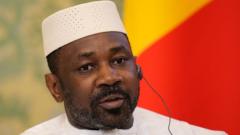
Western media loves a tragedy. When a bomb rips through a motorcade in Bamako and a high-ranking official ends up in a body bag, the headlines bleed with words like "instability," "chaos," and "crisis." It’s a tired script written by people who haven't stepped foot in the Sahel in a decade. They see the death of Sadio Camara and the subsequent move by Assimi Goïta to take the defense portfolio himself as a desperate grasp for survival.
They are wrong.
What we are witnessing isn't a meltdown. It’s a ruthless, necessary, and frankly overdue streamlining of a fractured command structure. In the brutal theater of West African geopolitics, "stability" is a luxury for the rich. For a state fighting three different insurgencies and a diplomatic cold war with its neighbors, redundancy is a death sentence. Goïta isn't "naming himself" out of ego; he is closing the gap between decision and execution.
The Myth of the Fragile Strongman
The standard narrative suggests that when a leader absorbs more power following an assassination, they are scared. The logic goes that if they trusted their inner circle, they’d appoint a successor. This ignores the reality of the "predecessor" problem.
In a transitional military government, the Defense Ministry isn't just a desk job. It’s the primary source of leverage. Having a separate Defense Minister creates a second sun in the solar system. It creates a target. By merging the Presidency with the Ministry of Defense, Goïta has effectively deleted the "coup-within-a-coup" playbook. You cannot peel away the military from the leader if the leader is the military.
Most analysts focus on the violence of the transition. They miss the efficiency of the result.
Why Decentralized Defense Fails in the Sahel
Look at the data from the last five years of conflict in Mali, Burkina Faso, and Niger. When operations fail, they don't fail because of a lack of "democratic oversight." They fail because of bureaucratic friction between the presidential palace and the military headquarters.
- Intelligence Lag: Reports from the front lines often sit on a minister's desk for 48 hours before reaching the head of state. In a drone-heavy combat environment, 48 hours is an eternity.
- Command Dilution: Field commanders often receive conflicting signals. The President wants a diplomatic victory; the Defense Minister wants a tactical body count.
- Funding Leakage: Every layer of the hierarchy in Bamako acts as a toll booth.
By removing the middleman, Goïta is adopting a "Flat Org" structure that Silicon Valley would drool over if it weren't happening in a war zone. This is a lean-startup approach to counter-insurgency. It’s brutal, yes. It’s unorthodox. But it is a direct response to the failure of the French-backed models that preceded it.
The Wagner Factor and the Sovereignty Pivot
Let’s address the elephant in the room that the mainstream press refuses to handle without a pair of ideological tongs: Russia.
The "lazy consensus" is that Mali is a puppet state for Russian interests. The reality is far more transactional. The death of the previous Defense Minister was a stress test for the Malian-Russian partnership. If the junta had blinked, if they had scrambled to find a compromise candidate to appease the West, the partnership would have folded.
Instead, Goïta doubled down. By taking the defense reigns, he becomes the sole point of contact for the Africa Corps (formerly Wagner). This isn't about being a puppet; it’s about reducing the number of people who can sell you out.
Imagine a scenario where a Defense Minister is offered a billion dollars by a foreign intelligence agency to flip. It’s happened a dozen times in post-colonial African history. Now imagine trying to buy off the guy who already holds the title of President. The price becomes too high. The risk becomes absolute.
The Fallacy of "Institutional Continuity"
You will hear pundits cry about the erosion of Malian institutions. This is a ghost story told to people who believe institutions are made of marble and law books. In Mali, the only institution that hasn't evaporated under the heat of the jihadist insurgency is the military.
When a "predecessor is killed," as the dry headlines put it, you don't look for a replacement who can fill a chair. You look for a way to ensure it doesn't happen again.
People ask: "Is this sustainable?"
The honest, brutal answer is: It doesn't have to be.
Western political thought is obsessed with the "long term." In Bamako, the long term is next Tuesday. If the state falls on Monday, your twenty-year plan for democratic transition is just scrap paper. Goïta’s consolidation is a short-term survival mechanism designed to win a war of attrition.
Breaking the "Democratic Peace" Delusion
There is a persistent, arrogant belief that "inclusive governance" is the cure for insurgency.
- The Theory: If everyone has a seat at the table, no one picks up a gun.
- The Reality: In the Sahel, the "table" is being burned for fuel.
Every time Mali tried to play by the international community's rules—holding messy elections, balancing cabinet positions between ethnic factions, keeping the military at arm's length from the executive—the territory held by the state shrunk.
Goïta is betting that a singular, focused, and militarized executive can achieve what a decade of "inclusive" failure could not. He is trading the appearance of legitimacy for the reality of force.
The High Cost of the Singular Leader
I’ve seen dozens of these movements. I've watched "strongmen" consolidate until they are the only pillar holding up the roof. The risk isn't that this move is "undemocratic." The risk is that it is singular.
When you become the President, the Defense Minister, and the face of the revolution, you become a single point of failure. If Goïta falls, the entire apparatus of the Malian state doesn't just stumble; it vanishes.
But here is the nuance the critics miss: Goïta knows this.
The consolidation isn't a sign of overconfidence. It is a sign of total commitment. He has burned the ships. There is no "stepping down" into a comfortable retirement in Paris for this generation of Malian leaders. They win, or they end up like the man Goïta just replaced.
Stop Asking the Wrong Questions
The media asks: "When will Mali return to civilian rule?"
They should be asking: "Can a civilian government actually hold Bamako?"
The media asks: "Is this a power grab?"
They should be asking: "Who else is qualified to grab it?"
We are watching the birth of a new, post-colonial political science. It is one where the lines between the barracks and the palace are permanently blurred. It is a response to a world that stopped providing security but kept demanding "standards."
Assimi Goïta didn't just name himself Defense Minister because he wanted another medal on his chest. He did it because, in a country where the previous guy was just murdered, the only person you can truly trust to guard your back is yourself.
The move isn't a collapse. It’s a hardening. Mali isn't falling apart; it’s finally deciding what it needs to be to survive.
If you're waiting for a "return to normalcy," you haven't been paying attention. Normalcy is what got the last guy killed.
The board is cleared. The players are reduced to one.
Now the real war begins.