Smoke smells different when it comes from wood that has lived for three hundred years.
Most fires smell sharp, resinous, and aggressive. Pine pops like small fireworks. Oak burns heavy and sweet. Olive wood, dense and slow-breathing, gives off a dry, almost dusty aroma—the scent of sun-baked limestone, summer heat, and oil held tight inside tight-grained timber. When a branch snaps under heat, it doesn't roar. It sighs.
Autumn in the West Bank is supposed to belong to that scent for a different reason. October and November bring the olive harvest, a season older than borders, older than modern maps, woven into the calendar of families who measure time not just by years on a wall, but by how the groves bore after a dry winter. Tarps spread beneath gnarled trunks. Ladders lean into silver-green canopies. Buckets fill with dark purple and green fruit that will become oil for cooking, soap, lamps, and winter reserves.
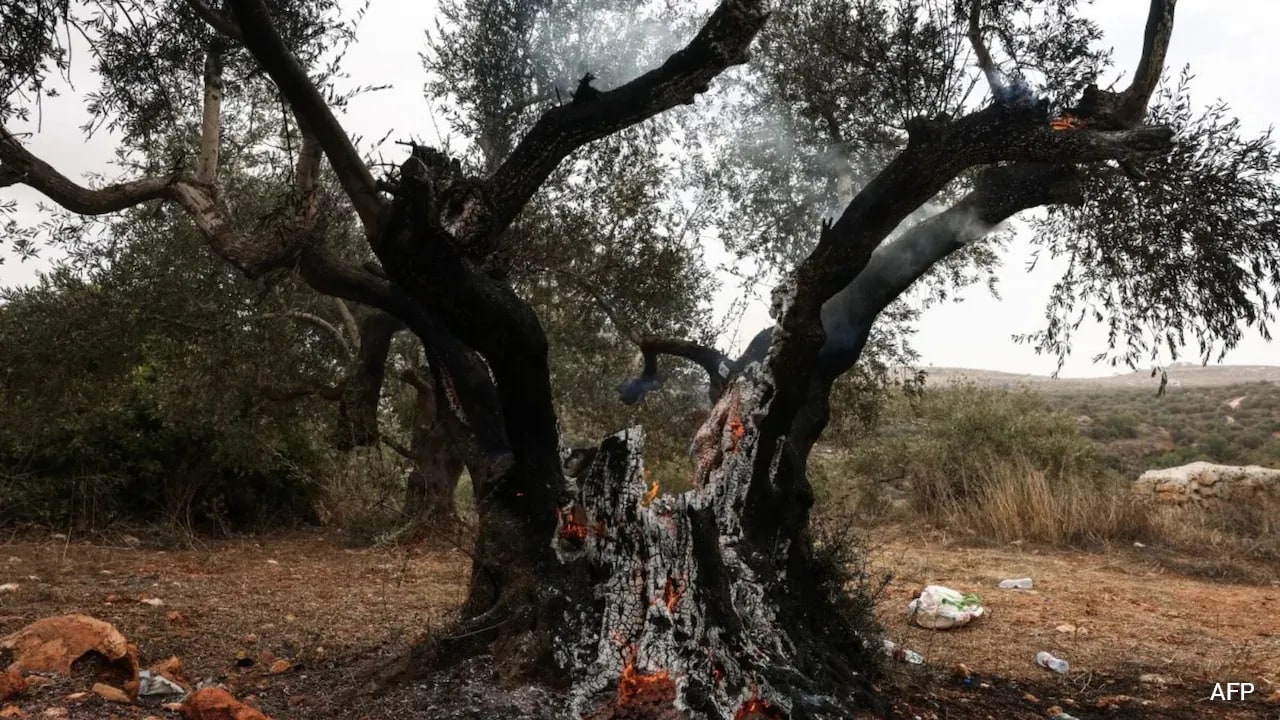
Instead, during harvest season, smoke often rises where ladders should be.
Reports of clashes during the olive harvest in the West Bank surface year after year with a grim, recognizable rhythm: Palestinian farmers tending their groves, confrontations erupting along hillside tracks and near outposts, stones flying across rocky terraces, orchards scorched by fire, crops damaged or lost, and patrols or security forces arriving after tension has already spilled over. Reading a short wire report can make the whole thing feel like weather—something terrible happening somewhere else, reducible to a headline about trees burning and rocks thrown.
Weather, though, doesn't have motives. People do. Fear does. Grief and land and memory do.
I have walked enough dry hillsides in this part of the world to know how quickly heat builds in a place where almost everything is already under pressure. You feel it in your calves climbing terraced stone walls that have slipped out of alignment. You feel it in your throat from fine white dust kicked up by boots on limestone. Even on a quiet morning, there is an edge in the air—a sense that any conversation can turn sharp if someone steps past an unspoken line.
Let me be honest with you right away: I am not standing in every grove on every ridge, and I cannot pretend every single incident unfolds identically. Facts on the ground in disputed, overlapping spaces can be contested, messy, and fiercely argued over. Anyone who claims total certainty about every stone thrown or every spark lit is selling simplicity where none exists. Still, certain patterns repeat with enough consistency that ignoring them requires willful blindness.
To understand what a burned tree or a thrown stone actually means—beyond the bare bones of a news brief—it helps to step inside the moment with people who feel the weight of it. The characters that follow are hypothetical composites built from documented patterns and real-world accounts of West Bank harvest seasons. I am naming them as hypothetical scenarios so you know where lived composite storytelling meets broader reality.
The Grove Above the Ridge
In this hypothetical scenario, call the farmer Tariq. He is fifty-four, with knuckles swollen from decades of pruning and lifting crates, and a habit of rubbing silver-green leaves between his thumb and forefinger before he decides which branches need thinning.
To Tariq, the grove on the upper slope is not a "real estate asset" or a "talking point." It is his father's backache. It is the winter his sister paid for university tuition with oil pressed from those exact trees. When a mature olive tree burns, it doesn't just lose this year's harvest. An olive tree can sprout again from its roots if the crown is charred, yes—nature in this region is stubborn—but years of yield vanish in an afternoon. That lost yield isn't an abstract line on an economic chart. It is cash that won't be there when medical bills arrive or school fees come due.
Consider what happens next when Tariq and his family arrive early in the morning with plastic sheets and harvest rakes.
Maybe they have coordinated through local organizers or local authorities to access land near a settlement or an unauthorized outpost. Maybe they haven't. Either way, the geography is intimate and unforgiving. A ridge that looks peaceful in morning light can hold people watching from above.
In a second hypothetical scenario, imagine Noam, a young man living in a nearby hilltop outpost. Perhaps he grew up hearing stories of attacks, bus bombings, or family trauma, or perhaps he was raised in an ideological circle that views every dunam of land as a sacred front line in a cosmic struggle. To him, the hillside isn't Tariq's family inheritance; it is contested ground where backing down feels like surrender, and where confrontation is framed as defense or assertion of sovereignty.
Two people can look at the same rocky slope and see two entirely different worlds.
That collision of worlds is where violence finds oxygen.
A shout echoes across the terrace. Someone appears on the crest above. Then comes the dry, sharp crack of a rock hitting stone—or hitting wood, or hitting flesh. A jerrycan or a torch meets dry grass and low scrub near the trunks. Smoke curls upward, thin at first, then thicker as heat catches dry twigs and fallen leaves.
Fear.
It hits before pain. Your chest tightens. Your eyes dart toward exits and cover. Suddenly a harvest—supposed to be slow, communal, almost meditative work—turns into a scramble to gather buckets, pull family members back, and figure out who is throwing what from where.
Why Stones and Fire Keep Returning
Why do rocks and fire show up so often in these stories?
Think of the tools at hand. A hillside in the West Bank is practically made of loose limestone. You don't need a supply line to pick up a rock. You stoop, your fingers find a jagged edge, and within seconds you have a projectile. It is primitive, immediate, and terrifying at close range—capable of cracking a windshield, breaking a collarbone, or sending people fleeing in panic.
Fire works differently. Fire is fast and destructive out of proportion to the effort required to start it. A match, a lighter, an accelerant tossed into dry brush on a breezy afternoon—and suddenly something that took decades to grow is blackened in minutes. For those who want to drive farmers away, disrupt the harvest, or send a message of intimidation without standing face-to-face for an hour, fire does the heavy lifting.
And yet, reducing the entire dynamic to "bad actors on one side" or "victims on the other" misses the broader machinery keeping the tension alive.
Look at the environment around the groves. Friction often flares where settlement expansion, military checkpoints, road restrictions, access denials, and long-standing grievances intersect. Farmers frequently describe needing special coordination or permits just to reach plots near settlements, sometimes finding paths blocked, gates locked, or access delayed until the best picking window has passed or fruit has dropped and spoiled. Meanwhile, residents of settlements and outposts often point to their own security fears, stone-throwing incidents on roads, or a sense of abandonment or hostility from surrounding villages.
When law enforcement or security forces arrive late—or when accountability feels uneven or distant—people start taking matters into their own hands.
Once people believe no one else will protect them or enforce order, escalation becomes a habit.
The Invisible Stakes Beneath the Headlines
Headline news is built for speed, not depth. A short report tells you trees burned and rocks were thrown during the olive harvest. Fair enough—that's the event.
What gets left behind on the cutting-room floor are the quieter casualties.
First, there is livelihood erosion. Agriculture in the West Bank already faces steep hurdles: water access disparities, fragmented plots, transport delays, market fluctuations, and rising input costs. Olive farming is seasonal and labor-intensive; miss a narrow stretch of autumn weather, or lose trees to arson and vandalism, and the financial dent lingers well into the next year. For families already living close to the margin, one bad harvest can force tough choices—taking on debt, cutting back on food or healthcare, or abandoning distant plots altogether because going there feels too dangerous.
Second, there is psychological wear. Living with chronic low-grade dread changes how a person moves through the world. A farmer stops going to the far terrace alone. A mother watches the ridge instead of watching the bucket fill. A teenager grows up assuming neighbors across the valley are enemies rather than people. Over years, that tension hardens into muscle memory.
Third, there is the erosion of trust in institutions. When residents on either side feel that rules aren't applied fairly, that grievances go unanswered, or that violence carries little real consequence, faith in law and civic order frays. And when faith in order frays, extremists on every fringe gain room to maneuver.
Sometimes I catch myself wondering how a conflict over land and identity can stay so stubbornly locked in place decade after decade. It can feel overwhelming—almost like watching a train heading toward a switch that nobody can reach in time. If you feel a wave of cynicism or fatigue reading about another flare-up during harvest season, you aren't alone. Plenty of people who live right next to these events feel exhausted by the cycle too.
A Different Way to See the Same Hill
If we want to understand why this matters beyond a single news cycle, we have to look at what an olive grove represents in human terms.
In a purely transactional view, an olive tree is just biomass and calories. You can calculate the market value of a few hundred kilos of olives or the replacement cost of sapling stock.
In a human view, a tree planted by a grandfather is a bridge between generations. Harvesting it together is a ritual that says: We are still here. The seasons still turn. Our family still holds together.
When someone sets fire to that grove or pelts harvesters with stones, they aren't just attacking property. They are attacking continuity. They are trying to break the thread connecting past, present, and future.
Conversely, when a harvest happens peacefully—when families gather fruit without fear, when disputes are contained before stones fly or matches strike—something quiet and radical happens, too. Normal life wins an afternoon.
That doesn't solve the political conflict. Nobody should pretend a peaceful afternoon in an orchard erases decades of displacement, security fears, sovereignty disputes, or deep political divides. Big problems require real policy, real security for everyone, real accountability, and serious political courage.
Still, peace doesn't usually arrive all at once like thunder. Often, if it comes at all, it starts small—in restraint where there could have been a rock, in protection where there was neglect, in refusing to let fear turn every neighbor into a monster.
What Remains After the Smoke Clears
Picture the slope the day after a clash.
The air is cooler now. A breeze moves across the limestone ledges, carrying the faint, bitter tang of charred bark mixed with the clean, green scent of crushed leaves left on the ground. A few overturned buckets lie near a stone wall. A blackened patch marks where heat crept up toward a low branch, leaving crisp brown leaves beside untouched silver-green ones just inches away.
Somewhere nearby, an olive tree still stands with its roots gripping the rock.
Fire can blacken the surface. Stones can bruise the bark and rattle the nerves of everyone on the ridge. Yet the deeper question—the one that decides whether the next autumn brings more smoke or a full basket—is whether the people standing on those hills choose escalation or restraint when the tension rises again.