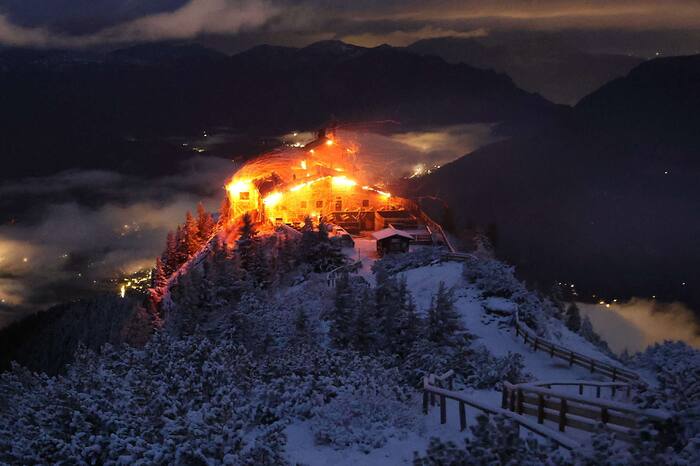
Smoke does not care about history.
High above the Bavarian town of Berchtesgaden, at an elevation of 1,834 meters where the air is thin enough to make your lungs ache after ten brisk paces, thick gray plumes began curling out from beneath the heavy timber eaves of the Kehlsteinhaus before dawn. By the time the first fire trucks fought their way up the steep, hairpin switchbacks of the Kehlsteinstrasse—a road blasted straight through solid alpine rock in thirteen frantic months during 1937 and 1938—the flames had already found the dry, resin-rich larch wood paneling inside. For an alternative look, check out: this related article.
Firefighters in heavy turnout gear dragged hoses across granite flagstones that were quarried by forced laborers nearly ninety years ago. Water froze in the shadows while embers drifted over the precipice toward the Königsee below. Within hours, the roof of the mountain retreat known globally as the Eagle’s Nest was gutted, its interior reduced to charred beams and sodden ash, and local police had taken a single suspect into custody on suspicion of arson.
To read the initial wire reports, you would think a historical monument had simply suffered an unfortunate municipal accident. One suspect detained. Roof destroyed. Investigation ongoing. Further coverage on the subject has been provided by Associated Press.
That clinical summary misses the entire weight of the mountain. Because when fire touches a building constructed as a fiftieth-birthday gift for Adolf Hitler, the flames do not just consume wood and mortar. They ignite an eighty-year argument over what a civilized society is supposed to do with the physical architecture of evil.
The Architecture of Intimidation
I stood inside that octagonal reception room three autumns ago, nursing a lukewarm coffee and watching a tour bus unload forty teenagers from Munich.
You cannot understand the Kehlsteinhaus until you feel the coldness of its granite. Martin Bormann, Hitler’s private secretary and the ruthless architect of the Nazi Party’s administrative machinery, spared neither money nor human lives to build it. Twelve workers died during its construction, falling from sheer cliffs or crushed by premature dynamite blasts, all so the German dictator could have a diplomatic teahouse perched literally above the clouds.
The engineering was meant to break your sense of scale before you even spoke a word. Visitors had to pass through heavy bronze double doors, walk down a 124-meter tunnel carved into the mountain's core, and step into an elevator lined with polished brass and Venetian mirrors. In forty-one seconds, that lift carried you the final 124 meters straight through the rock into the heart of the chalet.
Hitler himself actually hated the place. He suffered from severe vertigo, feared the elevator would be struck by lightning, and complained that the thin mountain air gave him headaches. He visited fewer than fifteen times, leaving the terrace mostly to Eva Braun and visiting dignitaries who were meant to look out over the Bavarian Alps and feel entirely insignificant.
Standing there in that octagonal room, staring at the red marble fireplace gifted by Benito Mussolini, I felt a strange, unsettling vertigo of my own—not from the altitude, but from the realization that the view was breathtaking. The jagged limestone peaks of the Watzmann massif glowed pink in the late afternoon sun. Hawks rode the thermals just meters from the terrace wall.
And that is the trap of the Kehlsteinhaus.
The Paralysis of Preservation
Consider a hypothetical visitor—let us call her Clara, a high school history teacher from Stuttgart who brings her tenth-grade class up the mountain every spring.
Clara does not bring her students to Berchtesgaden to admire Nazi engineering, nor does she want them taking smiling selfies against the alpine backdrop. She brings them there because teenagers read about fascism in textbooks and assume it looked like a dark, shadowy villain's lair from a movie. When they step onto the terrace of the Eagle’s Nest, they discover something far more disturbing: tyranny wrapped itself in sunlight, fresh mountain air, and exquisite stonework.
Now ask yourself what happens to Clara’s lesson when the roof burns down.
For decades, Bavarian authorities have walked an impossible tightrope with the remnants of the Third Reich. Tear the buildings down completely, and you risk erasing physical proof of the regime's megalomania, handing fuel to denialists and leaving behind empty hills that neo-Nazis quietly turn into secret pilgrimage sites. Leave the buildings standing untouched, and you risk maintaining shrines for extremists who still mail postcards to Berchtesgaden every April 20th.
Bavaria chose a third path: aggressive, almost stubborn banality.
After Allied bombers flattened the surrounding Obersalzberg complex in April 1945—sparing the Eagle’s Nest largely because its narrow ridge made it nearly impossible to hit from the air—the state eventually turned the Kehlsteinhaus into a mountaintop restaurant. You could order bratwurst and sauerkraut in the same room where Nazi ministers once toasted the invasion of Poland. The proceeds went directly to local charities. The history was deliberately stripped of its dark glamour and served alongside potato salad.
It was a clever psychological defense mechanism, turning a temple of authoritarian power into a mundane tourist cafeteria. Yet it never fully erased the tension humming beneath the floorboards. Every year, roughly 300,000 people rode those specialized mountain buses to the summit. Most were ordinary travelers drawn by the scenery and the weight of twentieth-century history. A quiet, persistent fraction were not.
What Fire Actually Destroys
When arson strikes a site like this, the public reaction splits immediately along predictable, emotional fault lines.
On one side, you hear a quiet sigh of relief. Let it burn, some argue. The stones were tainted from the moment the first pickaxe struck the mountain in 1937. Why spend millions of euros maintaining the vanity project of a genocidal regime when schools need roofs and bridges need steel?
On the other side sits a deep, gnawing anxiety among historians, educators, and survivors' families.
Think of the Kehlsteinhaus as a scarred witness in a courtroom. You do not have to like the witness. You certainly do not celebrate the crimes the witness saw. Yet if someone silences that witness before the next generation hears the testimony, the truth becomes slightly easier to distort.
I remember talking to an elderly archivist in Munich years ago who spent his career cataloging confiscated Nazi blueprints. I asked him why he bothered preserving the mundane architectural drawings of party rally grounds and alpine retreats. He looked at me over the rim of his glasses and admitted something I have never forgotten: he was terrified that once the last living survivor of the camps passed away, only the physical concrete and stone would remain to prove to cynical future generations that the madness was real, massive, and built by ordinary hands.
That fear feels sharper tonight than it did a week ago.
We do not yet know the motives of the suspect currently sitting in a Bavarian holding cell. Investigators are sifting through scorched insulation, melted wiring, and the remnants of accelerants, trying to determine whether this was an act of misguided anti-fascist vandalism, an extremist provocation, or the senseless impulse of someone seeking notoriety.
Whatever the motive, the result is the same. Fire is an indiscriminate editor. It does not separate the propaganda from the warning. It turns everything—the Mussolini marble, the forced laborers' masonry, the post-war charitable restaurant, the classroom where Clara taught her students how seduction and power work together—into identical gray dust.
The Weight of the Empty Ridge
Bavarian officials will soon face a grueling decision that carries far more political weight than a standard insurance claim.
Rebuilding the Eagle’s Nest in the twenty-first century sounds grotesque on its face. No elected official in Germany wants their signature on a budget line authorizing funds to restore Adolf Hitler’s mountain teahouse. The headlines practically write themselves, and they are brutal.
Yet leaving a blackened, roofless skeleton atop the Kehlstein presents an equally toxic problem. Ruins have a romantic pull that intact cafeterias do not. A burned-out shell high in the Alps looks dramatic, tragic, and mythic—precisely the visual aesthetic that fascist propaganda thrived on in the 1930s. If you abandon the ruin to the wind and snow, you hand the mountain back to the shadows.
Perhaps the answer lies not in restoring the larch wood paneling to its 1938 appearance, nor in bulldozing the granite into the valley below. Perhaps the fire forces Germany to finally stop hiding the building's origins behind bratwurst and tourist postcards, turning the scarred masonry into an open-air, unvarnished documentation center—a place where the roof is gone, the sky is bare, and the cold alpine wind blows straight through the bones of a failed empire.
Tomorrow morning, the sun will rise over the Berchtesgaden Alps just as it did before the first match was struck. The mist will burn off the Königsee. Down in the valley, the buses will sit parked in neat rows, their engines cold, waiting to see if anyone still wants to climb the mountain.
Up on the ridge, the granite walls are still standing, blackened by soot, smelling faintly of wet ash and pine, waiting to see what the living decide to do with the ghosts they refuse to bury.