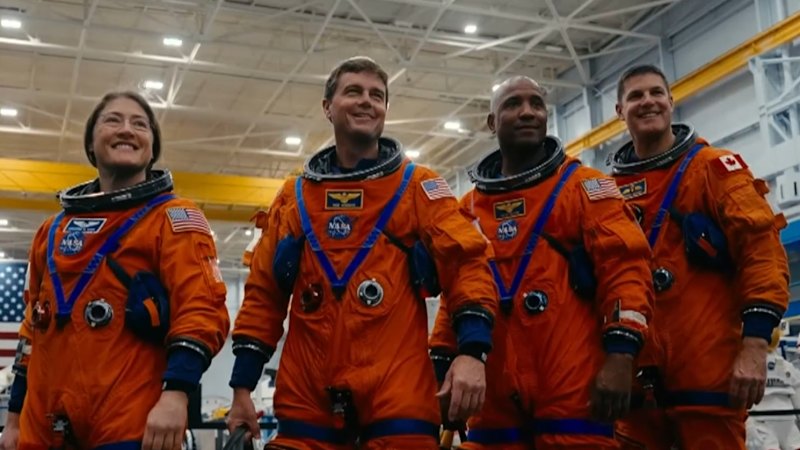
The four astronauts of the Artemis II mission are currently sitting in a high-tech bubble. They aren't in space yet. They're in Florida, waiting for a rocket that will carry them further from Earth than any human has traveled in over fifty years. This isn't just about avoiding a cold. It's about protecting a multi-billion dollar timeline that cannot afford a single sneeze.
If you’ve followed NASA missions before, you know the drill. But this time feels different. The stakes for Artemis II are massive. We aren't just going to "visit" the moon anymore. This mission is the stress test for everything that comes next—the Gateway station, the lunar base, and eventually, the long haul to Mars. During their final pre-launch Q&A, the crew looked remarkably relaxed for people about to sit on top of a controlled explosion.
The Brutal Reality of Pre-Flight Isolation
Quarantine sounds like a vacation until you're actually in it. For Commander Reid Wiseman, Victor Glover, Christina Koch, and Jeremy Hansen, these final days are a psychological balancing act. They’re effectively cut off from the world they’re about to leave behind. NASA calls it "Flight Crew Health Stabilization." I call it the ultimate sensory deprivation before the ultimate sensory overload.
The logic is simple. You can't perform a medical evacuation from the far side of the moon. If one crew member develops a viral infection three days into the mission, the entire $4 billion flight is compromised. The Orion capsule is a cramped environment. Germs don't just sit there; they circulate. In microgravity, your immune system actually behaves differently, often becoming less effective.
We saw this during the Apollo era. Apollo 7 commander Wally Schirra developed a severe head cold in orbit. It was a nightmare. In zero-G, your sinuses don't drain. Every cough is painful. The crew became irritable, even arguing with mission control over reentry procedures. NASA learned its lesson. Now, we lock them away.
Breaking Down the Artemis II Mission Profile
Most people think this is a landing mission. It isn't. Artemis II is a "hybrid free-return trajectory." Basically, they’ll use Earth’s gravity to slingshot around the moon and come right back.
It sounds simple. It’s not.
They’ll spend about ten days in space. The first twenty-four hours are the most critical. They’ll stay in a high Earth orbit to test the life support systems. If something breaks, they can still de-orbit and land back home quickly. Once they commit to the lunar TLI (Trans-Lunar Injection) burn, there’s no turning back. They are committed to the loop.
Christina Koch mentioned during the Q&A that they’ve been training for every "off-nominal" scenario imaginable. That’s NASA-speak for "when things go sideways." They’ve practiced manual piloting in case the automated docking systems fail. They’ve practiced emergency medical procedures. They’ve even practiced how to handle the psychological strain of seeing the Earth shrink to the size of a marble.
Why Jeremy Hansen’s Seat Matters
This mission isn't just a NASA victory. It’s an international one. Jeremy Hansen is representing the Canadian Space Agency (CSA). This marks the first time a non-American will leave low Earth orbit.
Canada didn't get this seat for free. They earned it by building the Canadarm3 for the future lunar Gateway. It’s a smart move. By bringing international partners into the fold, NASA ensures that the Artemis program is harder to cancel when political winds shift. It makes the moon a global destination rather than a national trophy case. Hansen’s presence in the quarantine quarters is a testament to a decade of grueling training and diplomatic maneuvering.
The Tech That Keeps Them Alive
The Orion spacecraft is a beast compared to the old Apollo command modules. It’s got more volume, better computers, and a heat shield designed to withstand 5,000 degrees Fahrenheit.
- Radiation Protection: Deep space is a radiation nightmare. Orion has specialized shielding, and the crew has protocols to create a "storm shelter" inside the cabin using water bags and cargo if a solar flare hits.
- Communication: They’ll be using the Deep Space Network. During the Q&A, the crew talked about the lag. It’s only a few seconds, but it’s enough to make a normal conversation feel disjointed.
- Life Support: This is the big one. They are testing the scrubbers that remove CO2. If these fail, the mission ends early.
What Happens When They Step Out of That Door
When the quarantine ends, the walk to the Astrovan is one of the most iconic moments in flight. It’s the last time they’ll breathe Earth’s natural atmosphere for nearly two weeks.
They’ll head to Launch Complex 39B. The SLS rocket—the Space Launch System—will be waiting. It’s the most powerful rocket ever built by NASA. Generating 8.8 million pounds of thrust, it’s a monster. The crew isn't just excited; they're focused. You could see it in Victor Glover’s eyes during the session. He’s the pilot. His job is to ensure that Orion performs exactly as the engineers promised.
The transition from the sterile silence of quarantine to the bone-shaking roar of the SLS is a violent one. It’s a shift from total control to total physics.
Your Next Steps to Follow the Mission
The launch window is approaching fast. If you want to actually understand what’s happening instead of just watching the pretty lights on the news, do this. Download the NASA app and look for the Artemis II flight path visualization. It shows you exactly where the "free-return" happens.
Monitor the weather reports for the Kennedy Space Center. Florida weather is notorious for scrubbed launches. If you see a 40% chance of "Probability of Violation" (POV), start prepping for a delay. This mission is too important to rush. We waited fifty years; we can wait another day for a clear sky.