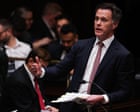
Politics loves a spectacle. We are conditioned to expect the grand theater of public humiliation, the flashing cameras, the raised voices across a scorched-earth parliament floor, and the dramatic declarations of victory or defeat. When an opposing party faces public corruption inquiries, the playbook is usually predictable. The opposition leader steps up to the microphone, grins for the television crews, and milks the moment for every drop of political capital it is worth. They gloat. They demand resignations. They turn a courtroom drama into a circus.
Chris Minns chose a different path.
When the Independent Commission Against Corruption turned its magnifying glass toward the internal affairs of the Liberal Party, the New South Wales Premier did something startling. He stayed quiet. There were no victory laps. There were no smug soundbites delivered with an arched eyebrow for the evening news. Instead, while the media machine chased the flashing lights of the inquiry rooms, Minns simply went to work. He picked up the broom.
To understand why this matters, you have to step away from the podium and look at how trust actually decays.
Trust is not lost in a single, catastrophic explosion. It leaks away slowly, through a thousand tiny fractures. A developer dinner here, an unvetted appointment there, a blurred line between public duty and private advantage. By the time an inquiry gets underway, the public is already exhausted. They are tired of the posturing. They are tired of watching leaders treat systemic institutional failure as a team sport where winning points matters more than fixing the broken machinery of government.
Imagine sitting in a modest kitchen in Western Sydney on a rainy Tuesday evening. The kettle is whistling, but the person pouring the water is distracted. They are staring at a smartphone screen, reading yet another headline about investigations, expenses, and secret meetings. There is no anger left in them, only a heavy, dull fatigue. They do not care which political color is currently wearing the stain of scandal. They only care that the potholes on their street remain unfilled, that the local hospital wait times are stretching past midnight, and that the people running the state seem entirely disconnected from the reality of paying a mortgage or buying groceries.
When politicians posture, they mock that kitchen table fatigue.
Minns understood this unwritten truth. Gloating over an opponent’s misfortune might score a momentary headline, but it fundamentally insults the voter. It says, Look at how bad they are, while distracting from the harder, dustier labor of proving that your own side can actually govern with integrity.
So, he took out the trash.
What does that look like in practice? It looks like unglamorous administrative reform. It looks like tightening procurement guidelines, reviewing ministerial accountability frameworks, and strengthening the oversight bodies that politicians usually try to starve of funding. It is the bureaucratic equivalent of cleaning out a neglected garage. Nobody writes poetry about organizing old paint cans. Nobody holds a ticker-tape parade for a revised code of conduct. But without that work, the whole structure eventually rots from the inside out.
Consider the physics of political momentum. When your rival trips over their own shoelaces, the natural instinct is to point and laugh. But physics tells us that every action has an equal and opposite reaction. If you spend your energy mocking the fallen, you are standing still. While Minns kept his mouth shut, his administration quietly focused on delivery. They leaned into the boring stuff. Infrastructure planning, service delivery, and institutional hygiene.
There is an old saying among master carpenters: measure twice, cut once, and never let the client see you sweat.
Modern political consultants hate that advice. They want drama. They want a narrative arc featuring villains and heroes, complete with cinematic showdowns. But real governance is rarely cinematic. It is administrative. It is tedious. It requires a level of emotional discipline that most high-profile leaders simply do not possess. To watch your political rivals self-destruct and actively choose not to dance on their grave takes a rare kind of tactical patience.
It also takes a profound understanding of public psychology.
Voters have developed an acute radar for insincerity. They can smell opportunistic outrage from a mile away. When a leader feigns shock at corruption while quietly benefiting from the same broken system, the public feels it. By refusing to play the glee card, Minns reframed the entire dynamic. He positioned himself not as an opportunistic challenger waiting to kick a man while he was down, but as the adult in the room who simply wants the mess cleaned up so everyone can get back to work.
That contrast is devastatingly effective.
You do not need to shout when your opponent is whispering their own undoing. You just need to be standing firmly on the other side of the room, holding a trash bag and a broom, looking entirely unimpressed by the mess.
History is littered with politicians who won the daily news cycle and lost the long game. They traded lasting credibility for a quick viral clip. They won the argument and lost the state. The leaders who endure, the ones who genuinely shift the trajectory of a community, are those who understand that power is a stewardship, not a weapon.
The inquiry rooms will eventually close. The transcripts will be archived. The television crews will pack up their cables and move on to the next crisis.
What remains when the lights go out is the state of the machinery itself. Is it cleaner? Does it work better for the person sitting at that kitchen table? Can the nurse, the teacher, and the small business owner trust that the rules apply equally to everyone, regardless of who is sitting in the premier's chair?
Those are the questions that cannot be answered with a witty retort in front of a camera. They can only be answered by what happens when nobody is clapping.
Minns didn't gloat. He just swept the floor. And in a world drowning in noise, silence has never been so loud.


