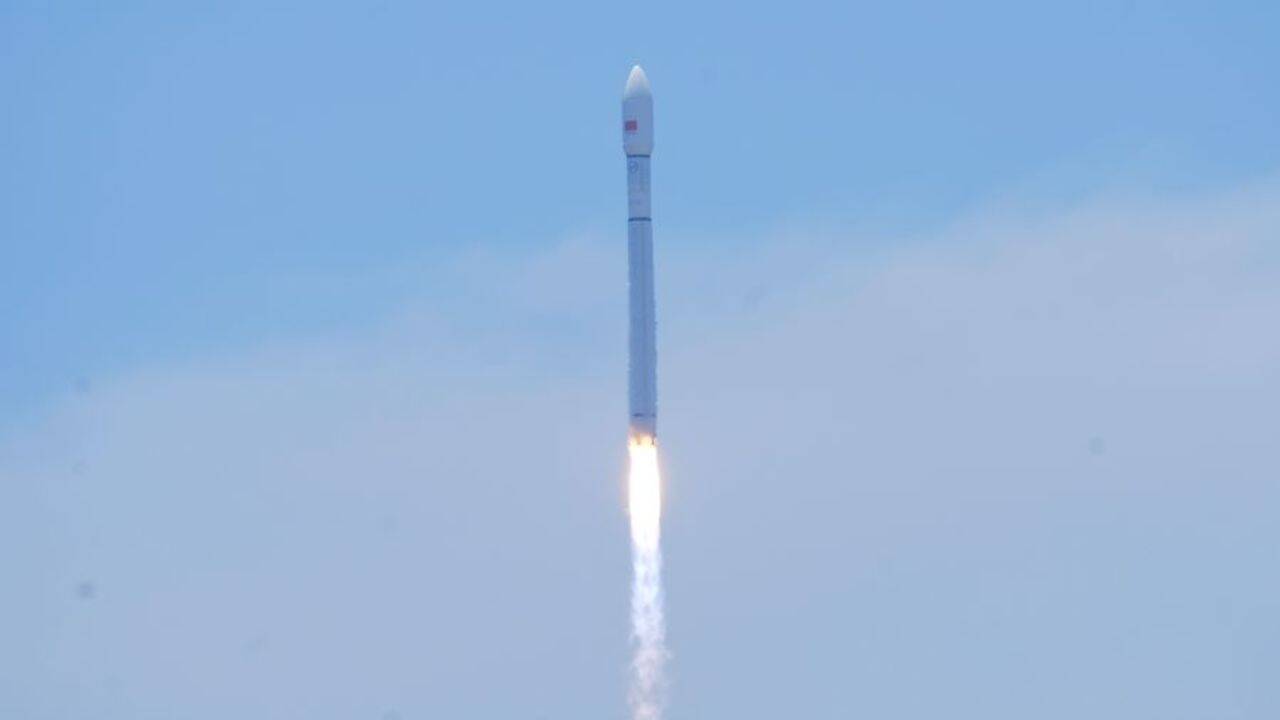
Deploying the twenty-fourth batch of low Earth orbit internet satellites via a Long March-12 vehicle from the Wenchang commercial space site in Hainan highlights a structural transformation in national space infrastructure. Stripping away surface-level reporting reveals a rigorous industrial equation: orbital shell density, medium-lift launch cadence economics, and the physics-bound constraints of commercial spaceport throughput. Understanding how state-directed megaconstellations scale requires examining the underlying engineering variables rather than treating individual launches as isolated milestones.
The Tripartite Mechanics of Megaconstellation Scaling
Building a functional low-latency broadband network from space depends on three core engineering variables: launch cadence frequency, orbital plane distribution, and mass optimization per payload fairing.
- Launch Cadence Frequency: Sustaining a high-frequency flight schedule demands modular launch vehicles that bypass the long refurbishment timelines typical of heavy-lift, man-rated systems. The Long March-12 utilizes kerosene and liquid oxygen propulsion configurations specifically engineered for rapid processing intervals.
- Orbital Plane Distribution: Satellites cannot be deployed into a single orbital ring without creating severe coverage gaps. Sequential batches like the SatNet LEO Group 24 require precise insertion parameters to populate multiple inclined orbital planes, ensuring continuous ground-station visibility.
- Mass Optimization: Payload mass fractions dictate constellation economics. Maximizing the number of flat-packed or stacked satellites per fairing directly lowers the capital expenditure per operational node in orbit.
[ Launch Infrastructure ]
       │
       ▼
[ Medium-Lift Vehicle (LOX/Kerosene) ]
       │
       ▼
[ Multi-Plane Orbital Insertion ]
       │
       ▼
[ Latency & Global Coverage Density ]
The Economic Cost Function of Commercial Spaceports
Geographic positioning dictates launch efficiency. The Hainan Commercial Space Launch Center provides an equatorial advantage, utilizing Earth's rotational velocity to boost payload capacity into low-inclination orbits while maintaining safety corridors over open water.
Operating a dedicated commercial spaceport introduces fixed-cost amortization challenges. To drive down the marginal cost per kilogram to orbit, launch complexes must shift from custom integration models to high-throughput industrial assembly lines. Pad turnaround times dictate overall network velocity. If launch pad clearance requires weeks of manual diagnostic testing, downstream constellation completion stalls, regardless of how many satellites wait in inventory.
Orbital Congestion and Frequency Allocation Bottlenecks
Placing thousands of nodes into low Earth orbit generates immediate systemic externalities. The primary operational ceiling is no longer manufacturing capacity; it is regulatory spectrum coordination and orbital collision avoidance.
International Telecommunication Union filings require operators to demonstrate actual deployment progress to secure frequency rights, creating a structural incentive for rapid, high-volume batch launches. However, packing low-altitude shells introduces severe tracking complexities. Autonomous station-keeping propulsion systems consume a finite propellant budget, capping operational lifespans and forcing operators to budget for continuous replacement cycles.
Strategic Outlook for Mega-Scale Infrastructure
The acceleration of state-backed commercial networks shifts competitive dynamics from technological proof-of-concept to industrial supply chain resilience. Long-term constellation viability depends on minimizing single points of failure across both ground infrastructure and upper-stage manufacturing. Operators that decouple rocket engine production lines from custom vehicle configurations will sustain the deployment velocity required to achieve continuous global coverage.


