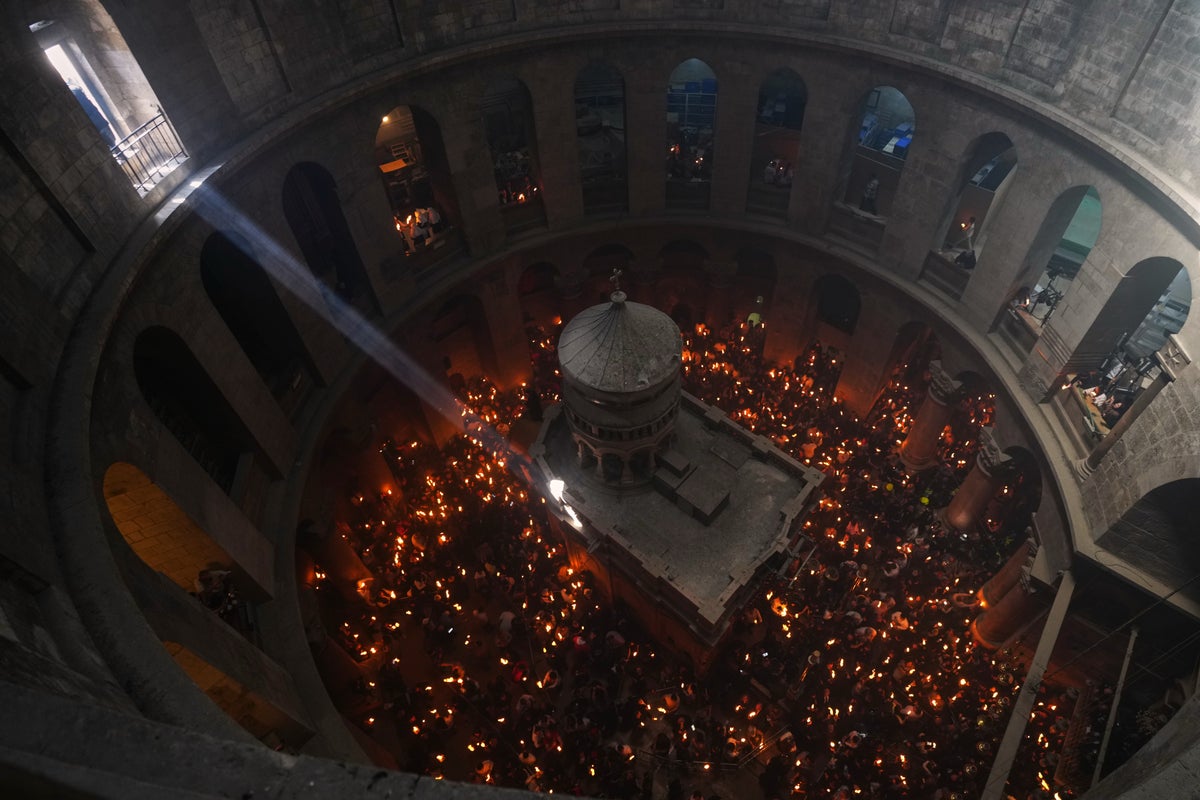
The physical enclosure of the Church of the Holy Sepulchre in Jerusalem is governed by a rigid legal and operational framework established centuries ago to manage intractable sectarian conflict. When the heavy wooden doors are bolted from the outside each evening, a complex jurisdictional mechanism shifts into effect. This nightly lockdown transforms a heavily contested multi-denominational asset into a controlled, closed-system environment. Analyzing this transition reveals how institutional governance, spatial partitioning, and geopolitical shocks dictate the operational reality of one of the world's most scrutinized religious sites.
The Three Pillars of Custodial Governance
Management of the basilica relies on a strict legal framework known as the Status Quo, codified during the Ottoman era in the 19th century. This framework freezes the property rights, cleaning schedules, liturgical hours, and spatial boundaries of the competing Christian denominations inside the structure.
- The Greek Orthodox Church retains primary physical dominance over the central dome and the main katholikon, holding the largest structural footprint within the basilica.
- The Latin Roman Catholic Church, represented operationally by the Franciscan Custody of the Holy Land, manages key administrative quarters and specific altars, including the Chapel of the Apparition.
- The Armenian Apostolic Church maintains jurisdiction over several surrounding auxiliary chapels, while smaller communities such as the Coptic, Ethiopian, and Syrian Orthodox maintain rigidly defined, marginal access rights.
This division creates an operational environment where physical interaction between groups is heavily regulated to prevent friction. The nightly locking ceremony itself requires the participation of an external, neutral agent. Two Muslim families—the Nuseibehs, who hold the key, and the Joudehs, who safeguard it—administer the opening and closing protocols. This historical arbitration prevents any single Christian denomination from claiming absolute structural ownership of the entry threshold, neutralizing a potential flashpoint for sectarian conflict.
The Cost Function of Regional Volatility on Access Metrics
The operational metrics of the basilica are directly correlated with broader geopolitical stability in the Levant. Tourism and pilgrimage volume serve as the primary indicators of health for the local religious economy. Recent conflicts, including regional escalations involving Israel, Hamas, and Iran, have suppressed international travel channels, driving pilgrimage numbers down from pre-pandemic baselines.
This compression of visitor volume alters the internal economy of the site. During peak operational periods, the daytime environment is characterized by high congestion, strict queuing architectures managed by clergy, and short dwell times at primary shrines such as the Edicule and the Stone of Anointing. The high density of tourists generates significant logistical friction, forcing administrators to constantly cycle crowds through the narrow chambers.
Conversely, the nocturnal lockdown represents an operational anomaly. Once the exterior bolts are secured, the population density drops from thousands of daytime visitors to approximately a dozen resident clerics, a small cohort of registered overnight pilgrims, and a transient population of feral cats. This drastic reduction in foot traffic removes the commercial and touristic noise, exposing the raw acoustic and spatial dimensions of the fourth-century architectural layout.
The Mechanics of Spatial Partitioning and Liturgical Rotation
Inside the locked basilica, the spatial layout operates on a time-shared schedule. Because denominations cannot occupy the same altar simultaneously without violating the Status Quo, liturgical actions follow a sequential chain of custody throughout the night.
At approximately midnight, the static silence of the enclosure is broken by the initiation of nocturnal services. The operational sequence proceeds through a predictable timeline:
- Resident Franciscan, Greek Orthodox, and Armenian clergy initiate rolling incensing rounds, visiting each other's primary chapels in an ordered rotation.
- The Greek Orthodox community commences its extensive Divine Liturgy, a four-hour service utilizing the central spaces in front of the Edicule.
- Subsidiary groups, including Coptic and Syrian priests, conduct localized dawn chants at their designated wall-attached altars.
This rotational framework ensures that zero spatial overlap occurs between competing theological factions, maintaining an uneasy equilibrium that has persisted for generations. The architecture forces proximity while the legal framework enforces separation, turning the interior into a micro-laboratory of enforced coexistence.
Strategic Assessment of the Overnight Protocol
For the external observer or registered pilgrim, gaining access to this closed ecosystem offers a rare view of religious infrastructure stripped of commercialized distraction. However, the experience remains bounded by the precise logistical parameters enforced by the resident monastic communities. The strict prohibitions against unmonitored wandering during active liturgies and the mandatory pre-registration vetting process ensure that the institution maintains absolute control over its interior space even when sealed from the outside world.
Future operational stability depends entirely on the resilience of the Status Quo agreement. As long as external geopolitical pressures continue to depress tourist inflows, the internal cadence of the Church of the Holy Sepulchre will rely heavily on its core clerical residents to sustain its daily liturgical output. The nightly ritual of the key remains the sole point of continuity between a fractured modern city and an ancient, immutable sanctuary.