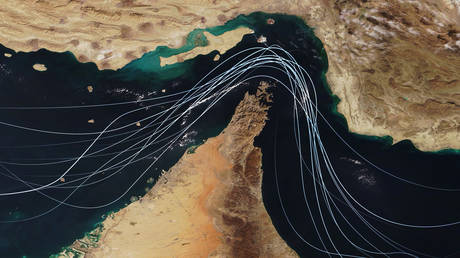
The shipping lanes of the Strait of Hormuz are currently empty, silent, and obscenely expensive. While Washington and Tehran trade frantic public assurances that no maritime tariffs are being collected, the reality on the water tells a completely different story.
The primary conflict is not about whether a toll exists today. It is about who controls the infrastructure of global extortion tomorrow. Discover more on a similar issue: this related article.
On June 24, 2026, President Donald Trump declared on social media that Iran had promised "NO TOLLS" for vessels moving through the chokepoint, threatening to blow up bilateral peace talks in Switzerland if Tehran was lying. Yet, just hours earlier, Oman and Iran released a joint statement confirming they are actively designing a framework to dictate the "future management of navigation" and the "associated costs" of transiting the strait.
What the diplomatic theater hides is a terrifying structural shift. For nearly a century, freedom of navigation was an immutable law of global trade. That era is over. The current crisis has proved that the world's most critical maritime choke points can be converted into tollbooths, setting a precedent that will permanently alter the economics of consumer goods, energy, and sovereign power. More journalism by Al Jazeera highlights similar views on this issue.
The Two Million Dollar Shakedown
To understand how we arrived at this fragile 60-day truce, one must look at the mechanics of the blockade that began on February 28, 2026. Following US and Israeli airstrikes, the Islamic Revolutionary Guard Corps (IRGC) did not just shut the strait with mines and fast-attack boats. They commercialized it.
While Western media reported a total shutdown, a black market for safe passage quietly emerged. Tankers willing to pay up to $2 million per transit were granted military escorts by the IRGC Navy. This was not a standard administrative fee. It was state-sponsored piracy disguised as a regulatory mandate.
The money did not go to an official treasury. It was funneled directly to the IRGC, an organization heavily sanctioned by the US Treasury Department. For an international shipping firm, paying this fee meant committing a federal crime under US sanctions law. For many desperate operators with vessels trapped inside the Persian Gulf, the alternative was bankruptcy.
+------------------------------------------------------------+
|             THE REVENUE ENGINE OF THE CHOKEPOINT           |
+------------------------------------------------------------+
|  Historical Volume:  ~20% of global petroleum, 20% LNG     |
|  Peak Extortion Toll: Up to $2,000,000 per vessel transit  |
|  Sanctions Status:   Directly funds IRGC (SDN/FTO listed)  |
+------------------------------------------------------------+
The current Swiss-brokered memorandum of understanding mandates a 60-day suspension of these charges. But the strategic leverage has already been proven. Iran has demonstrated that a regional power can successfully monetize international waters, exploiting the commercial desperation of global supply chains.
The Guardrail of International Law Shatters
The legal architecture governing the world's oceans was built to prevent exactly what is happening in Hormuz. Under the 1982 United Nations Convention on the Law of the Sea (UNCLOS), the right of transit passage is absolute. Coastal states cannot hamper, suspend, or tax ships navigating through straits used for international navigation.
Iran signed UNCLOS but never ratified it. Oman ratified it, but both nations are now exploring a legal loophole that should alarm every logistics executive on earth.
By recharacterizing tolls as "mandatory maritime service fees" or "compulsory environmental insurance policies," coastal states can effectively bypass international law. They claim the revenue is required to fund navigation aids, oil spill response capabilities, and local security. In reality, it is a sovereign tariff on global GDP.
The danger is the precedent. If the international community legitimizes Iran’s right to charge a fee for passing through Hormuz, the concept of a free ocean collapses.
Consider the Strait of Malacca, the narrow channel between Malaysia, Indonesia, and Singapore that carries more than three times the commercial traffic of Hormuz. Unlike the Middle East, where pipelines can occasionally bypass the water, Malacca has no viable alternative. If the littoral states of Southeast Asia adopt the Iranian model, the cost of moving an electronics container from Shanghai to Rotterdam will instantly double.
The Phantom Openings and Navigational Chaos
On the water, the chaos is compounded by the breakdown of traditional maritime safety protocols. Oman recently announced that the Traffic Separation Scheme—the standard, internationally recognized shipping lanes established by the UN in 1968—is currently unsafe.
In its place, Muscat has designated temporary corridors north and south of the traditional routes to let stranded ships escape. This is a logistical nightmare. Merchant ships are being forced to navigate unmapped paths through waters heavily salted with naval mines and subjected to severe satellite spoofing and GNSS jamming.
   [ Persian Gulf ]
        /      \
       /        \  <-- Iranian Coast (IRGC Speedboats & Missile Sites)
  [ Temporary North Lane ]
  =========================================== [ Disused 1968 Shipping Lane ]
  [ Temporary South Lane ]
       \        /
        \      /   <-- Omani Coast (Muscat Control)
   [ Gulf of Oman ]
When a ship's GPS coordinates are artificially shifted by shore-based jamming stations, the vessel can easily drift into sovereign territorial waters. This provides the perfect legal pretext for boarding and seizure. It is a highly coordinated system designed to project administrative control over an area that international law dictates belongs to everyone.
The Illusion of the Sixty Day Truce
The current diplomatic optimism is built on quicksand. The Trump administration’s strategy relies on financial leverage, specifically offering to buy American agricultural commodities using frozen Iranian assets to alleviate Tehran’s domestic food crisis.
But this leverage is temporary. The fundamental disagreement remains unaddressed. The US demands a permanent return to pre-February freedom of navigation with zero financial friction. Iran and Oman are explicitly planning a post-truce regime where the strait is treated as a joint economic utility.
This creates a ticking clock for global energy markets. Shipowners are currently refusing to send empty tankers back into the Gulf because no insurer will underwrite a voyage where the rules of engagement change every 60 days. The war-risk premiums alone have rendered standard transport unprofitable.
If the Swiss talks expire without a permanent, enforceable ban on maritime fees, the extortion mechanism will return with a vengeance. Iran knows the West cannot endure a permanent energy shock. They have successfully mapped the threshold of global pain, and they are fully prepared to use it again.