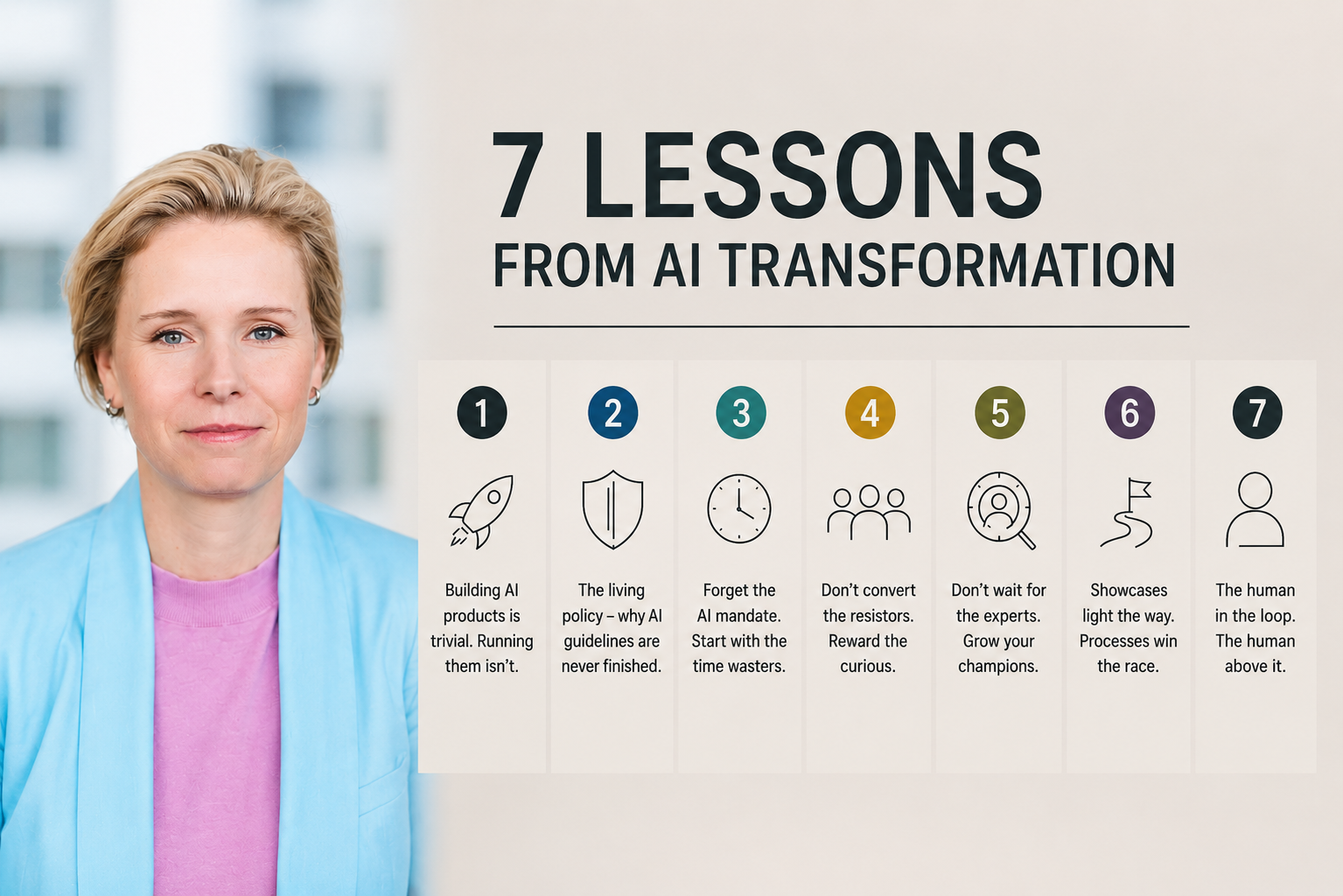
Flashy artificial intelligence demonstrations create a dangerous corporate optical illusion. When an enterprise engineering team builds a standalone generative AI showcase—such as an automated newsletter generator or an internal policy chatbot—executive leadership frequently mistakes this proof-of-concept for scalable operational capability. This error represents a fundamental misunderstanding of structural value creation. Showcases temporarily lower the psychological barrier to technology adoption, but they do not alter the firm’s cost function. Long-term competitive advantage is exclusively a product of deep process re-engineering.
To successfully move from a localized pilot to enterprise-wide margin expansion, an organization must systematically dismantle its legacy workflows and rebuild them with automation at the core. This transition demands a shift in executive focus from isolated software outputs to comprehensive process mechanics. If you liked this post, you might want to look at: this related article.
The Bifurcation of Value: Showcases vs. Systemic Processes
A critical structural bottleneck in legacy enterprises is the confusion between a technological capability and an operational workflow. A showcase is a localized, low-risk demonstration designed to prove that a specific technology can execute a single discrete task. Conversely, a process is an interconnected, repeatable chain of tasks that delivers a predictable corporate outcome.
The divergence between these two concepts governs the actual return on investment for enterprise technology transformations. For another look on this event, check out the recent coverage from The Motley Fool.
The Lifecycle Decay of the Enterprise Showcase
Showcases possess high initial utility for organizational psychology but zero structural utility for operational efficiency. Their primary function is political risk mitigation. By deploying an isolated AI tool, an organization achieves three non-operational objectives:
- De-risking Executive Capital: Demonstrating a tangible output satisfies the board's demand for innovation without requiring structural organizational friction.
- Cognitive Familiarization: Exposing frontline employees to automated interfaces reduces the baseline psychological resistance to future workflow changes.
- Localized Capability Mapping: Revealing the exact boundaries where a specific model or infrastructure setup experiences technical degradation (e.g., context window limitations or token latency).
The failure occurs when leadership treats the showcase as a production-ready asset. A showcase operates in a vacuum, utilizing cleaned, static datasets and bypassing the rigorous compliance, security, and latency requirements of enterprise infrastructure. Relying on showcases as a primary innovation strategy creates a state of perpetual experimentation, consuming capital without driving operating margin improvements.
The Mechanics of Structural Process Re-engineering
Real economic optimization requires what operational theorists define as the complete overhaul of the firm’s internal production function. This means moving past the superficial implementation of software layers to fundamentally redefine how data, labor, and capital interact.
When a media conglomerate or service enterprise integrates generative AI into its core operations, it is not simply replacing a human copywriter with an LLM agent. It is structurally decomposing the workflow into its constituent components: ingestion, synthesis, verification, contextualization, and distribution.
True process optimization requires mapping every single touchpoint, identifying systemic bottlenecks, and building an automated pipeline where human intervention is reserved strictly for high-leverage verification and strategic edge cases. This shift transforms technology from a superficial tool into a foundational infrastructure asset.
The Three Pillars of Enterprise Scale
Transitioning an organization from an experimental framework to an optimized, AI-native operating model requires a disciplined execution strategy. This operational transformation relies on three distinct, structural pillars.
       [ THE THREE PILLARS OF ENTERPRISE SCALE ]
                          │
     ┌────────────────────┼────────────────────┐
     ▼                    ▼                    ▼
[PILLAR 1]           [PILLAR 2]           [PILLAR 3]
Granular Workflow    Systematic Talent    The Architectural
Deconstruction       Upskilling           Feedback Loop
1. Granular Workflow Deconstruction
An enterprise cannot effectively automate what it has not explicitly measured. The initial operational requirement involves breaking down complex corporate workflows into micro-tasks, then categorizing those tasks based on their automation feasibility and strategic value.
Consider the standard operational pipeline for converting raw corporate inputs (such as press releases, financial disclosures, or legal filings) into public-facing content. A legacy organization views this as a single, holistic task executed by a highly paid knowledge worker. A structured approach deconstructs this process into five discrete variables:
- Ingestion and Parsing: Extracting structured data from unstructured legacy formats (e.g., PDFs, audio transcripts).
- Synthesis and Formatting: Condensing the core factual data into predefined structural templates.
- Fact-Verification: Cross-referencing synthesized claims against trusted baseline data sources to eliminate hallucination risks.
- Tone and Brand Alignment: Adjusting the stylistic attributes of the output to match specific organizational or regional guidelines.
- Final Approval and Distribution: Executing human-in-the-loop compliance checks prior to pushing data to external channels.
By decoupling these steps, engineering teams can build targeted automation vectors for the high-volume, low-cognition steps (Ingestion, Synthesis, and Formatting), while retaining human capital exclusively for high-leverage steps (Verification and Strategic Modification).
2. Systematic Talent Upskilling
The second pillar shifts the organizational focus from technology to human capital. A common failure mode in corporate transformation is the top-down mandate, where leadership decrees that all staff must utilize a new tool without altering their underlying performance incentives or structural capabilities.
Organizations must democratize technical competency by turning learning into a portable asset for the employee. Rather than mandating generic training sessions, enterprises should implement micro-credentialing frameworks that travel with the worker. Employees should be incentivized to systematically identify inefficiencies within their own workflows—often structured as internal corporate efficiency challenges—and design the initial prompt-chains or agentic workflows to resolve them.
This approach converts potential operational resistors into internal champions, aligning individual career advancement directly with organizational optimization goals.
3. The Architectural Feedback Loop
The third pillar establishes a continuous improvement mechanism across the entire corporate infrastructure. As automated workflows run at scale, they generate massive volumes of operational metadata: latency telemetry, error rates, prompt performance logs, and human correction frequencies.
An enterprise operating model must capture this data and funnel it directly back into the technical architecture. If metadata analysis reveals that human editors are consistently correcting the output of a specific localized model at the "Tone and Brand Alignment" stage, the system must trigger an automated optimization cycle. This involves updating the underlying system prompt, executing few-shot fine-tuning on the corrected examples, or switching to an entirely different model architecture specialized in stylistic nuances.
Without this feedback loop, an automated system experiences gradual operational drift, rendering it obsolete as market conditions and organizational requirements evolve.
Quantifying the Transformation Cost Function
A primary reason corporate leadership retreats to superficial showcases is the hidden financial friction of deep process integration. True operational re-engineering demands significant upfront capital and creates immediate near-term disruptions. To evaluate the viability of an automation initiative, leadership must calculate the complete operational cost function ($C_{total}$).
The total capital required to transition a legacy workflow to an automated state is expressed by the following mathematical relationship:
$$C_{total} = C_{dev} + C_{infra} + C_{fric} + C_{comp}$$
Where each variable represents a distinct, unavoidable operational expense:
- $C_{dev}$ (Development and Integration Cost): The direct capital required to build API integrations, design custom agent middleware, and connect legacy databases to modern orchestration frameworks.
- $C_{infra}$ (Infrastructural and Computational Run Cost): The recurring variable cost of API tokens, vector database compute, cloud hosting, and underlying fine-tuning pipelines.
- $C_{fric}$ (Organizational Friction and Retraining Cost): The temporary loss of productivity during the transition phase, alongside the direct expenses of employee retraining and micro-credentialing programs.
- $C_{comp}$ (Compliance, Security, and Governance Cost): The capital required to implement data loss prevention (DLP) guardrails, execute legal reviews of model outputs, and ensure compliance with evolving regional data privacy frameworks.
A strategic assessment reveals that while a showcase only incurs a fraction of $C_{dev}$, a true production asset demands heavy investment across all four parameters. If the projected long-term reduction in variable human labor costs does not comfortably clear the amortization of $C_{total}$, the workflow should remain manual.
Organizations must avoid the trap of spending more capital on automating a marginal task than the task itself costs to execute manually over its lifecycle.
Operational Risk Boundaries and Strategy Limitations
No optimization strategy is free of structural vulnerabilities. Before committing capital to comprehensive process automation, enterprise leaders must explicitly recognize and mitigate three specific operational risks.
The Problem of Hardened Inefficiencies
Automating an unoptimized legacy workflow does not resolve its underlying flaws; it merely accelerates them. If a firm's data collection methodology is fundamentally broken or biased, wrapping that pipeline in an automated API layer simply scale-produces flawed data at a higher velocity. Before any software engineering occurs, a rigorous, manual process audit must be executed to strip out redundant corporate checkpoints and legacy bureaucratic bloat.
Model Dependency and Vendor Lock-in
Building an enterprise process entirely around a single proprietary foundational model provider introduces substantial counterparty risk. Model updates can change underlying behavior without warning, breaking highly calibrated prompt structures and agentic systems.
Organizations must deliberately build model-agnostic abstraction layers into their technology stacks. This architecture allows engineering teams to swap underlying models seamlessly based on cost, speed, and accuracy metrics without rewriting the entire operational process.
The Diminishing Returns of the Human-in-the-Loop
As automated systems achieve higher performance levels, human monitors frequently experience cognitive fatigue and complacency. When a system is accurate 98% of the time, human verification steps often degrade into a superficial rubber-stamping exercise. This vulnerability leaves the organization highly exposed to the remaining 2% of complex, high-consequence errors.
Mitigating this risk requires designing active verification protocols, where human operators are randomly prompted with artificial edge cases to audit their actual engagement levels and maintain operational vigilance.
Executing the Post-Showcase Deployment
The definitive play for modern enterprise leadership requires a systematic cessation of low-impact experimentation. To convert existing technical momentum into permanent margin improvement, the corporate roadmap must prioritize structural alignment over superficial innovation.
First, institute an immediate freeze on new standalone showcase funding. Direct all engineering and product resources to audit existing proof-of-concepts, filtering them strictly by their integration capacity into the core enterprise stack. Any showcase that cannot be mapped directly to an existing, high-volume workflow within forty-five days must be archived.
Second, establish a centralized Process Transformation Unit. This cross-functional team must sit at the intersection of enterprise architecture, operational finance, and business unit leadership. The unit's sole mandate is to systematically deconstruct corporate workflows, calculate the complete transformation cost function ($C_{total}$), and deploy scalable, automated pipelines that continuously capture operational metadata.
Value does not reside in the novelty of the technical interface; it is realized in the permanent, quantified reduction of the organization's unit economics. Focus capital execution on the structural plumbing of the firm, where optimized processes consistently outpace experimental showcases.