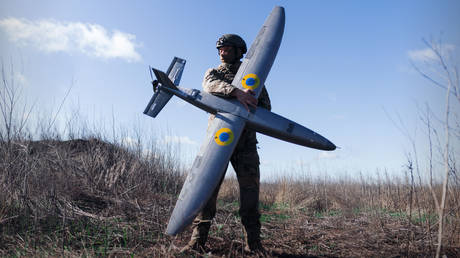
The term Ukrainian drone functions as a political shorthand rather than a technical reality. While the branding suggests a localized industrial breakthrough, the actual value chain reveals a complex assembly of global dependencies, where domestic innovation is concentrated in software integration and airframe design rather than fundamental component manufacturing. The strategic vulnerability of this model lies not in the assembly lines in Kyiv or Lviv, but in the silicon and lithium-ion pathways originating in East Asia. To understand the viability of Ukraine’s drone program, one must move past the optics of "garage-built" heroism and quantify the three distinct layers of its production stack: the imported commodity layer, the domestic integration layer, and the electronic warfare (EW) survival layer.
The Tripartite Model of Production
The production of unmanned aerial vehicles (UAVs) in a conflict zone operates under a different economic logic than civilian aerospace. Speed of iteration and unit cost are the primary variables, often at the expense of long-term durability. This system is defined by three specific tiers:
- The Commodity Tier (Import Dependent): This includes brushless motors, flight controllers, Electronic Speed Controllers (ESCs), and CMOS camera sensors. Ukraine possesses near-zero domestic capacity for high-yield semiconductor fabrication or precision motor winding at scale.
- The Structural Tier (Domestic/Hybrid): This involves the manufacturing of airframes (carbon fiber, 3D-printed thermoplastics, or wood) and the assembly of wiring harnesses. This is where Ukrainian firms have achieved significant scale, moving from artisanal workshops to decentralized industrial facilities.
- The Cognitive Tier (Proprietary Software): This is the most critical domain of domestic value-add. It includes custom flight control firmware (e.g., modified ArduPilot or PX4 stacks), target recognition algorithms, and signal-hopping protocols designed to circumvent Russian jamming.
The operational reality is that a "Ukrainian" drone is essentially a Western or Chinese electronic nervous system encased in a locally manufactured skeleton, powered by a proprietary brain.
The Silicon Bottleneck and the Shenzhen Paradox
The primary contradiction in Ukrainian drone strategy is the reliance on Chinese components to fight a war where China maintains a "no-limits" partnership with the adversary. The supply chain for First-Person View (FPV) drones—the current backbone of tactical operations—is almost entirely routed through the Pearl River Delta.
The core components—specifically flight controllers based on the STM32 microcontroller architecture—are manufactured by global firms but distributed through Chinese hubs. When Beijing imposes export restrictions on "dual-use" technologies, the friction manifests as increased lead times and a 15% to 30% price premium as procurement teams utilize third-party distributors in Poland, Turkey, or the UAE. This creates a "shadow tax" on production that drains the Ukrainian defense budget.
A failure to diversify this layer results in a strategic fragility where a single regulatory shift in Shenzhen could ground 70% of the Ukrainian FPV fleet within 45 days. The bottleneck is not the lack of money, but the physical absence of alternative high-volume, low-cost production lines for 2207-type brushless motors or ELRS (ExpressLRS) radio links.
The Cost Function of Attrition
The economics of drone warfare are governed by the Ratio of Replacement. If a $500 FPV drone can disable a $4 million T-90M tank, the ROI is mathematically undeniable. However, this calculation ignores the systemic costs of human capital and electronic interference.
The cost function of a single drone unit can be expressed as:
$$C_{total} = (C_{kit} + C_{payload} + C_{logistics}) / P_{success}$$
In this equation, $P_{success}$ (the probability of reaching the target) is the most volatile variable. In environments with heavy GPS spoofing and localized radio frequency (RF) jamming, the $P_{success}$ of a standard off-the-shelf drone can drop below 10%. To counteract this, Ukrainian engineers are forced to move up the value chain into more expensive technologies:
- Frequency-Agile Radio Links: Shifting from standard 2.4GHz/5.8GHz bands to non-standard frequencies (e.g., 700MHz-900MHz), which requires custom-tuned antennas and modified receivers.
- Optical Flow and Thermal Imaging: Standard daylight cameras are useless for night operations or in heavy smoke. Integrating thermal sensors (like the FLIR Lepton or Chinese equivalents) triples the base cost of the unit.
- Terminal Guidance AI: To mitigate the loss of the video link in the final meters of an attack (the "cliff effect" of jamming), drones are being equipped with low-power edge-computing chips (e.g., Raspberry Pi Compute Module 4 or specialized AI accelerators) to lock onto targets visually.
As these features are added, the "cheap" $500 drone quickly becomes a $2,000 precision instrument. The challenge for Ukrainian production is maintaining the "cheap enough to lose" philosophy while ensuring the "smart enough to hit" requirement.
Decentralization as a Defensive Metric
Unlike traditional defense contractors (e.g., Lockheed Martin or BAE Systems) that rely on massive, centralized campuses, the Ukrainian production model is hyper-decentralized. This is a deliberate response to the threat of long-range missile strikes.
A single "manufacturer" may actually be a network of twenty distinct workshops. One site prints frames, another assembles PCBs, and a third handles final munitions integration. This modularity ensures that the destruction of a single node does not halt the entire assembly line. However, this decentralization introduces significant quality control (QC) variances.
The lack of standardized testing protocols across these disparate cells leads to high "DOA" (Dead on Arrival) rates at the front lines. The transition from "brave amateurism" to "industrial rigor" requires the implementation of automated testing benches—systems that can simulate flight loads and RF environments—before the drones leave the workshop.
The Electronic Warfare (EW) Arms Race
The battlefield in Ukraine is the first in history where the electromagnetic spectrum is as contested as the physical ground. This has forced a fundamental shift in drone architecture. Russian EW systems, such as the Pole-21 or Zhitel, create "domes" of interference that render standard GPS-guided drones inert.
The Ukrainian response has been the development of "CRPA" (Controlled Reception Pattern Antennas). These antennas use digital nulling to ignore signals coming from the direction of jammers while focusing on legitimate satellite signals. While highly effective, these components represent a significant jump in complexity and cost. They require sophisticated FPGA (Field Programmable Gate Array) programming, a skillset that is in high demand and short supply globally.
Furthermore, the shift toward wired (fiber-optic) drones represents a regression in technology that serves as a masterclass in adaptation. By physically tethering the drone to the operator via a spool of micro-fiber optic cable, the system becomes immune to all forms of radio interference. The trade-off is a reduction in maneuverability and range, but the $P_{success}$ increases to nearly 100% in high-EW zones.
The Human Capital Constraint
While much focus is placed on hardware, the ultimate bottleneck in the Ukrainian drone ecosystem is the "pilot-technician" pipeline. Operating a racing-style FPV drone at 100km/h into a moving target requires hundreds of hours of simulator and flight time.
The production chain is currently outstripping the training chain. Ukraine can produce 50,000 FPV drones a month, but training 5,000 effective pilots in that same window is a much steeper challenge. This creates a surplus of hardware that cannot be effectively deployed, leading to "stockpile rot" where drones become obsolete due to shifting enemy EW frequencies before they are even used.
Strategic Shift: From Assembly to Component Sovereignty
The long-term viability of the Ukrainian drone program depends on its ability to move down the supply chain. This does not mean building a 3nm semiconductor fab—which is economically impossible in the near term—but it does mean localizing the production of:
- Electric Motors: Developing high-torque motors that do not rely on Chinese-sourced neodymium magnets or precision bearings.
- Battery Chemistry: Establishing local assembly of 18650 and 21700 lithium-ion cells to reduce the shipping risks associated with bulk battery transport.
- Proprietary RF Silicon: Designing ASICs (Application-Specific Integrated Circuits) specifically for resilient military communications, rather than relying on repurposed commercial chips.
The current "Ukrainian" drone is a triumph of integration and tactical agility. However, it remains a hostage to global logistics. The next phase of the strategy must focus on "Component Sovereignty"—the ability to maintain a baseline of production even if the Pearl River Delta supply lines are severed.
The immediate tactical priority is the standardization of the "Payload Interface." Currently, dozens of different drone models use non-standardized mounting and triggering mechanisms for munitions. By enforcing a universal hardware and software interface (a "NATO rail" for drone software), Ukraine can decouple the development of the "carrier" from the "effecter." This allows for faster iteration of specialized warheads—thermobaric, shaped charge, or fragmentation—without needing to redesign the drone airframe for every mission profile.
The competitive advantage in this conflict will not go to the nation that builds the "best" drone, but to the one that builds the most adaptable ecosystem. The focus must shift from counting airframes to measuring the speed of the "Sensor-to-Shooter" loop and the resilience of the component pipeline.