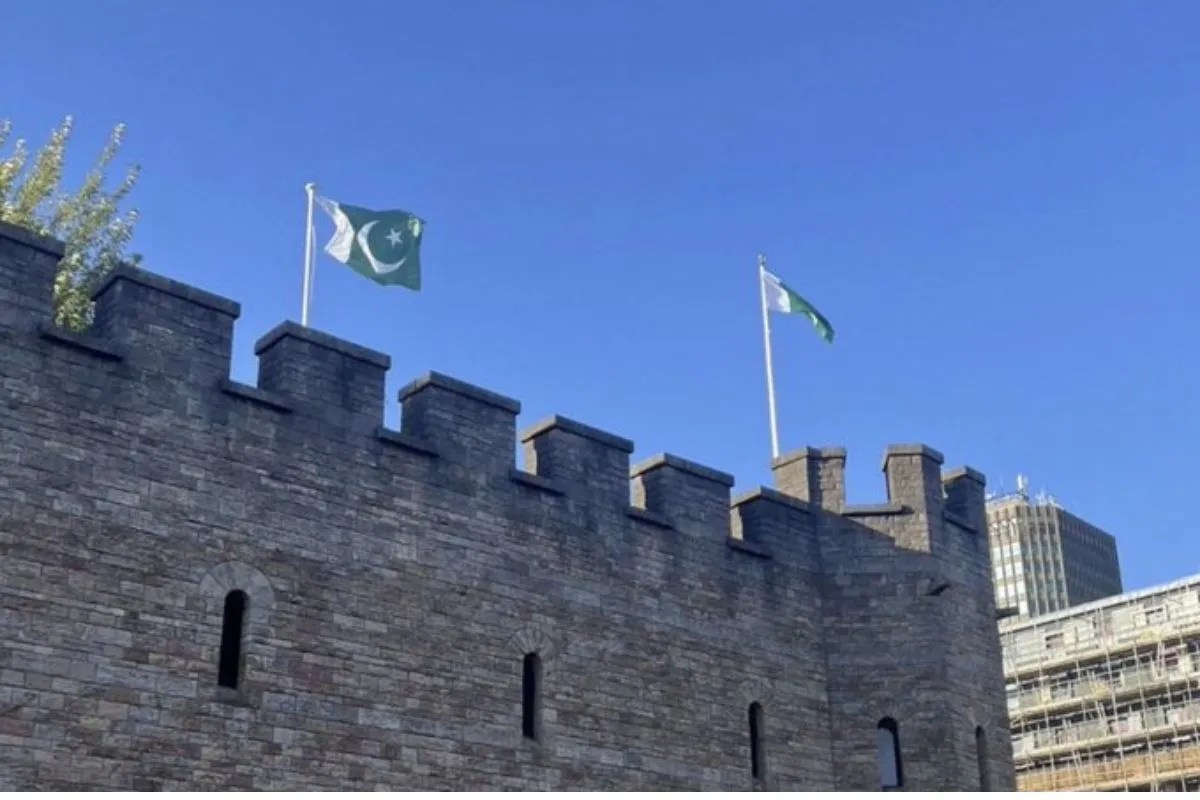
The operational mechanics of modern political polarization rely on institutional visibility. When symbols of foreign sovereignty or diaspora recognition occupy state-sanctioned architectural assets, the resulting friction is rarely about the fabric of the flag itself. Instead, it exposes structural disagreements over national identity, municipal authority, and the boundaries of civic inclusion.
The recent controversy surrounding the hoisting of the Pakistani flag at Cardiff Castle in Wales provides a clear case study in how municipal policy collides with populist political mobilization. Deconstructing this event requires examining three distinct variables: the administrative protocol governing civic infrastructure, the tactical exploitation of symbols by emerging political movements, and the systemic divergence in how urban versus nationalist entities define territorial belonging.
The Administrative Protocol of Municipal Flag Policies
Public assets like Cardiff Castle operate under codified municipal guidelines that dictate how and when non-sovereign or international flags may be displayed. Local authorities maintain calendars of cultural significance, permitting diasporic communities to mark national milestones—such as independence days—alongside the Union Flag and the Welsh Dragon.
From an institutional perspective, this operational model serves a dual purpose. It functions as a diplomatic gesture toward immigrant populations contributing to the local economy and tax base, and it projects an image of an inclusive, multicultural capital. The Cardiff Council's rationale rested on temporal proximity: the Pakistani flag was raised to mark independence commemorations in mid-August, closely followed by the Indian flag for its corresponding national day, mirroring similar protocols applied to various international communities throughout the calendar year.
However, the vulnerability of this administrative framework lies in its abstraction. For a municipal council, flag-raising is a routine bureaucratic transaction governed by civic pluralism. For critics, the exact same act is interpreted as a dilution of national primacy. The administrative failure here is one of communication rather than execution; councils often treat symbolic inclusion as routine maintenance, failing to anticipate that visual markers carry heavy semiotic weight in a polarized political climate.
The Political Economy of Outrage Mobilization
The escalation of the Cardiff Castle event from a local council procedure into a national political flashpoint illustrates the mechanics of modern opposition strategy. Figures within populist movements, notably representatives from Reform UK, weaponized digital recordings of the flag-raising to challenge the legitimacy of municipal decisions.
This dynamic operates on a specific feedback loop:
- Identification: Sourcing localized municipal actions that involve non-traditional cultural displays.
- Decontextualization: Removing the administrative rationale—such as the rotation of multiple international flags including Indian and Polish symbols—to frame the action as an isolated, asymmetric concession.
- Amplification: Distributing the imagery via digital networks to evoke a sense of territorial displacement among disaffected demographics.
The political utility of this approach targets voters alienated by rapid demographic shifts and cultural pluralism. By framing the temporary display of a foreign flag on a historic fortress as "cultural submission," opposition figures consolidate support by tapping into anxieties surrounding national decline. This creates a zero-sum framing where any institutional recognition of minority diasporas is cast as a direct subtraction from indigenous identity.
The Ideological Fracture Over Sovereignty and Integration
The debate exposes a deeper schism within the political establishment regarding the definition of integration. Traditional conservative and centrist defense mechanisms, represented locally by figures pointing to inclusive multicultural participation, argue that civic integration is reinforced when diaspora communities are publicly acknowledged and integrated into local civic life. Under this framework, loyalty to the British state is not compromised by acknowledging the heritage of its citizens; rather, participation strengthens social cohesion.
Conversely, the populist critique rejects this additive model of identity. It posits that historical monuments possess an unalterable national sanctity that should exclusively bear indigenous state insignia. This school of thought treats national identity as a finite resource where the display of external symbols dilutes the dominant culture. The friction is exacerbated by the weaponization of archival material, where older images—such as photographs from previous years' celebrations—are recycled to maintain continuous outrage cycles regardless of current administrative realities.
Strategic Forecast for Municipal Governance
As demographic diversity intersects with heightened populist scrutiny, local authorities face an increasingly rigid cost-function regarding public displays. The traditional assumption that civic neutrality can accommodate diverse diasporic celebrations without political blowback is obsolete.
Councils must transition from passive scheduling to explicit, transparent communication frameworks that pre-emptively outline the criteria for all flag-raising events. Without a formalized, publicly defensible matrix for symbolic inclusion, municipal infrastructure will remain vulnerable to exploitation by political actors seeking to manufacture cultural friction for electoral leverage. The strategic imperative for institutions is to either codify their pluralistic traditions with absolute transparency or retreat to strict minimalism where only core national flags are displayed, thereby removing the variables exploited by polarized factions.