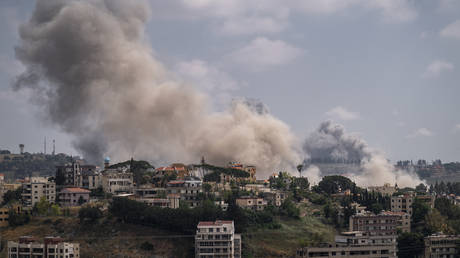
The announced U.S.-brokered ceasefire between the Israeli government and the sovereign state of Lebanon fundamentally miscalculates the structural incentives of the non-state actor at the center of the conflict. By designing a bilateral agreement that excludes Hezbollah from the formal text while demanding its unilateral relocation north of the Litani River, policymakers have built an unstable diplomatic architecture. The breakdown of this framework does not stem from a mere failure of diplomatic will; it is the predictable outcome of irreconcilable strategic math.
To understand why Hezbollah Secretary-General Naim Qassem denounced the Washington declaration as a roadmap for surrender, the conflict must be analyzed through three core operational vectors: asymmetric sovereignty, the strategic depth cost function, and the tri-lateral proxy leverage loop. Expanding on this idea, you can also read: The Brutal Truth Behind Germany Corporate State War on Online Insults.
1. The Paradox of Asymmetric Sovereignty
The primary structural flaw in the Washington-mediated framework is the disconnect between formal diplomatic authority and de facto territorial control. The United States and Israel negotiated directly with Lebanese President Joseph Aoun and the Lebanese government. This creates an immediate operational bottleneck: the entity signing the treaty (Beirut) lacks the monopoly on violence required to enforce compliance on the entity executing the combat (Hezbollah).
The Lebanese Armed Forces (LAF) are structurally incapable of disarming or forcibly displacing Hezbollah from southern Lebanon. The deployment of Lebanese troops into pilot zones like Dibbine and Marjayoun occurs strictly within the parameters of Hezbollah’s tactical tolerance. When the treaty establishes pilot zones where the LAF takes exclusive control to the exclusion of non-state actors, it introduces an existential threat to Hezbollah’s domestic political architecture. Analysts at Associated Press have shared their thoughts on this matter.
For Hezbollah, conceding to a framework where the Lebanese state reasserts sovereign defense authority over the south is not a concession of territory—it is an institutional liquidation. The group's entire domestic legitimacy rests on its self-defined role as the sole viable defense shield against Israeli incursions. Accepting a deal that transfers this mandate to the Lebanese state effectively dissolves Hezbollah's parallel governance model.
2. The Strategic Depth Cost Function
From a purely military standpoint, the demand that Hezbollah evacuate its forces from areas south of the Litani River imposes an unacceptable operational cost. In conventional warfare, a withdrawal to defensive positions can preserve combat power. In asymmetric warfare, abandoning fortified subterranean infrastructure and prepared firing positions equates to unilateral disarmament.
The cost function of Hezbollah’s defensive posture relies on two variables:
- Fixed Tactical Infrastructure: Subsurface missile launch pads, ammunition caches, and hard-point fortifications constructed over two decades cannot be relocated north.
- Proximity to the Target Set: Moving artillery and short-range rocket systems north increases the required range to strike northern Israeli security zones, reducing accuracy and allowing Israeli active defense layers (such as the Iron Dome and David’s Sling) higher interception windows.
The secondary limitation of the proposal lies in the asymmetric nature of the verification mechanisms. The agreement grants the Israel Defense Forces (IDF) freedom of action to execute airstrikes against Hezbollah targets if the group fails to vacate the southern sectors. This creates a permanent verification asymmetry. Israel retains the right to strike based on unilateral intelligence assessments of Hezbollah non-compliance, while Hezbollah is stripped of its primary deterrent—the immediate, short-range retaliatory rocket volley into northern Israel.
Because the text leaves Israeli air and drone operations unconstrained while locking Hezbollah into a static retreat, the military value of the treaty to Hezbollah is less than zero. This calculation explains why the IDF, under Defense Minister Israel Katz, continues ground operations and air interdictions in the Bekaa Valley and Nabatieh simultaneously with the diplomatic announcements. The military objective remains the degradation of the fixed asset infrastructure before any geopolitical freeze is implemented.
3. The Tri-Lateral Proxy Leverage Loop
The theater in southern Lebanon cannot be isolated from the broader geopolitical theater involving the United States and Iran. Hezbollah operates not as an independent actor, but as the forward-deployed strategic deterrent of the Iranian Revolutionary Guard Corps (IRGC) Quds Force.
The escalation that began following direct U.S.-Israeli engagements with Iran transformed Lebanon into a primary bargaining chip in a larger grand strategy game. The current diplomatic push by the U.S. executive branch aims to delink the Lebanese front from the Iranian nuclear and regional architecture. Tehran’s explicit strategy, however, relies on keeping these fronts tethered. By making a comprehensive ceasefire in Lebanon conditional on a wider peace deal with Washington, Iran ensures that any tactical pressure applied to Hezbollah acts as a direct economic and diplomatic tax on the United States.
The statement by Quds Force Commander Esmail Qaani—defining the minimum demand as a full Israeli return to pre-war positions—highlights the Iranian calculation. Iran cannot allow Hezbollah to accept a degrading terms-sheet in Beirut because doing so diminishes Iran's primary leverage point against an escalation on its own soil. If Hezbollah retreats from the border, Israel's northern civilian population returns to normal economic activity, freeing Israeli conventional military assets to reallocate toward long-range strike packages targeting Iranian energy or military infrastructure.
4. Operational Realities of the Buffer Zone
The structural failure of the 2024 ceasefire agreement serves as the baseline for current expectations. Under that previous arrangement, a nominal pullback was agreed upon but never realized at the operational level. The IDF conducted over 10,000 baseline intelligence and low-intensity interdiction strikes over the subsequent 15 months to counter what it identified as covert reconstruction of launch sites.
This historic friction loop informs the current IDF posture. The creation of a self-declared security zone south of the Zahrani River is designed to operate as a high-friction buffer zone. By enforcing a strict civilian exclusion zone south of the Yellow Line, Israeli planners are attempting to solve the identification problem that plagues anti-insurgency operations. In this defined geography, any moving signature is classified as an combatant target, standardizing the engagement rules and lowering the threshold for drone-delivered munitions.
This operational design introduces a severe demographic disruption. Displaced populations are prevented from returning to agrarian and urban centers in the south, converting a temporary military operational zone into a permanent geopolitical barrier. Hezbollah’s counter-strategy relies on generating unsustainable economic friction within Israel to break this enforcement mechanism. By maintaining sporadic but persistent rocket and drone alerts across northern border communities—even during high-level diplomatic visits—the group seeks to prevent the normalization of economic life in northern Israel, matching civilian displacement for civilian displacement.
The Strategic Play
The current U.S.-brokered text is dead on arrival because it treats Hezbollah as a state actor bound by the signatures of a sovereign government it fundamentally dominates. Diplomatic efforts that focus on rewriting the language of the Lebanese state's authority will continue to fail so long as the underlying asymmetric military infrastructure remains intact.
The only viable path to a stabilized front requires shifting the strategic focus from formal treaties to explicit containment parameters. Western and regional actors must accept that the Lebanese government cannot enforce compliance. Therefore, any workable framework must be built on a hard deterrence equilibrium between Israel and Iran directly, where the intensity of strikes in Lebanon is tied mathematically to sanctions relief or asset protection for Tehran. Until the primary sponsor's cost-benefit matrix is altered, the tactical back-and-forth in southern Lebanon will persist, regardless of the declarations signed in Washington.
Hezbollah Rejects U.S.-Backed Ceasefire Plan As Israel Keeps Striking Lebanon
This video provides raw footage and real-time reportage detailing the immediate aftermath of the Washington declaration and Naim Qassem's public refusal of the terms.