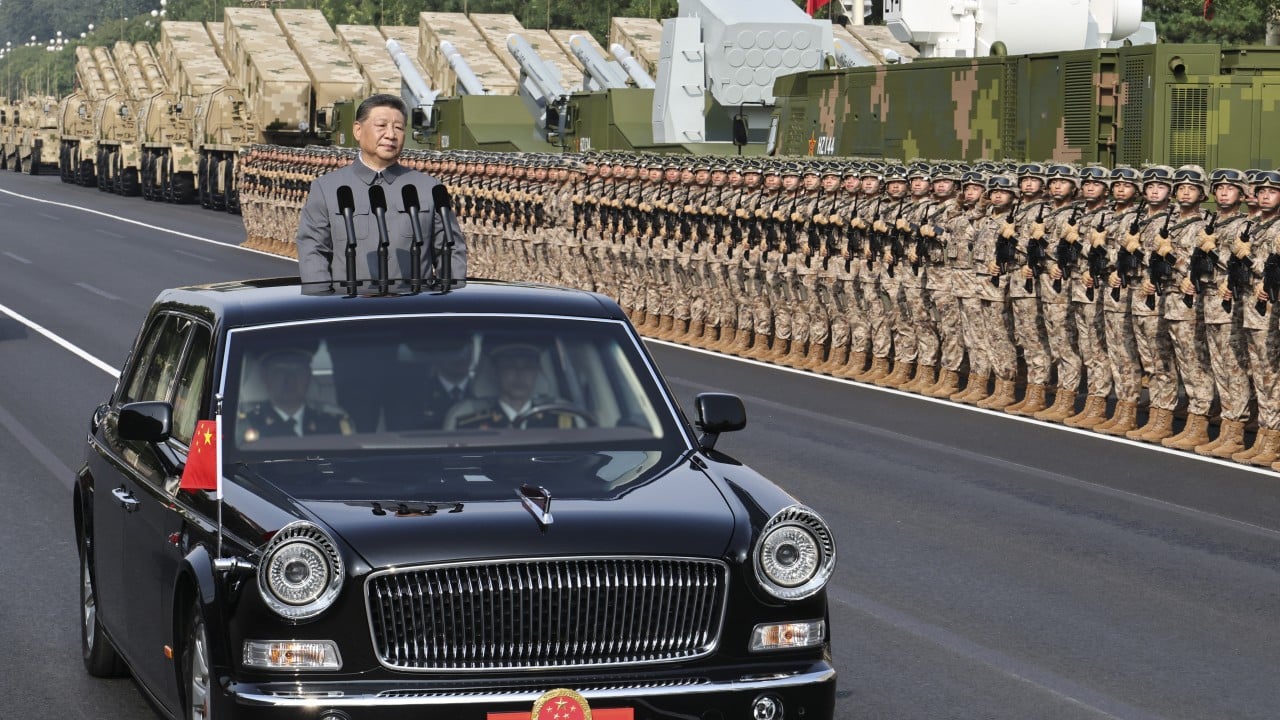
The operational mandate issued by Beijing leadership targeting the integration of machine learning and autonomous hardware into the People's Liberation Army marks a structural shift from experimental adoption to core doctrine. Observers tracking this transition frequently mistake high-level political declarations for immediate tactical readiness. This creates a fundamental misreading of state capacity. The recent Politburo study session emphasizing automated systems and network-centric architecture is not a sudden pivot. It is a formal synchronization point tied to a hard institutional deadline: the 2027 centenary of the armed forces.
Evaluating this directive requires stripping away generalized geopolitical commentary to examine the underlying mechanics. Modernizing an enterprise of millions of personnel through algorithmic command-and-control systems introduces massive friction. The transition from human-centered doctrine to machine-driven execution exposes severe structural bottlenecks, supply chain constraints, and internal governance hurdles that dictate the actual speed of deployment.
The Tripartite Vector of Intelligentized Warfare
Strategic planning within the military-industrial complex of the People's Republic relies on three distinct technological tiers. Each tier carries unique developmental costs, technical hurdles, and integration timelines.
The first vector involves autonomous hardware platforms. This encompasses aerial drones, uncrewed maritime vessels, and automated ground logistics units. Unlike traditional heavy armor or manned aviation, these systems eliminate biological crew constraints from the physics of combat. Yet, hardware production is bound by semiconductor availability and high-performance sensor fabrication. While volume manufacturing of basic airframes is trivial for an industrialized state economy, embedding radiation-hardened microprocessors and neural processing units at scale remains constrained by export controls and domestic fabrication ceilings.
The second vector centers on algorithmic decision support. Modern engagements generate telemetry data volumes that exceed human cognitive processing thresholds. The objective of algorithmic integration is data reduction and predictive threat modeling. Command nodes require models that filter noise from signal in congested electronic warfare environments. Building these models requires proprietary operational datasets. Synthetic data generation can bridge this gap partially, but real-world tactical feedback loops are irreplaceable for tuning parameters against adversarial jamming.
The third vector governs network-information systems. Algorithms are inert without low-latency distribution grids. The push to deepen network integration involves binding disparate sensing nodes—satellites, radar arrays, subsurface acoustic sensors—into a unified processing fabric. This requires resilient, jam-resistant tactical data links that can survive the degradation of space-based assets.
The Structural Friction Points
Command directives from top leadership encounter severe operational inertia at the regional command and procurement levels. Three primary constraints slow the velocity of military algorithmic adoption.
First, the institutional friction of legacy hierarchies limits adaptability. Officer corps trained in mechanized, linear doctrine struggle to decentralize execution down to autonomous swarm units. Machine speed warfare demands a devolution of authority that runs counter to centralized political control models. When algorithms compute tactical options in milliseconds, traditional reporting chains introduce latency that neutralizes computational advantages.
Second, the structural tension between civil-military integration and specialized defense requirements creates quality control vulnerabilities. Relying on commercial technology ecosystems introduces dual-use vulnerabilities. Commercial components optimized for cost and civilian throughput often lack the environmental hardening, thermal tolerance, and electromagnetic shielding required for contested combat environments.
Third, internal anti-corruption campaigns within defense procurement introduce risk aversion among program managers. While structural audits clean up supply chains over long horizons, they freeze immediate bureaucratic initiative. Procurement officers facing rigorous personal liability for project failures prefer delayed compliance over aggressive technological experimentation.
The Calculus of Deterrence and Strategic Stability
The acceleration of algorithmic command tools fundamentally alters crisis stability models between major powers. Traditional deterrence relies on predictable second-strike survivability and transparent communication channels during escalatory phases. Algorithmic integration introduces compressed timelines that degrade crisis management.
When automated reconnaissance and strike systems are optimized for speed, human oversight risks becoming a bottleneck that automated protocols bypass. If one actor deploys machine-speed threat evaluation, opposing commands face a compressed decision window. This dynamic creates an algorithmic arms race where hesitation is mathematically penalized. The operational incentive shifts toward preemption, as automated defense systems calculate that waiting for human confirmation increases vulnerability to blinding strikes.
Furthermore, the integration of uncrewed platforms alters attrition calculations. Political cost structures shift when human casualties are removed from initial engagement phases. Lowering the political threshold for initiating kinetic action increases the frequency of localized friction, raising the statistical probability of accidental escalation into full-scale conflict.
Implementation Vectors for Defense Planners
Monitoring the execution of these military directives requires shifting analytical focus away from state media declarations and toward measurable industrial indicators. Observers must track specific operational metrics to gauge actual capability gains.
Monitor specialized semiconductor procurement patterns, specifically domestic production yields for radiation-hardened edge-computing silicon. Track the frequency, scale, and complexity of multi-domain exercises involving uncrewed swarm coordination without pre-programmed paths. Measure the integration depth of civilian commercial entities into the defense supply chain by auditing dual-use patent filings in automated logistics and sensor fusion. Evaluate the structural evolution of command academies to determine whether training curricula emphasize algorithmic exception handling over manual procedural compliance.
Operationalizing machine learning within armed forces is an exercise in managing extreme complexity under severe constraint. The 2027 milestone does not represent a finished endpoint of a fully autonomous force. It serves as an institutional checkpoint designed to force internal alignment, accelerate industrial output, and test the friction limits of algorithmic command structures against the reality of state bureaucracy.