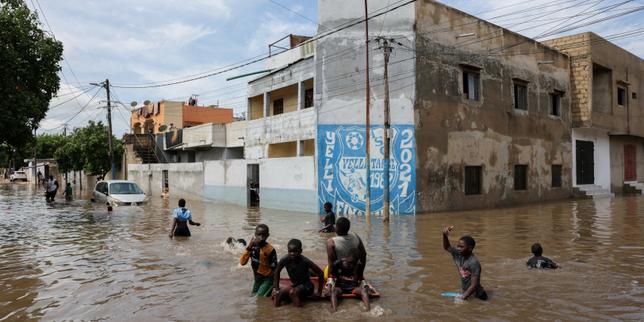
Dakar operates under a hydrological deficit that manifests not as a drought, but as structural drowning. When abnormal precipitation events strike the Cap-Vert peninsula, the urban fabric fails systematically. This failure is neither accidental nor purely meteorological; it is the predictable output of an equation balancing accelerated demographic expansion against stagnant hydrological infrastructure. To understand why the Senegalese capital succumbs to seasonal deluges, one must deconstruct the structural mechanics governing water accumulation, soil saturation, and systemic urban vulnerability.
The Hydrological Bottleneck and Surface Runoff Economics
Urban expansion in the Dakar metropolitan area has systematically replaced permeable topsoil with impermeable asphalt and concrete. Natural drainage basins, such as the Grand Yoff watershed, function under severe hydraulic stress. Under undisturbed conditions, precipitation partitions into infiltration, evaporation, and surface runoff. Rapid pavement expansion alters this ratio drastically, shifting coefficients toward immediate surface accumulation.
During high-intensity rainfall events, the volume of surface water vastly exceeds the volumetric capacity of existing gravity-fed storm drains.
- Infiltration Failure: Water cannot penetrate the subsurface due to dense building footprints and widespread paving.
- Elevated Water Tables: Subsurface saturation in low-lying peri-urban zones like Pikine and Guédiawaye means the ground can absorb zero additional moisture, forcing rising water tables to merge with surface pooling.
- Discharge Constriction: Outlets leading to the Atlantic Ocean or inland retention basins suffer from sedimentation, structural degradation, and solid waste blockage, reducing discharge velocity to near zero.
This dynamic creates an artificial hydraulic trap. Rainwater does not merely sit on streets; it mixes with domestic wastewater from overflowing septic systems and unmanaged sanitation networks, transforming neighborhoods into stagnant biological hazards.
The Cost Function of Informal Settlement Growth
Economic pressures drive internal migration toward Dakar's periphery, where land availability correlates inversely with safety. Informal settlements disproportionately occupy low-lying depressions, ancient marshlands, and zones designated as natural retention areas.
Municipal planning encounters a severe friction coefficient when attempting retrofitting operations in high-density informal zones. The cost of eminent domain acquisition, demographic displacement, and subterranean engineering scales exponentially once communities are established. Consequently, capital allocation lags far behind population influx rates.
The economic burden manifests across three distinct ledgers:
- Direct Asset Destruction: Inundation compromises structural foundations, collapses mudbrick or substandard masonry walls, and ruins commercial inventories.
- Productivity Paralysis: Road network submersions sever supply chains, halt public transport operations, and prevent workforce mobility.
- Public Health Expenditure: Stagnant water vectors drive spikes in waterborne and vector-borne pathologies, straining clinical infrastructure already operating at capacity.
Institutional Inertia and Engineering Limitations
Capital injections into flood management—such as multi-phase projects backed by international financial institutions—tend to prioritize macro-infrastructure like retention basins and major
Dakar Under Water The Structural Failure Points of Urban Drainage Systems
news
Urban vulnerability is not merely a product of meteorological extremity; it is the physical manifestation of deferred municipal infrastructure investment clashing with rapid spatial expansion. When abnormal precipitation events overwhelm a coastal metropolis, the resulting disruption exposes systemic faults in hydrological planning, soil mechanics, and urban land-use governance. The flooding of Dakar during severe rainy seasons reveals precisely how municipal systems fail when conveyance capacity is outpaced by urban surface sealing and shifting precipitation regimes.
The Hydrological Bottleneck of Coastal Urban Topography
Dakar occupies a peninsula characterized by low-lying topography, high water tables, and a dense concentration of impermeable surfaces. In an unbuilt environment, precipitation is naturally mitigated through infiltration, evapotranspiration, and slow sub-surface percolation. Urbanization alters this balance fundamentally by replacing permeable soils with concrete and asphalt, shifting the runoff coefficient upward and dramatically accelerating the time of concentration.
When rainfall intensity exceeds the designed discharge capacity of legacy stormwater networks, surface water accumulates rapidly. The physical constraints of a peninsula compound this issue: water cannot easily drain away when sea levels, tidal fluctuations, and flat inland gradients restrict gravitational outflow. Without active pumping infrastructure and subterranean retention basins engineered for peak loading, low points in the urban fabric inevitably become permanent collection zones during intense storms.
The Economic Cost Function of Infrastructure Deficits
The financial toll of recurring urban inundation extends far beyond immediate emergency response costs. It operates as a persistent tax on economic productivity, human capital, and physical assets.
- Asset Degradation: Submerged roadways, saturated foundations, and water-damaged electrical infrastructure accelerate depreciation schedules across municipal and private capital investments.
- Productivity Friction: Mobility paralysis prevents workforce transit, closes commercial establishments, and halts logistics chains, directly suppressing municipal gross domestic product during and immediately following flood events.
- Public Health Externalities: Standing water mixed with untreated sewage creates vector-breeding grounds and contamination pathways for waterborne pathogens, shifting economic burdens onto healthcare systems.
Traditional cost-benefit analyses in municipal planning frequently underestimate these externalities because they treat flood mitigation as an operational expense rather than an indispensable capital input for economic stability. When drainage maintenance budgets are treated as discretionary, the secondary costs of paralysis consistently dwarf the initial capital expenditure required for system upgrades.
Spatial Expansion Versus Drainage Capacity
The velocity of informal and formal real estate development in peripheral zones frequently outpaces municipal utility provisioning. As housing developments spread into low-lying natural drainage basins, wetlands, and depressions, they eliminate the city's natural retention capacity.
This creates an inverse relationship between spatial growth and systemic resilience. Each newly paved hectare upstream increases the peak discharge volume directed toward downstream urban centers that are already operating at maximum capacity. Retrofitting high-density neighborhoods with subterranean drainage trunks is logistically complex and capital-intensive, requiring extensive disruption of existing transport arteries and utility corridors. Consequently, municipal authorities find themselves trapped in a reactive cycle of emergency pumping rather than executing proactive structural realignment.
Operational Realignment for Resilient Urban Systems
Mitigating chronic urban inundation requires shifting from reactive disaster management to preventive spatial engineering. Municipal frameworks must integrate hydrological modeling into zoning laws, ensuring that no further development occurs within natural retention basins without mandatory compensatory storage mechanisms.
Critical infrastructure must be audited for hydraulic bottlenecks, prioritizing the expansion of primary discharge collectors and the integration of decentralized retention ponds. Sustainable urban drainage systems, including permeable pavements and bioswales, must replace traditional hard engineering wherever soil profiles permit infiltration. Without these structural corrections, abnormal rainy seasons will continue to expose the exact limits of municipal carrying capacity.


