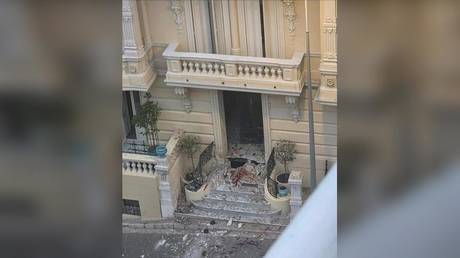
The detonation of an improvised explosive device (IED) targeting a suspected Ukrainian oligarch on Rue Révérend Père Louis Frolla in Monaco represents more than a local security anomaly. It marks a systemic shift in the geography of proxy conflict and asymmetric warfare. Prior to this event, the microstate operated as a high-security sanctuary, insulating ultra-high-net-worth individuals (UHNWIs) from the physical risks associated with geopolitical exposure. The breach of this environment demonstrates that the operational envelope of kinetic actors has expanded into regions previously deemed risk-mitigated by standard municipal surveillance.
Analyzing this incident requires looking past the sensationalism of standard journalism. We must evaluate it using rigid structural frameworks that account for perpetrator mechanics, supply chain visibility, and the optimization vectors of contemporary non-state targeting. By breaking down the operational steps of the attack, we can identify exactly where the security systems failed. This breakdown provides a blueprint for assessing asset protection when geopolitical risks escalate.
The Triad of Kinetic Vulnerability
The success of a targeted asymmetric attack relies on three distinct operational variables. When these variables align, they neutralize traditional close-protection methods and municipal defense systems.
[Geopolitical Exposure] + [Surveillance Disruption] + [Local Access Optimization]
                      │
                      ▼
          [Targeting Optimization]
1. Geopolitical Exposure
Capital flight from conflict zones often creates localized clusters of high-value targets in neutral territories. When displaced elites migrate to concentrated enclaves like the French Riviera, they inadvertently centralize intelligence gathering for their adversaries. The target's political profile, financial influence, or past alignment creates a high-yield asset for state or non-state proxies looking to project force or disrupt financial networks.
2. Surveillance Disruption
Municipalities like Monaco rely heavily on dense closed-circuit television (CCTV) networks and tight border controls to deter crime. However, these systems create a false sense of security. They are built to deter low-capability, opportunistic criminals rather than well-trained networks. A disciplined operator can bypass automated surveillance by exploiting blind spots, using physical disguises, or executing the attack within a tiny operational window that leaves no time for a coordinated response.
3. Local Access Optimization
The physical layout of dense European luxury real estate presents a structural vulnerability. Multi-family residential buildings, even those near national borders, usually have shared access points at the street level. By placing a parcel bomb filled with buckshot and bolts directly at an entrance, the attacker eliminated the need to breach internal security doors or alarms. They effectively weaponized the transition zone between public and private space.
The Mechanics of Asymmetric Targeting in Low-Risk Enclaves
The Monaco bombing exposes a major flaw in how private security firms assess threats. Most models over-index on regional historical data, assuming that because an area has a low violent crime rate, the threat level remains baseline low. This approach ignores how asymmetric warfare actually operates. Highly capable actors choose their deployment zones based on where the target is most likely to let their guard down.
The delivery of a parcel-based IED packed with shrapnel (buckshot and bolts) reveals specific operational choices:
- Resource Constraints: The use of a backpack or package indicates a low-footprint deployment strategy designed to blend into pedestrian traffic, bypassing vehicle checkpoints and regional border monitoring.
- Proximity Requirements: The device was placed at a residential entrance, showing the attacker had precise intelligence on the target's daily routines and entry vectors.
- Collateral Acceptance: Choosing a fragmentation device in a public space indicates that the perpetrators prioritized a high probability of neutralization over minimizing civilian casualties. This is a common hallmark of state-sponsored intimidation or highly aggressive reprisal networks.
This operational profile points to a calculated trade-off. The attacker accepted the extreme risk of operating within a heavily policed, high-surveillance territory because the strategic value of hitting the target in their presumed safe haven outweighed the logistical difficulty of the deployment.
The Cost Function of Asymmetric Enforcement
To map the logic of transnational targeting, we can look at the operation through an economic lens. We can model the attacker's decision-making process using a basic cost function:
$$C_a = L_s + E_o - V_t$$
Where:
- $C_a$ is the net operational cost to the perpetrator.
- $L_s$ represents the logistical friction of operating inside a secure enclave (surveillance, border controls, egress restrictions).
- $E_o$ is the risk of operational compromise or capture during deployment.
- $V_t$ is the strategic, political, or financial value of neutralizing the target.
When $V_t$ exceeds the combined value of $L_s$ and $E_o$, the security architecture of the host nation loses its deterrent power. In this specific case, the target’s value to the adversary was clearly high enough to justify the risks of operating in Monaco. This calculation shows that relying on a host country's reputation for safety is no longer an effective defense for politically exposed persons (PEPs).
Structural Inefficiencies in Private Security Models
The primary bottleneck in protecting expatriate elites is the breakdown of defensive vigilance over time. Security teams operating in stable environments frequently succumb to routine-based decay. This operational vulnerability manifests in three distinct ways:
- Over-Reliance on Municipal Deterrence: Security teams often treat local police and city cameras as a replacement for active counter-surveillance. This leaves them completely exposed to attackers who know how to exploit gaps in those public systems.
- Failure to Secure the Perimeter Outer Ring: Standard protocols focus heavily on protecting the inside of a property. They tend to neglect the public-to-private transition points, such as sidewalk entrances and entry vestibules, where a target is most vulnerable.
- Inadequate Package and Logistics Screening: In high-density residential buildings, standard mail and courier deliveries are rarely routed through off-site screening facilities. This allows an explosive device to be easily introduced directly into the target's immediate environment.
To fix these vulnerabilities, security teams must shift from static defense to active threat mitigation. This means running regular counter-surveillance operations, treating all public entrance zones as high-risk environments, and inspecting every single package off-site before it gets anywhere near the target.
Strategic Playbook for High-Risk Asset Protection
The Monaco incident proves that geographic displacement no longer guarantees safety from sophisticated adversaries. For corporate entities, family offices, and security consultants managing high-risk profiles, mitigating this evolving threat requires immediate tactical changes.
First, you must decouple the threat assessment from the local geography. A high-value target facing state-level or sophisticated non-state adversaries carries that threat level with them globally, regardless of local crime rates. Second, secure the physical transition points. You must treat all shared entranceways and sidewalk access zones as hostile sectors. This requires installing continuous sweep protocols, advanced thermal or chemical screening at outer gates, and strict access controls that keep deliveries away from the main structure. Finally, run active counter-surveillance to identify and disrupt the hostile reconnaissance phase before an attack can materialize.
If you don't adjust your security models to account for this wider operational landscape, high-value assets in luxury enclaves will remain soft targets for asymmetric attacks. Host nations will be forced to adapt their border and intelligence tracking to stop these proxy conflicts from spilling onto their streets.
For a deeper look into the evolving dynamics of international asset tracking and security, the investigative report Ukrainian refugees encounter pro-Russia oligarchs in France details the growing friction and surveillance challenges within these high-density expatriate communities on the Riviera.