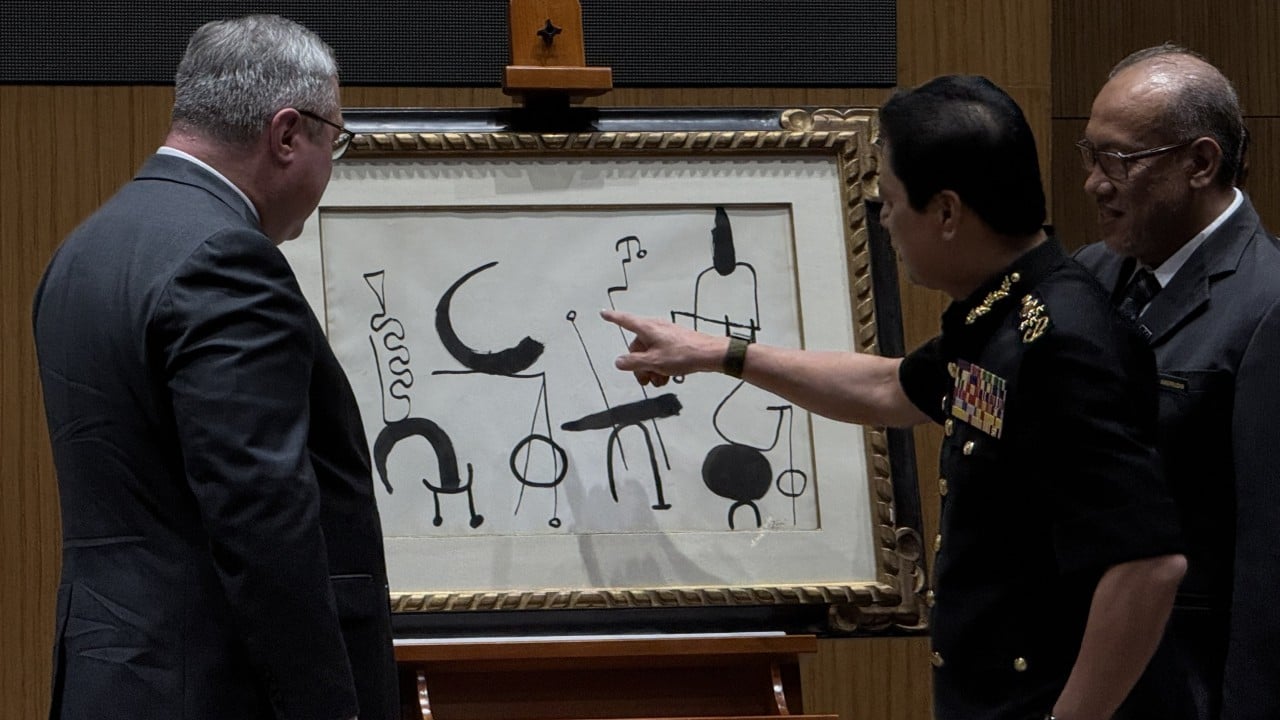
The return of four high-value modernist artworks to Putrajaya is a micro-level execution of a macro-level financial recovery operation. Rather than a mere cultural milestone, the repatriation of these pieces by Pablo Picasso, Joan Miró, Maurice Utrillo, and Balthus represents the application of cross-border legal frameworks to claw back capital from a sovereign wealth fund siphon.
With the Malaysian Anti-Corruption Commission (MACC) reporting a recovery rate of 74.5% of the estimated RM42 billion stolen through the 1Malaysia Development Berhad (1MDB) scandal, the mechanics of this operation offer a blueprint for sovereign states combating complex, international capital flight. This analysis deconstructs the legal, logistical, and economic structures used to convert illicitly acquired physical assets back into sovereign capital.
The Economics of Illicit Asset Transformation
To understand how fine art became a primary vehicle for 1MDB money laundering, it is necessary to examine the asset class properties that appeal to those siphoning capital. Standard cash transfers leave deep transaction footprints within the SWIFT banking system, subjecting high-volume transfers to strict Know-Your-Customer (KYC) and Anti-Money Laundering (AML) flags.
Fine art, conversely, acts as a highly liquid, transportable, and historically under-regulated store of value. The table below outlines the financial transformation profile of the four recently repatriated works:
| Artist | Artwork Title & Year | Purchase/Valuation (USD) | Local Valuation (MYR equivalent) | Primary Acquisition Mechanism |
|---|---|---|---|---|
| Joan Miró | Composition (1953) | $93,750 | RM371,218.75 | Direct acquisition via siphoned capital / stored at international auction house custody |
| Maurice Utrillo | Maison de rendez-vous, rue Saint-Rustique, Montmartre (1934) | $50,000 | RM197,985.00 | Stored under third-party holding structures |
| Balthus | Étude pour femme couchée (1948) | $28,125 | RM111,365.63 | Surrendered via legal proxy negotiations |
| Pablo Picasso | L'Ecuyère et les clowns (1961) | $26,250 | RM103,971.87 | Print medium; highly liquid asset class bypass |
The Value-Dense Capital Flight Loop
The conversion process relies on a three-stage money laundering cycle:
- Placement: Siphoning state-backed capital from 1MDB accounts into shell corporations controlled by proxy actors.
- Layering: Dispersing funds across multiple jurisdictions (including the United States, Switzerland, and Singapore) through complex layers of transactions to obscure the source of the capital.
- Integration: Purchasing highly concentrated physical wealth—such as these paintings—where value can be stored silently, away from real-time banking ledger oversight.
These four specific pieces, representing a combined value of USD 198,125 (approximately RM786,556), constitute a minor fraction of the estimated USD 4.5 billion siphoned from 1MDB between 2009 and 2014. Yet, their recovery demonstrates the vulnerability of physical store-of-value assets when confronted with coordinated state action.
The Legal Framework of Cross-Border Recovery
Sovereign states seeking to recover assets from foreign jurisdictions cannot rely on unilateral authority. The repatriation of these works was not executed through physical seizure by Malaysian agents, but through a structured legal mechanism involving mutual legal assistance and voluntary surrender protocols.
[Siphoned 1MDB Funds] -> [Shell Companies/Foreign Accounts] -> [Art Purchases (Picasso, Miró, etc.)]
                                                                        |
[MACC & AGC Malaysia] <--- (Power of Attorney/MLAT) <--- [US Dept of Justice Asset Forfeiture]
          |
[National Art Gallery (Acclimatisation & Valuation)] -> [Finance Ministry (Holding vs. Liquidation)]
Mutual Legal Assistance and Power of Attorney
The primary legal instrument driving this repatriation is the cooperation between the United States Department of Justice (USDOJ), under its Kleptocracy Asset Recovery Initiative, and Malaysia's Attorney General's Chambers (AGC) alongside the MACC.
Because the artworks were physically located within the United States and stored in international auction houses (specifically Christie’s and Sotheby’s) under the custody of US federal authorities, Malaysia's legal team utilized a Power of Attorney (POA) framework. Rather than enduring protracted civil forfeiture litigation in US courts, the assets were legally transferred to the MACC through the execution of these POAs. This minimized court-related depreciation of asset values and expedited the physical transfer of ownership.
Sovereign Asset Recovery as a Multi-Jurisdictional Game
The success of this operation hinges on the alignment of three distinct legal pillars:
- Sovereign Standing: The Malaysian government established its status as the ultimate victim of the fraud, proving that the funds used to purchase the art originated from state-backed debt instruments.
- Jurisdictional Treaty Compliance: Relying on bilateral agreements to bypass traditional diplomatic friction points, allowing law enforcement agencies to share evidence and asset registries in real-time.
- Third-Party Custody Resolution: Clearing legal claims from secondary buyers, galleries, or custodians who may have held possessory liens over the physical paintings.
Environmental and Conservation Logistics
The transition of fine art from a highly controlled storage environment in Western auction houses to the tropical climate of Southeast Asia introduces severe preservation risks. Artworks executed on paper or canvas are highly susceptible to relative humidity (RH) spikes and rapid temperature shifts, which can trigger irreversible structural damage.
The Acclimatisation Protocol
Upon arrival at the MACC headquarters in Putrajaya, the paintings were placed into a strict environmental stabilization protocol. The physical mechanics of this process are highly structured:
- Micro-Climate Control: The artworks are kept in sealed, climate-controlled chambers where relative humidity is stabilized at $50% \pm 5%$ and temperature is maintained at $20^\circ\text{C} \pm 2^\circ\text{C}$.
- Equilibrium Period: To prevent warping of wooden frames and expansion/contraction of paint layers, the works undergo a mandatory acclimatisation period. Uncrating cannot occur until the moisture content within the packing materials reaches equilibrium with the local, controlled indoor environment.
- Verification and Authentication: Once stabilized, the National Visual Arts Development Board (LPSVN) executes forensic verification. This involves examining the works under ultraviolet (UV) light to detect post-acquisition restorations, verifying signatures, and comparing physical canvas dimensions and paper watermarks against catalogued auction records.
Sovereign Balance Sheet Implications
The MACC's recovery of RM31.3 billion—representing roughly 74.5% of the total identified misappropriated 1MDB capital—stands as an outlier in the global history of asset recovery. Historically, the recovery rate for large-scale sovereign wealth fund looting rarely exceeds 15% due to jurisdictional friction and the rapid dissipation of funds.
The recovery rate can be modelled as a function of asset type and jurisdictional cooperation:
$$R_p = \frac{\sum (A_{rec} \cdot C_j) - L_{fees}}{A_{total}}$$
Where:
- $R_p$ is the recovery percentage.
- $A_{rec}$ represents the appraised value of the recovered assets.
- $C_j$ is the jurisdictional cooperation coefficient (ranging from 0 to 1).
- $L_{fees}$ represents the legal, logistical, and administrative costs of recovery.
- $A_{total}$ is the total estimated value of the misappropriated capital.
When assets are converted into illiquid, highly concentrated physical forms (like fine art or real estate), $C_j$ increases because physical assets cannot be moved through digital networks to uncooperative jurisdictions once flagged. This makes physical asset recovery structurally simpler than tracing liquid funds through secondary and tertiary shell networks, even though the liquidation of physical assets introduces a secondary transaction cost.
The Strategic Disposition Choice
With the paintings currently under secure holding, the Malaysian government face a classic public-finance optimization dilemma. The Ministry of Finance must choose between two distinct strategies for these assets.
                  ┌─────────────── [Option A: Public Retention] ───────────────┐
                  │  - Capitalise as Sovereign Heritage Assets                │
                  │  - Generate Long-Term Cultural Dividends                  │
                  │  - Educate Public on Institutional Corruption Risk        │
[Recovered Art] ──┤                                                            │
                  │                                                            │
                  │─────────────── [Option B: Liquidation] ────────────────────│
                  │  - Auction via Global Art Houses (e.g., Sotheby's)        │
                  │  - Immediate Capital Inflow to Sovereign Debt Fund        │
                  │  - Settle Remaining 1MDB Debt Principal & Interest        │
                  └────────────────────────────────────────────────────────────┘
Option A: The Heritage Hold
Retaining the artworks within the National Art Gallery as sovereign-owned heritage assets. Under this model, the economic value is calculated via cultural dividends, public education regarding state accountability, and institutional prestige. MACC Chief Commissioner Tan Sri Azam Baki noted the strategic value of this path, stating that keeping the works serves as a permanent, physical lesson on the consequences of state-level corruption.
Option B: Financial Liquidation
Consigning the works to global auction houses to convert the physical assets back into liquid capital. While this option delivers an immediate, quantifiable cash inflow to the Treasury, it subjects the state to market risk. The current market value of these specific pieces (approximately USD 198,000) is relatively low compared to the tens of millions represented by other unrecovered 1MDB assets.
A premature auction could yield suboptimal returns if execution occurs during a downturn in the global modern art market. Furthermore, auctioning these pieces incurs significant transaction costs, including seller's commissions and transit insurance.
The optimal strategic play for the Ministry of Finance is to split the portfolio based on asset liquidity and historical significance. The lower-value works—such as the Picasso print and the Balthus study—should be retained for permanent public exhibition. The cost of their maintenance is minimal, yet their educational utility as physical symbols of sovereign recovery is highly potent.
Conversely, should the remaining eight higher-value paintings from the original DOJ custody list of twelve be successfully repatriated, those should be targeted for structured liquidation. By grouping those higher-value assets into a dedicated, high-profile "1MDB Recovery Auction" hosted in a major financial hub, the Malaysian state can maximize the scarcity premium, offset recovery costs, and directly channel the proceeds into retiring the remaining interest-bearing debt obligations inherited from the 1MDB fund's collapse.