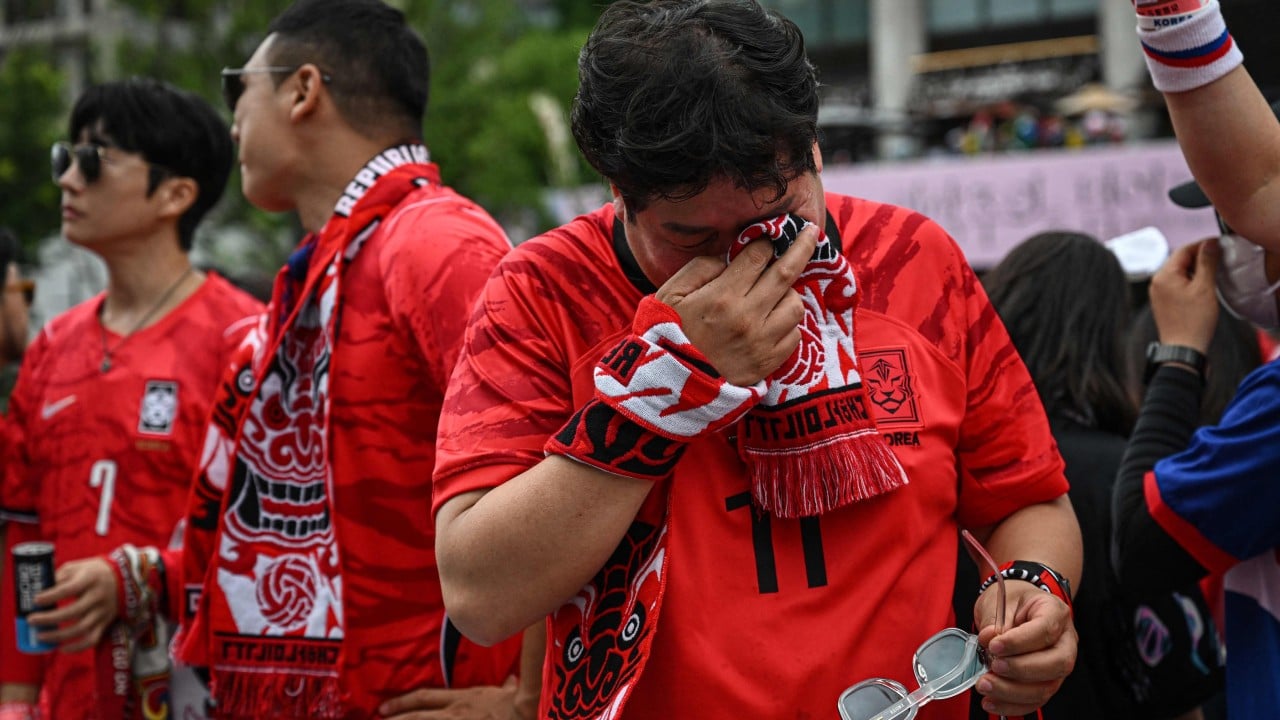
The systemic failure of elite sports organizations rarely stems from a lack of public passion or political will. Instead, it is almost always an architectural failure—an inability to translate macroeconomic investments and individual baseline talent into predictable, repeatable international output. The public outrage following South Korea's recent World Cup exit, echoed by executive demands for institutional overhaul from the presidential office down to grassroots fan bases, isolates a crucial friction point. The core issue is not simply a poor tournament performance; it is a structural bottleneck within the Korea Football Association (KFA) that systematically misallocates elite human capital and stifles tactical innovation.
To understand why a nation with world-class individual assets frequently hits a hard ceiling during international tournaments, we must bypass emotional narratives of "mental toughness" or "lack of desire." We need to analyze the underlying structural mechanics instead.
The Three Pillars of International Football Optimization
An elite national football program operates as a production function where international success is the output variable. This function depends on three distinct, interdependent pillars:
- The Tactical Engine: The operational philosophy, tactical flexibility, and technical staff capability to maximize individual player profiles within modern footballing frameworks.
- The Talent Pipeline and Domestic Infrastructure: The systemic identification, development, and progression of youth talent through the domestic pyramid (K League) into elite foreign leagues.
- Institutional Governance: The administrative efficiency, transparency, and strategic continuity provided by the governing federation.
When any of these pillars rot, elite output suffers. In the case of South Korea, structural decay across all three layers has created an environment where individual talent must actively overcome institutional deficits to compete globally.
1. The Tactical Engine: Asymmetric Reliance and Over-Indexation
The first systemic failure manifests in the squad's tactical construction. South Korea possesses elite individual assets competing at the absolute highest levels of European club football. This elite dispersion creates a highly skewed talent distribution curve.
A recurring structural flaw in the national team's tactical deployment is an over-reliance on individual brilliance to solve collective positional problems. Instead of building a cohesive tactical framework that maximizes spatial efficiency and ball progression, managers frequently defaults to an asymmetrical system. This system forces elite forwards to drop deep into the midfield to initiate progression, rendering them less effective in the final third.
[Defensive Line] ---> [Positional Fluidity Deficit] ---> [Elite Attackers Drop Deep] ---> [Low-Value Attacking Transitions]
This structural failure is compounded by a lack of tactical flexibility during tournament play. Modern international football requires rapid mid-game adaptations based on expected goals (xG) metrics, pressing intensities, and low-block variations. The KFA’s historic tendency to appoint managers based on reputational metrics rather than stylistic compatibility creates a persistent friction point: the team relies on rigid, outdated systems that fail to adjust when opponent defensive lines compress spatial opportunities.
2. Pipeline Friction: The K League to Europe Bottleneck
The second limitation lies within the domestic infrastructure. While the K League remains one of Asia's most stable domestic competitions, the transition mechanics for young domestic players moving into elite European leagues face significant economic and bureaucratic drag.
The valuation model for South Korean domestic talent often creates an optimization trap. K League clubs, operating on tight corporate budgets primarily subsidized by major conglomerates, frequently price young prospects out of mid-tier European developmental leagues (such as the Belgian Pro League, Dutch Eredivisie, or Austrian Bundesliga). By setting high release clauses or demanding inflated transfer fees to balance short-term operational sheets, domestic clubs inadvertently stifle the long-term compounding value of international exposure.
- The Developmental Cost: Players who remain in the domestic system past their developmental peak (ages 18–22) miss out on the high-intensity pressing environments and advanced tactical schooling characteristic of modern European academies.
- The Physical Intensity Gap: Data tracking physical outputs shows a stark discrepancy in high-intensity running distances and transition speeds between elite European tiers and domestic Asian leagues. When a squad is composed of a stark divide between European-based starters and domestic-based reserves, the tactical cohesion of the team fractures under elite, sustained pressure.
3. Institutional Governance: The Continuity Deficit
The third, and arguably most destructive, bottleneck is the institutional governance of the KFA itself. A high-performing sports organization requires strategic continuity that outlasts individual tournament cycles. The KFA, however, has historically operated via reactive decision-making cycles driven by public relations optimization rather than long-term sporting merit.
The hiring and firing cycles of national team technical directors and head coaches reveal an institutional pattern of risk aversion. When a tournament exit occurs, the administrative response is almost uniformly sacrificial: terminate the manager, issue a public apology, and appoint a high-profile successor without altering the underlying technical committee responsible for the initial systemic failure. This process creates a structural reset every two to four years, wiping out institutional knowledge and forcing the player pool to adapt to entirely different tactical languages during their prime developmental windows.
The Strategic Blueprint for Institutional Reform
Resolving this underperformance requires a top-down structural overhaul designed to align South Korea's institutional capabilities with its raw talent profile. The following tactical interventions represent the necessary strategic play to break the current cycle of underperformance.
Restructure the Technical Committee
The KFA must insulate its technical selection committee from political and commercial pressure. The committee should be populated by objective data analysts, experienced scouts, and sporting directors with proven track records in European or South American developmental models. The objective must shift from hiring "celebrity coaches" to securing tactical architects whose playing philosophies match the high-pressing, high-tempo physical profile of modern Korean players.
Implement an Economic Subsidization Model for Youth Transfers
To accelerate the expatriation of young talent to Europe, the KFA should partner with K League clubs to create a financial incentive structure. If a domestic club sells an under-22 prospect to a European side for a lower initial fee, the KFA should subsidize the developmental gap through youth infrastructure grants, while retaining sell-on percentage clauses that protect the long-term financial viability of the domestic club. This mechanism effectively lowers the entry barrier for South Korean players entering Western European developmental pipelines.
Standardize Tactical Curriculums Across Youth Tiers
To build internal positional fluidity, the KFA must enforce a standardized tactical curriculum across all national youth teams (U-15 through U-23). This curriculum must focus on spatial awareness, press resistance, and rapid transition mechanics. When a player graduates from the youth ranks to the senior squad, the positional expectations, tactical triggers, and structural demands should remain identical, eliminating the steep learning curves that currently hamper international camp preparations.
The current public and executive outcry must not be wasted on superficial personnel changes. Without executing these fundamental structural reforms, any future international success will remain a product of erratic individual brilliance rather than a sustainable, institutional certainty.