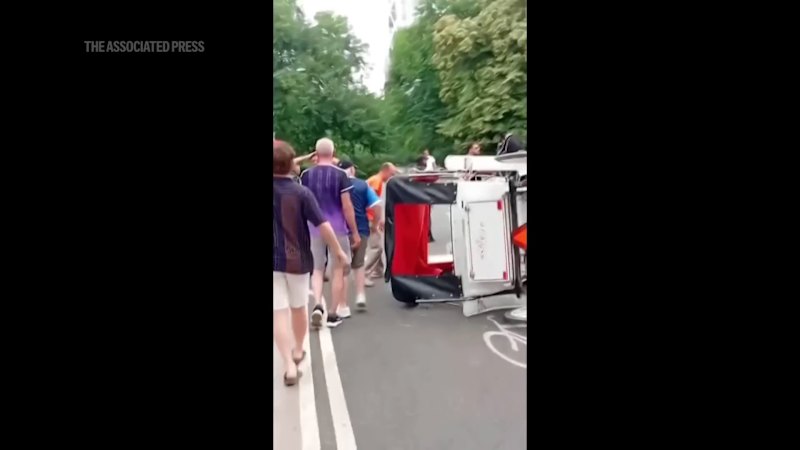
Fatalities resulting from a passenger jumping from a runaway horse carriage in New York expose a structural failure in risk allocation, human decision-making under acute stress, and urban street dynamics. Standard incident reporting treats such tragedies as isolated acts of fate or sudden animal misbehavior. That framing obscures the mechanics of how an ordinary recreational ride escalates into a life-threatening event and why a split-second choice to exit a moving vehicle carries catastrophic kinetic consequences. Because no external source text or incident log was provided here, this analysis evaluates the underlying risk architecture and causal chains rather than asserting unverified specifics about any single case.
To understand what goes wrong during a runaway carriage event, analysts must separate what is established by physics and operational reality from what remains an educated hypothesis in the absence of a full investigative record. Known facts include the basic biomechanics of equine locomotion, the kinetic energy of a moving carriage, and the high-friction, high-obstacle environment of dense city streets. By contrast, claims about the exact trigger of a spook, the precise speed at the moment of a jump, or the internal state of an occupant are hypotheses unless verified by physical evidence, witness accounts, or official records. Confusing the two leads to misplaced blame and ineffective safety measures.
The Four Risk Vectors of Urban Carriage Operations
A runaway carriage incident rarely stems from a single flaw. Instead, it emerges from the intersection of four operational vectors that govern how force builds and how people respond.
- Environmental Volatility: Urban streets introduce unpredictable sensory inputs—horns, sirens, construction noise, delivery vehicles, pedestrians, and shifting light—that can startle a draft animal even when handlers follow standard routines.
- Mechanical and Control Constraints: A horse pulling a wheeled carriage operates through harness, reins, and momentum. Once speed increases, stopping distance grows nonlinearly, and steering in tight traffic requires high leverage and room to maneuver.
- Human Threat Appraisal: Passengers and drivers experience time compression during sudden acceleration. When an animal bolts, occupants face an immediate conflict between staying inside an accelerating vehicle and exiting into an unpredictable street environment.
- Kinetic Exit Severity: Jumping from a moving carriage transfers forward velocity directly to the human body upon ground contact. Hard pavement, curbs, parked cars, and adjacent traffic turn a moderate rolling speed into a severe impact hazard.
The second limitation in most public commentary is treating exit behavior as irrational panic rather than a predictable reaction to perceived entrapment. A passenger inside a vehicle that is speeding up or veering toward traffic perceives loss of control. From the occupant's perspective, remaining seated can feel like surrendering to an escalating crash, while jumping feels like seizing agency. Yet biomechanics punishes that intuition: stepping or leaping out without training or controlled deceleration often sends the body pitching forward or sideways into unyielding asphalt or passing vehicles.
Causal Chains Behind a Fatal Jump
Conventional reporting typically compresses a multi-stage sequence into a single headline: a horse bolted, a passenger jumped, and a tragedy occurred. In operational terms, that compression erases the decision points where outcomes diverge.
The first link in the chain is the transition from controlled movement to loss of control. A horse may react to a sudden sound, a visual flash, physical discomfort, or an abrupt change in footing. When forward acceleration outpaces the driver's ability to restore calm and directional command, the system enters an unstable state. Noise and movement in surrounding traffic then compound the problem, narrowing the driver's options and increasing the risk of collision with stationary or moving objects.
The second link is the passenger's risk miscalculation under stress. Most riders have no mental model of how speed translates into ground impact. A carriage moving at a brisk trot or canter may feel manageable from a cushioned seat, yet the horizontal velocity carried by a person leaving that seat is substantial. If the jumper lands off-balance, strikes a curb or vehicle, or enters the path of other traffic, secondary blunt-force trauma or crush injury becomes far more likely than a clean roll or recovery.
High-consequence decisions made in under two seconds frequently rely on intuitive risk estimates that fail when velocity and street friction enter the equation.
Consider a conceptual illustration of two riders facing the same runaway event. Rider A remains seated, braces against the carriage structure, and relies on whatever containment and steering control the driver retains. Rider B decides that staying aboard is intolerable and jumps toward the side of the street. Even if Rider B clears the carriage wheel, the combination of forward momentum, awkward landing angle, and hard pavement or nearby obstacles can produce severe head or torso trauma. Conversely, if the carriage itself strikes a solid barrier, occupants inside face crash forces. Neither path guarantees safety once control is lost, which underscores why prevention upstream matters far more than improvisation mid-runaway.
Why Standard Narratives Miss the Real Bottlenecks
Public debates around urban horse carriages often polarize into moral stances rather than systems analysis. One side emphasizes tradition, tourism value, and operator experience; the other focuses on animal welfare, street congestion, and inherent hazard. Both positions tend to overlook operational bottlenecks that determine day-to-day safety.
One major bottleneck is situational awareness in mixed traffic. Unlike dedicated tracks or closed courses, public streets mix vulnerable road users, cyclists, motorcycles, cars, buses, and pedestrians within feet of one another. A driver managing reins and scanning ahead for sudden lane changes or openings faces high cognitive load the moment traffic turns erratic.
A second bottleneck is post-incident information gaps. When a serious or fatal incident occurs, early headlines often rely on incomplete fragments before official reconstruction, medical findings, or video review are available. Treating preliminary details as settled fact distorts policy discussions and obscures which specific link in the chain—equipment, traffic interaction, driver response, or passenger action—failed.
Operational Controls and Their Practical Limits
Improving safety around high-risk street operations requires evaluating controls by what they actually prevent and where they fall short. No single measure eliminates risk in a complex urban environment.
- Route and Traffic Separation: Restricting operations to lower-speed corridors or designated zones reduces exposure to high-speed vehicles and dense cross-traffic, though it cannot remove all pedestrians, cyclists, or sudden street noises.
- Handler Training and Equipment Standards: Rigorous driver preparation, routine tack and harness inspection, and clear emergency protocols improve control margin, yet no equipment can completely override a severe startle response in every situation.
- Passenger Briefing and Restraint Design: Clear pre-ride instructions on staying seated and holding on during emergencies can counter impulsive exits, though fear in an acute crisis can still override prior advice.
- Incident Reconstruction and Data Tracking: Systematic review of near-misses, spook triggers, traffic conflicts, and injury mechanisms builds an empirical baseline, provided reporting captures environmental context rather than just outcomes.
Every control carries trade-offs and limits. Tighter restrictions can reduce exposure but may create friction with permit holders, tourism operators, or municipal enforcement capacity. Meanwhile, relying solely on behavioral advice—telling passengers never to jump—ignores how human beings act when terrified. Effective risk management pairs clear passenger guidance with structural reductions in speed, traffic conflict, and environmental shock.
Strategic Play for Risk and Policy Decision-Makers
Treat every runaway carriage incident as a systems-failure audit rather than an isolated anomaly, and anchor any operational or regulatory response in verified reconstruction data before enacting sweeping rules. Operators, insurers, and municipal regulators should map each event across four discrete stages—trigger, loss of control, exit or impact decision, and injury mechanism—and target interventions where exposure and severity overlap most sharply: separating operations from high-conflict traffic corridors, standardizing pre-ride safety briefings that explicitly address why jumping heightens impact risk, and enforcing transparent incident logging. Even disciplined controls cannot make street travel risk-free, so the decisive strategic move is to shrink the frequency of runaway triggers and limit kinetic exposure before panic ever begins.