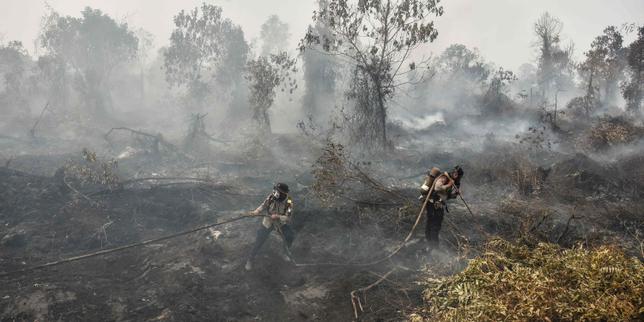
Peatland fires across the islands of Borneo and Sumatra represent a distinct class of environmental disaster, fundamentally different from standard forest blazes. When surface vegetation ignites, public attention fixes on the visible smoke plumes, yet the primary thermodynamic engine burns underground within compacted layers of dead organic matter. These subterranean fires consume centuries of accumulated carbon under conditions of oxygen starvation, creating self-sustaining thermal anomalies that resist standard suppression tactics. Understanding why these fires become uncontrollable requires deconstructing the physical composition of peat, the hydrology of cleared drainage canals, and the economic incentives driving agricultural conversion.
The Thermodynamic Mechanics of Subsurface Peat
Standard wildfire suppression relies on two variables: fuel removal and water application to lower surface temperatures below the combustion threshold. Peat renders both variables obsolete through its chemical and structural profile. Peat is not wood; it is a dense, highly organic soil matrix composed of partially decayed plant material accumulated over thousands of years under waterlogged conditions.
When commercial developers or smallholders drain a peatland for agriculture—predominantly oil palm and acacia plantations—the water table drops. The once-saturated organic sponge dries out, exposing carbon deposits to atmospheric oxygen.
[Hydrological Drainage] -> [Water Table Drops] -> [Peat Desiccation] -> [Subsurface Ignition Vector]
Once ignited by surface clearing or accidental sparks, peat burns through smoldering combustion rather than flaming combustion.
- Thermal Insulation: Dry peat possesses extremely low thermal conductivity, trapping heat within the underground matrix rather than dissipating it into the air.
- Oxygen Autonomy: The microscopic pore structure of compressed peat retains sufficient trapped oxygen to sustain slow smoldering reactions even when surface suppression coats the topsoil with water.
- Depth Proliferation: Fire fronts move vertically downward as well as horizontally, burning meters beneath the surface where pressurized water streams from firefighting aircraft cannot penetrate.
Surface dousing extinguishes visible flames while leaving subterranean thermal pockets intact. These pockets can smolder undetected for weeks during dry seasonal cycles, only to flare back into open surface fires when wind shifts introduce fresh oxygen channels.
The Hydrological Deficit and Canal Networks
The vulnerability of Sumatra and Borneo stems directly from structural alterations to regional hydrology. Natural peatlands function as massive sponges, maintaining high saturation levels that naturally inhibit combustion even during extended dry phases.
To convert these wetlands into arable land, commercial operators dig extensive networks of drainage canals. These canals accelerate water runoff, intentionally lowering the water table to make the soil firm enough for heavy machinery and commercial crops. This engineering intervention creates an acute hydrological deficit.
During normal precipitation cycles, the system remains fragile. When meteorological anomalies such as El Niño suppress seasonal rainfall, the water table drops far below the critical threshold required to maintain soil saturation. The drainage canals transform into vectors of vulnerability. Instead of retaining moisture, the dried canal networks facilitate the rapid spread of drought conditions across millions of hectares. The structural drying of the landscape ensures that any ignition source—whether intentional land-clearing or accidental friction—encounters an uninterrupted fuel continuum across concession boundaries.
Economic Incentives and Enforcement Asymmetry
The persistence of these fires cannot be understood through physical science alone; it requires analyzing the cost function of land preparation. Clearing secondary forest or scrubland requires heavy mechanical equipment, labor, and capital investment. Fire offers a zero-cost alternative for land clearance, rapidly removing biomass and depositing nutrient-rich ash into the soil.
Even when strict moratoria on slash-and-burn practices exist, the economic calculus for smallholders and independent contractors favors illicit burning. The probability of detection combined with the low enforcement capacity across remote jungle concessions yields an expected penalty value far below the cost of mechanical clearing.
- Detection Lag: Satellite monitoring identifies thermal anomalies only after ignition has occurred, introducing a time delay before investigative or law enforcement units can mobilize.
- Jurisdictional Fragmentation: Concession ownership boundaries often obscure ultimate corporate liability, as shell companies or fragmented supply chains insulate parent corporations from judicial penalties.
- Resource Constraints: Local disaster management agencies face severe logistical constraints when attempting to police thousands of remote hectares simultaneously during peak dry seasons.
When state actors respond with mass arrests or temporary suspensions, they address the symptoms of compliance failure rather than the structural profitability of using fire as an agricultural tool.
Regional Atmospheric Externalities and Public Health Metrics
The combustion of tropical peat releases disproportionate volumes of particulate matter and greenhouse gases compared to standard biomass burning. Because peat contains concentrated carbon accumulated over millennia, its combustion transfers ancient carbon stores directly into the atmosphere at an accelerated rate.
The resulting atmospheric haze blankets not only local population centers in Sumatra and Borneo but crosses international maritime borders, affecting neighboring population hubs. The economic friction caused by reduced visibility, closed educational institutions, and grounded flights creates a multi-sector crisis. Public health systems absorb the primary shock. Inhaling fine particulate matter—specifically PM2.5 generated by smoldering organic matter—triggers acute respiratory distress, cardiovascular complications, and elevated rates of premature mortality across millions of residents. Medical infrastructure in affected provinces frequently experiences surge capacities, running short of filtration equipment, oxygen supplies, and specialized respiratory care units.
Mitigating recurrent regional crises requires shifting capital allocation from reactive firefighting to mandatory hydrological restoration. Peatland recovery depends on blocking drainage canals, re-establishing high water tables, and re-wetting dried organic layers to restore the natural moisture barrier that prevents subterranean ignition. Until industrial concession management aligns with the physical limits of tropical hydrology, the landscape will remain vulnerable to thermal runaway.



