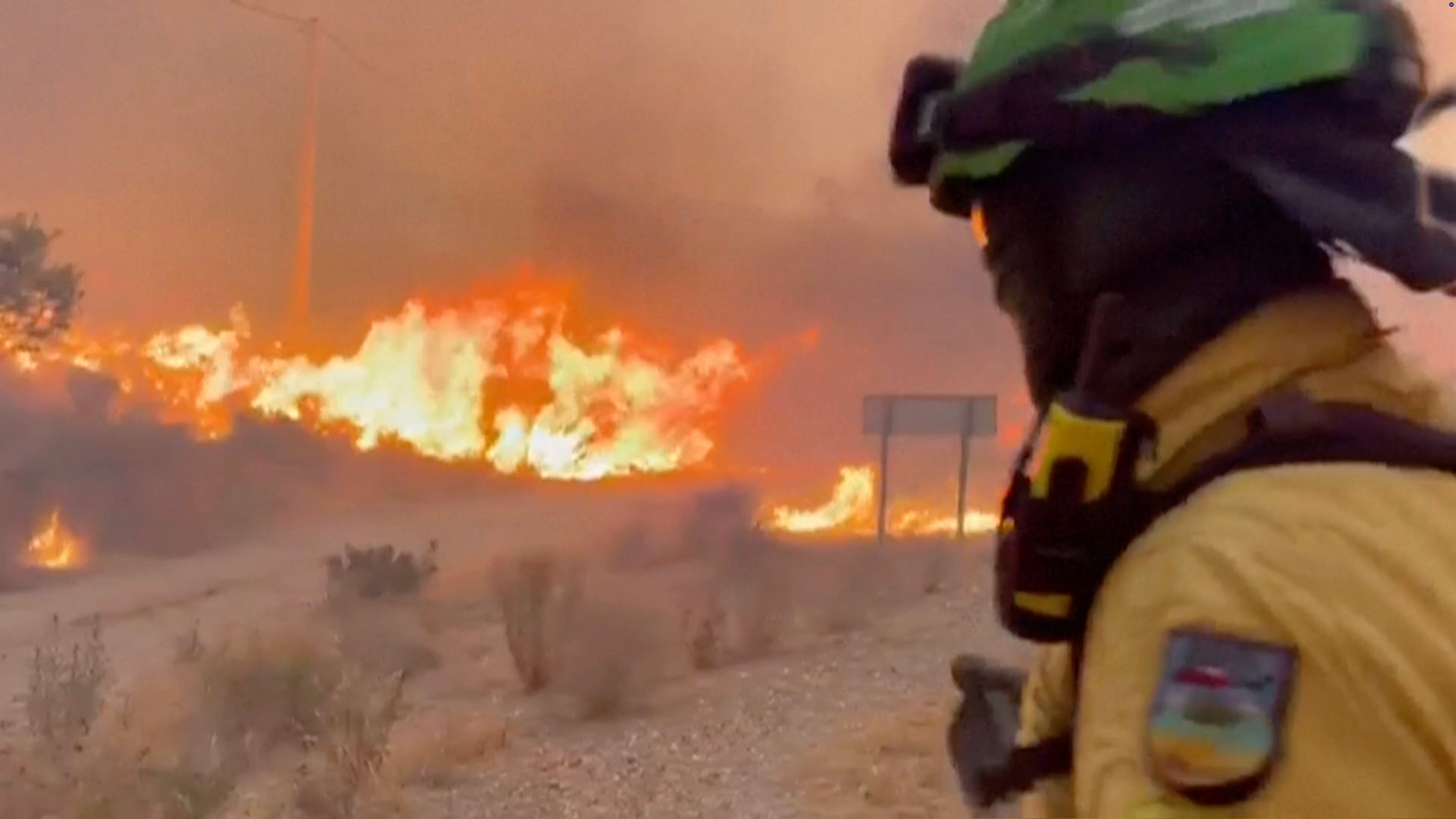
The catastrophic wildfire in Spain’s southern province of Almeria, which has claimed at least 12 lives and left 23 people missing near the Sierra de Los Filabres mountains, reveals a critical failure mode in emergency management: the asymmetric risk of uncoordinated vehicular evacuation versus structured sheltering in place. Preliminary assessments indicate that the vast majority of fatalities occurred not due to a lack of tactical firefighting resources, but because civilians—primarily foreign nationals—evacuated into an active thermal path. When extreme meteorological conditions converge with highly combustible fuel loads, public non-compliance with emergency directives creates an immediate bottleneck that transforms civilian infrastructure into a structural trap.
Understanding this disaster requires deconstructing the event into three distinct analytical components: the thermal velocity equations of the fire, the communication breakdown within the localized demographic, and the structural morphology of the physical landscape that impeded escape.
The Fire Behavior Matrix: Fuel, Wind, and Thermal Velocity
The rapid expansion of the Almeria blaze, which consumed over 3,200 hectares of forest and semi-arid farmland within its initial hours, stems from a predictable three-factor compounding mechanism. Wildfire propagation velocity under extreme conditions can be modeled through the intersection of cumulative fuel dryness, localized atmospheric pressure gradients, and topographically driven wind amplification.
- The Fuel Load: Multi-week heatwaves exceeding 40°C lowered the fuel moisture content of the local vegetation—predominantly scrubland, pine forest, and esparto grass—to critical thresholds. This created a highly receptive fuel bed where the energy required for ignition approached zero.
- The Ignition and Initial Acceleration: Unconfirmed reports attribute the ignition to a fallen power line in a rural hamlet. In a parched landscape, such an arc produces an instantaneous fire brand, allowing the blaze to skip the initial smoldering phase and transition directly into a high-intensity canopy fire.
- Topographic Wind Convection: The proximity to the Sierra de Los Filabres introduced a chimney effect. As heated air rose rapidly along the mountain slopes, it drew in cooler, denser air from the lowlands, creating self-sustaining convective winds that propelled the fire front forward at speeds that outpaced localized vehicular traffic.
This combination generated what fire scientists classify as an eruptive fire behavior matrix. Under these parameters, the radiant heat emission ahead of the physical flame front is sufficient to ignite vehicles and structures before direct contact occurs, invalidating standard civilian flight timelines.
The Evacuation Paradox: Why Flight Proved Fatal
The distinguishing characteristic of the Almeria tragedy is the high concentration of fatalities among individuals who attempted to flee rather than utilizing shelter-in-place protocols. Emergency services confirmed that 11 of the 12 deceased individuals were discovered either inside burnt-out vehicles or within close proximity to them after abandoning them on foot. This behavior exposes a critical breakdown in risk perception during acute crises.
[Emergency Alert Sent]
       │
       ▼
[Recipient Population] ──(Language/Cultural Barrier)──► [Misinterpretation of Protocol]
       │                                                          │
       ▼ (Compliant: Stay Put)                                    ▼ (Non-Compliant: Flight)
[High-Mass Structural Shielding]                           [Improvised Escape Route Deployment]
       │                                                          │
       ▼                                                          ▼
[Survival Optimization]                                    [Convective/Radiant Heat Trap]
The first limitation of uncoordinated evacuation is the thermal vulnerability of standard civilian automobiles. Modern vehicles are not designed to withstand high levels of radiant flux. When caught in a wildfire plume, engines quickly stall due to oxygen starvation caused by dense smoke and ash ingestion. Once a vehicle immobilizes, the thin aluminum and glass exterior provides minimal thermal insulation, rapidly turning the cabin into a convection oven.
The second bottleneck involves spatial terrain limitations. Evacuees in Almeria attempted to navigate improvised routes, including a dry riverbed. While topographically intuitive as an open pathway free of standing vegetation, a dry riverbed acts as a low-resistance corridor for superheated gases, smoke, and convective wind. When the fire front shifted, this geographic trench became an unescapable cul-de-sac. Seven victims who abandoned their vehicles to escape via this route on foot were overcome by thermal exhaustion and smoke inhalation within minutes.
The Expat Information Asymmetry
A significant variable in the fatality distribution is the demographic composition of the affected zone. The region near Los Gallardos hosts a dense concentration of foreign retirees and expats, including British nationals. This cohort faces specific systemic vulnerabilities during natural disasters that regional emergency frameworks frequently fail to mitigate.
First, language barriers delay the consumption of real-time emergency broadcasts. While native residents react immediately to regional alert networks, broadcast media, and local law enforcement instructions, non-native populations face a cognitive delay while translating instructions or searching for secondary confirmation within expat networks.
Second, a lack of historical context regarding Iberian fire dynamics alters risk calculation. Individuals accustomed to northern European climates often underestimate the velocity of an alpine or semi-arid wildfire fueled by dry Mediterranean vegetation. This unfamiliarity leads to the false assumption that a vehicle provides a safe, mobile envelope capable of outrunning a blaze, directly driving the non-compliance with explicit shelter-in-place orders issued by Andalusian emergency authorities.
Systemic Preparedness Limitations and Strategic Protocols
The response infrastructure deployed by Spain—comprising 150 regional firefighters and 220 personnel from the Military Emergency Unit (UME)—represents a massive tactical capability. However, the Almeria deployment highlights a fundamental limitation: suppression forces cannot offset the defensive deficits of an unhardened wildland-urban interface (WUI) during the initial explosive phase of a fire.
To minimize civilian casualties in future high-velocity WUI blazes, municipal and regional planning must pivot toward a hard-coded defensive framework.
Municipalities must enforce mandatory vegetation clearance zones of at least 30 meters around all residential structures in semi-arid zones to decouple homes from wildland fuel sources. Emergency alert mechanisms require structural upgrades to automatically broadcast multi-lingual, high-definition spatial instructions based on the real-time geolocation of foreign-registered mobile devices. Furthermore, community design must incorporate designated, clear-span communal thermal refuges within expat communities, ensuring that staying put remains a physically viable option when roads become compromised.
Regional emergency managers must operate on the principle that during an eruptive fire event, civilian movement on public roads represents the highest single point of failure in the life-safety matrix. Tactical efforts during the first 60 minutes of an ignition must prioritize the physical enforcement of roadblocks to prevent flight, forcing reliance on internal structural sheltering until thermal intensity subsides.