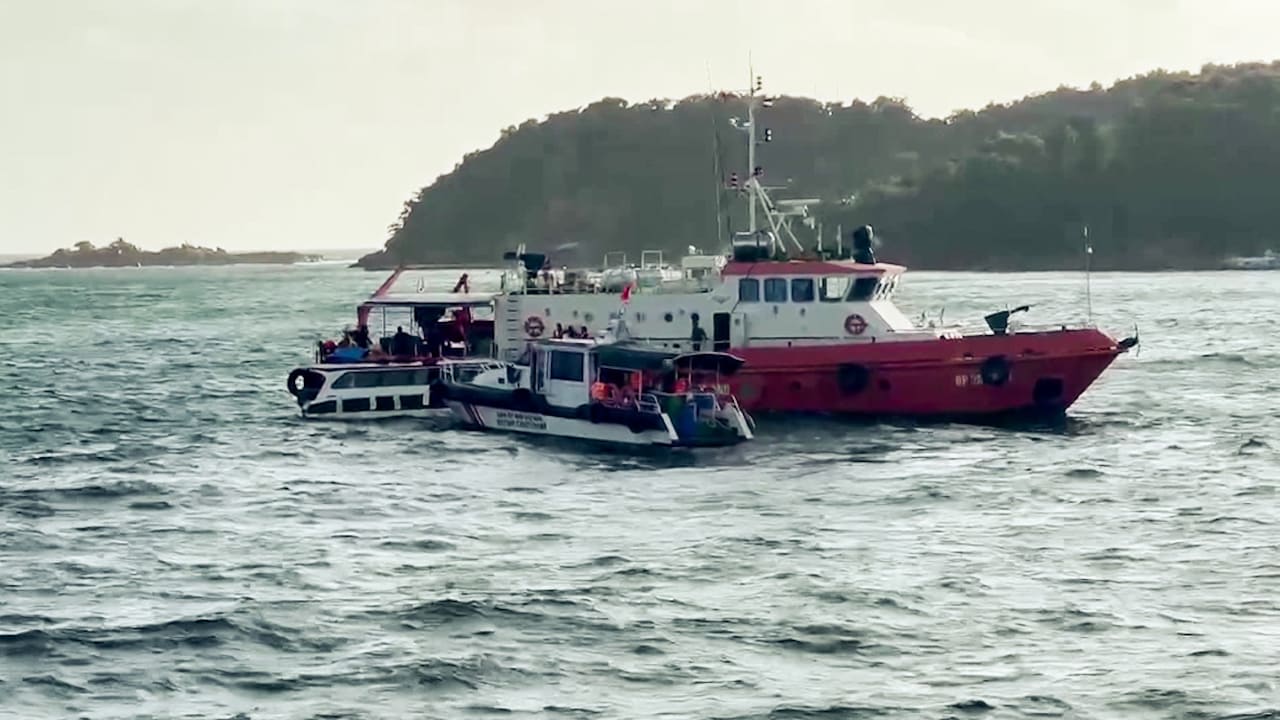
The fatal capsizing of a commercial speedboat carrying 32 Indian transit passengers and 4 local crew members off Hon May Rut Ngoai island, near Phu Quoc, Vietnam, exposes deep vulnerabilities in the structural oversight of international corporate incentive travel and regional maritime safety protocols. This systemic failure resulted in 15 confirmed fatalities—comprising 10 individuals from Tamil Nadu, 3 from Andhra Pradesh, and 2 from Kerala—all of whom were part of a corporate incentive cohort for an Indian mobile manufacturing firm.
When a high-density, closed-hull vessel undergoes dynamic instability under half a kilometer from the shore, the resulting disaster is rarely the product of a single isolated failure. Instead, it represents a compounding sequence where environmental stressors, design limitations, and localized infrastructure deficits converge. Deconstructing this event requires an examination of three operational vectors: the physics of vessel instability in a closed-hull architecture, the logistical bottlenecks governing near-shore emergency response, and the administrative mechanisms deployed during rapid cross-border repatriation.
The Kinematics of Inversion: Closed Hull Dynamics and Environmental Stressors
A preliminary assessment of the accident indicates that the vessel, operating approximately 400 meters off the coast of Hon May Rut Ngoai island, encountered sudden meteorological deterioration characterized by high-amplitude wave action and elevated localized wind velocities. The transition from stable transit to catastrophic capsizing can be modeled through the intersection of hull geometry, load distribution, and hydrodynamic forces.
The vessel in operation was a closed-hull speedboat. While closed-hull configurations offer superior aerodynamic profiles and protection from basic ambient spray, they introduce structural risks during an uncontrolled inversion. In an open-hull vessel, passengers are frequently ejected into the water column upon capsizing, which, assuming functional personal flotation devices (PFDs), permits immediate surfacing. Conversely, a closed-hull geometry creates a structural overhead barrier when inverted, effectively transforming the passenger cabin into a localized overhead environment. Surviving passengers reported that multiple individuals became trapped inside the submersed cabin architecture, requiring exit through shattered window frames while fighting dynamic water ingress.
This structural hazard was compounded by three distinct mechanical and behavioral variables:
- The Free Surface Effect and Mass Displacement: Witness accounts indicate that passengers were engaged in widespread photography immediately prior to the incident. In a narrow-beam speedboat, the sudden lateral movement of passengers to one side of the vessel creates a rapid shift in the center of gravity. This lateral shift reduces the metacentric height—the distance between the center of gravity and the metacenter—which directly diminishes the vessel’s natural righting leverage. When a large external wave strikes the hull concurrently with this internal mass displacement, the rolling moment exceeds the restoring stability of the vessel, initiating an irreversible capsizing sequence.
- Volumetric Overloading vs. Structural Capacity: The vessel was carrying 36 occupants (32 passengers and 4 crew). Speedboats deployed in regional archipelagic transit are frequently optimized for maximum passenger density rather than structural resilience against cross-current vectors. If the total passenger weight approached or exceeded the maximum rated displacement of the craft, the baseline freeboard—the distance from the waterline to the upper deck—would be significantly compromised, allowing low-amplitude waves to swamp the deck and rapidly degrade buoyancy.
- Hydrodynamic Wave Coupling: Operating near coastal landmasses like Hon May Rut Ngoai often subjects small vessels to shoaling waves, where the shallowing seafloor increases wave height and steepness. A vessel traveling parallel to these wave crests risks "broaching to"—a phenomenon where the ship is forced broadside to the wave, maximizing the lateral surface area exposed to the kinetic energy of the water and causing an immediate roll-over.
Emergency Response Deficits in Archipelagic Tourism
The survival rate of a near-shore maritime incident depends heavily on the execution velocity of the initial response phase. In this instance, nearby civilian and commercial vessels executed the primary extraction of survivors within an estimated five-minute window, followed by secondary deployment from the An Thoi Border Guard Station, the Vietnamese Navy, and Coast Guard Region 4. However, the operational efficacy of the rescue was severely bottlenecked upon reaching the shoreline.
Survivors noted a total absence of dedicated emergency medical services (EMS) or triage infrastructure at the immediate landing point on the island. This gap highlights a common failure mode in rapidly developing tourist economies: the asymmetry between commercial marketing capacity and localized medical infrastructure.
[Vessel Capsizes 400m Offshore]
       │
       ▼
[Primary Extraction by Civilian Crafts (T+5 Mins)]
       │
       ▼
[Transit to Shoreline Landing Point]
       │
       ▼
[CRITICAL BOTTLENECK: Zero Localized EMS / Triage Infrastructure]
       │
       ▼
[Secondary Transit to Off-Island Medical Facilities]
When multi-casualty incidents occur in remote or archipelagic settings, the lack of immediate advanced life support (ALS) at the water's edge creates a dangerous transit delay. Submersion victims experiencing acute respiratory distress, secondary drowning, or severe hypothermia require immediate stabilization, oxygenation, and positive-pressure ventilation. Forcing critically injured survivors to endure secondary transit to larger medical facilities across the channel or on the main island of Phu Quoc significantly extends the period of unmitigated physiological stress. This structural deficit directly shifts the status of patients from stable to critical.
Corporate Liability and the Mechanics of Transnational Repatriation
Because this excursion was an executive incentive trip organized for an extensive distributor and dealer network, the incident triggers complex layers of corporate duty of care, multi-jurisdictional legal accountability, and state-level diplomatic intervention.
The operational architecture of international incentive travel typically involves a primary corporate entity contracting a domestic travel agency, which then subcontracts a Destination Management Company (DMC) within the destination state, who finally hires local transportation vendors. This multi-tiered supply chain frequently obfuscates liability and dilutes safety enforcement.
[Corporate Entity (India)]
       │
       ▼ (Primary Contract)
[Domestic Travel Agency (India)]
       │
       ▼ (Subcontract)
[Destination Management Company (Vietnam)]
       │
       ▼ (Local Service Contract)
[Local Maritime Transport Vendor]
To manage the fallout, the administrative response requires tight synchronization between state governments, federal ministries, and foreign diplomatic missions. The recovery and repatriation framework established for the deceased passengers from Andhra Pradesh, Tamil Nadu, and Kerala relies on a specific sequence of administrative protocols designed to navigate international sovereignty constraints:
- Consular Verification and Identity Mapping: The Indian Consulate General in Ho Chi Minh City established dedicated emergency operations units to interface directly with the Vietnamese Ministry of Foreign Affairs and local border guard detachments. This step is necessary to reconcile passenger manifests against recovered bodies, managing the complications introduced when victims possess identical surnames or lack matching physical identification documentation post-incident.
- The Legal-Medical Clearance Sequencing: Before mortal remains can clear international airspace, they must clear a rigid sequence of local administrative steps. The host nation must complete a formal forensic investigation into the cause of death—a process accelerated in this instance by a direct investigative mandate from Vietnamese Prime Minister Le Minh Hung. Following the investigation, local authorities must issue official death certificates, embalming certifications, and non-contagious disease clearances.
- Inter-Governmental Logistics Coordination: At the domestic level, the Real-Time Governance Society (RTGS) Command and Control Centre in Andhra Pradesh, alongside parallel state organs in Tamil Nadu and Kerala, acted as the primary data clearinghouse. These bodies coordinate with the Ministry of External Affairs (MEA) in New Delhi and state-specific representative offices (such as Andhra Pradesh Bhavan and Tamil Nadu House) to manage the customs clearance, cargo routing, and final domestic transport of the deceased to their respective home districts, including Machilipatnam, Kadapa, and Hindupur.
Strategic Imperatives for Corporate and Jurisdictional Risk Mitigation
Preventing the recurrence of multi-casualty transit failures during international corporate operations requires moving away from reactive diplomacy and toward proactive risk management frameworks. Organizations utilizing international destinations for large-scale corporate deployments must institute mandatory, non-negotiable vendor vetting protocols. These frameworks must evaluate the underlying operational mechanics of every local transport provider, looking past surface-level marketing materials.
Corporate procurement policies must require all international DMCs to provide audited verifications of their subcontractors' safety configurations. These audits must verify the presence of active vessel tracking telemetry, certified hull stability ratings that match local seasonal weather patterns, and verified passenger-to-PFD ratios. Furthermore, corporate logistics teams must assess the localized medical infrastructure of any tour site. If a destination features zero edge-of-dock triage or emergency medical capabilities within a fifteen-minute transit radius, the location must be classified as a high-risk operational zone, requiring either the deployment of independent, contracted medical personnel or the selection of an alternative transit route.
Concurrently, regional maritime authorities in expanding tourism corridors must enforce structural reforms on local transport fleets. This involves mandating automated weather alert systems linked directly to vessel ignition overrides, banning high-density closed-hull configurations on small speedboats prone to rapid inversion, and establishing permanent, government-subsidized emergency stabilization clinics at major archipelagic transit nodes. Until these risk-mitigation architectures are structurally integrated into both corporate travel procurement and host-nation maritime enforcement, the expansion of global tourism corridors will continue to outpace the safety systems required to protect international travelers.