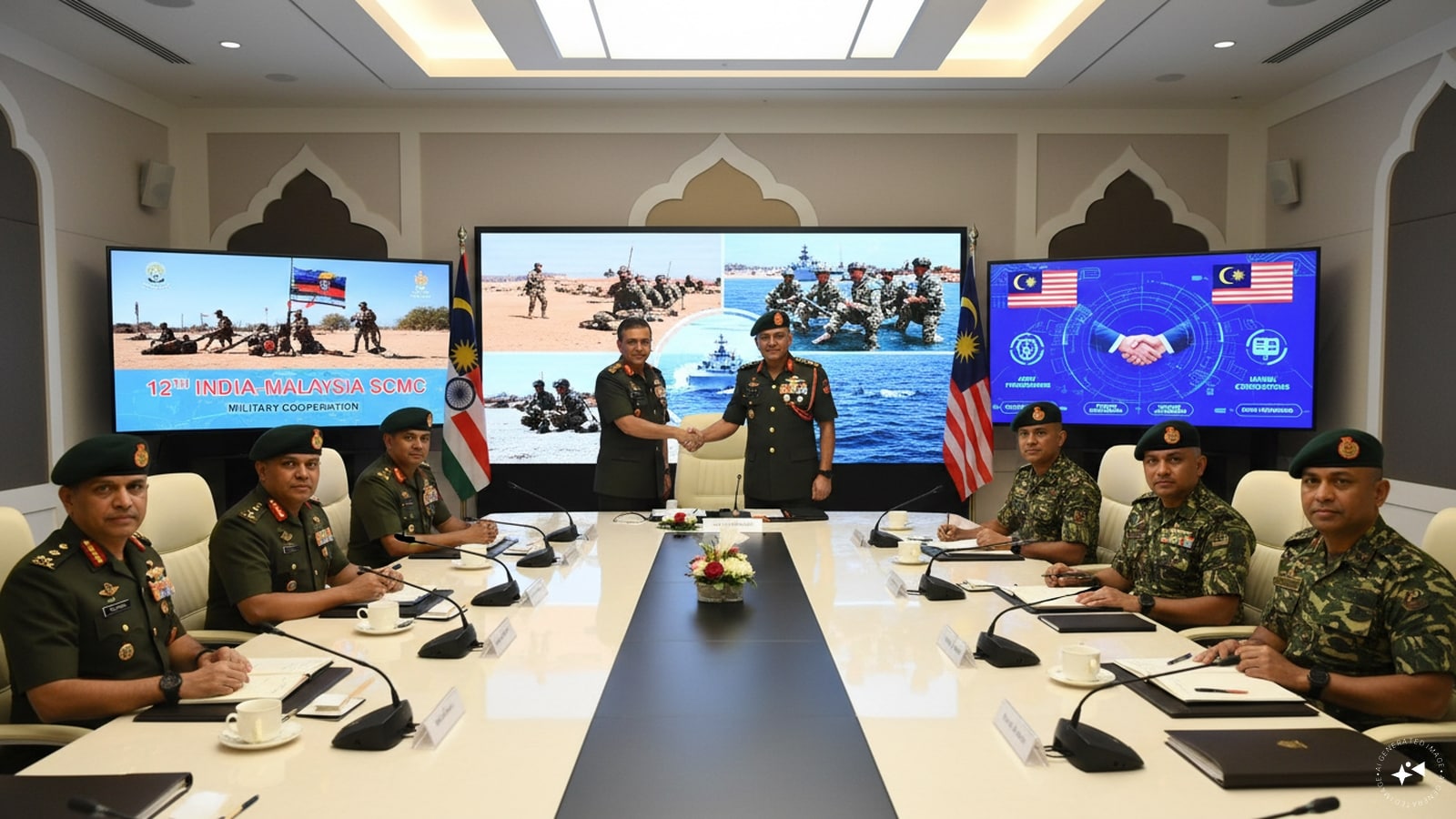
The 12th India-Malaysia Sub Committee Meeting on Military Cooperation (SCMC) held in New Delhi on July 1, 2026, marks a calculated shift from diplomatic signaling to hard-target structural alignment. While mainstream reporting frames these talks as a routine review of bilateral exercises and training, a rigorous operational analysis reveals a deeper mechanization: both nations are actively building institutional architecture to insulate their defense infrastructure from shifting Indo-Pacific power vectors.
The security relationship, upgraded during the February 2026 Putrajaya Summit to a Comprehensive Strategic Partnership, functions via a multi-tiered consultative hierarchy. The SCMC serves as the primary tactical-to-operational conveyor belt. Co-chaired by India’s Joint Secretary of the Ministry of Defence, Amitabh Prasad, and Malaysia’s Assistant Chief of Staff for Defence Operations and Training, Major General Amer Mahmud Bin Abdul Rahman, its core objective is to translate policy directives into high-level military execution before the higher-level India-Malaysia Defence Cooperation Meeting occurs at the Defence Secretary tier.
The Tri-Border Strategic Matrix
The defense alignment operates across three distinct operational pillars, each addressing a specific vulnerability within the regional security architecture.
1. Interoperability Mechanics and Tactical Synchronization
The first pillar focuses on standardizing tactical procedures between the Indian Armed Forces and the Royal Malaysian Armed Forces. This is executed through bilateral drills, notably the Harimau Shakti exercise sequence, whose fifth iteration concluded in Rajasthan in December 2025.
The operational output of these exercises is not mere diplomatic optics; it acts as a stress test for tactical integration. The primary metric of success here is the reduction of command-and-control lag during combined operations. By expanding vacancies in each other's elite military courses and training institutions, the two militaries establish a shared baseline of operational doctrine. This baseline reduces the initialization friction required to stand up joint task forces during regional contingencies.
2. Maritime Domain Awareness and SLOC Protection
The Malacca Strait forms the primary chokepoint connecting the Indian Ocean to the South China Sea. For India, ensuring unhindered Sea Lines of Communication (SLOCs) through this corridor is a core economic interest. For Malaysia, maintaining territorial integrity and exclusive economic zone (EEZ) rights requires a high degree of maritime domain awareness (MDA).
The operational reality relies on regular operational deployments rather than fixed naval structures. The naval visits of the guided-missile frigate INS Sahyadri to Kemaman in October 2025 and the survey vessel INS Sandhayak to Port Klang in July 2025 demonstrate the mechanics of this cooperation. These deployments serve two functional purposes:
- Hydrographic Data Exchange: Maximizing underwater bathymetric data to improve submarine and anti-submarine warfare capabilities in the shallow, congested waters of the Malacca Strait.
- Coordinated Patrol Optimization: Aligning radar and tracking feeds between India’s Andaman and Nicobar Command and Malaysia’s naval centers to create a continuous operational picture of transiting commercial and military vessels.
3. Industrial and Technological Tech Transfer
A significant development during the July 2026 SCMC was the deliberate focus on Indian Defence Public Sector Undertakings (DPSUs). The Malaysian delegation’s formal visit to the DPSU Bhawan at the World Trade Centre in New Delhi signals an intent to move the relationship from a buyer-seller arrangement to a co-development framework.
Malaysia’s ongoing defense modernization program requires reliable supply chains for spare parts, maintenance, and electronic subsystems. India’s domestic defense manufacturing infrastructure offers a diversification pathway away from traditional Western or Russian suppliers, whose production capacities face severe constraints due to active global conflicts. The primary technical focus areas during these talks included cyber security integration, unmanned aerial vehicle (UAV) systems, and localized logistics hubs.
The Multi-Lateral Sub-System: ADMM-Plus and Counter-Terrorism
Bilateral defense ties do not exist in a vacuum; they serve as a testing ground for wider regional integration. Under the ASEAN Defence Ministers’ Meeting-Plus (ADMM-Plus) framework, India and Malaysia co-chair the Expert Working Group on Counter-Terrorism for the 2024–2027 cycle.
This co-chairmanship moves beyond theoretical white papers. The structural milestone for 2026 is the upcoming Expert Working Group Table-Top Exercise (EWG CT TTX) hosted by Malaysia. The execution logic of a Table-Top Exercise relies on a simulated command structure designed to achieve specific goals:
[Simulated Transnational Threat Vector]
                  │
                  ▼
[ADMM-Plus Combined Command Cell] ──► [Joint Intel Synthesis]
                  │
                  ▼
[De-conflicted Operational Directives] ──► [Tactical Unit Deployment]
The primary objective is the creation of a unified crisis-response protocol capable of overriding disparate national command structures when responding to asymmetric threat vectors, such as cyber warfare targeting critical infrastructure or maritime piracy networks operating across multiple jurisdictions.
Structural Constraints and Strategic Bottlenecks
A realistic assessment of the Indo-Malaysian defense matrix requires identifying the limitations inherent to both states' geopolitical positioning.
The first constraint is the principle of strategic autonomy. Malaysia maintains a strict policy of non-alignment, choosing to preserve functional diplomatic and economic ties with all major global powers. Kuala Lumpur will not participate in any bilateral defense initiative that mimics a formal military alliance or targets a specific third country. Consequently, the defense cooperation remains strictly functional, focused on capacity building, humanitarian assistance and disaster relief (HADR), and international law adherence rather than joint offensive projections.
The second bottleneck is defense procurement compatibility. While India has made progress in domestic defense manufacturing, its export mechanisms remain complex and bureaucratic. Malaysia's procurement cycles are highly sensitive to domestic budgetary reallocations. This creates a lag between the identification of mutual industrial opportunities at the SCMC level and the execution of actual procurement contracts or joint development initiatives.
Strategic Recommendation
To maximize the value of the 12th SCMC agreements, operational planners must transition from broad institutional reviews to the implementation of discrete, micro-level integration targets.
The immediate tactical priority must be the formalization of a secure, real-time data-sharing protocol linking the Indian Navy’s Information Fusion Centre for the Indian Ocean Region (IFC-IOR) with Malaysia's National Maritime Command Centre. By institutionalizing an automated track-sharing mechanism for white shipping, both nations can optimize asset allocation, freeing up surface combatants from routine monitoring and allowing them to focus on high-end combat readiness and specialized anti-submarine training. This shift converts high-level political intent into a measurable, daily operational capability.