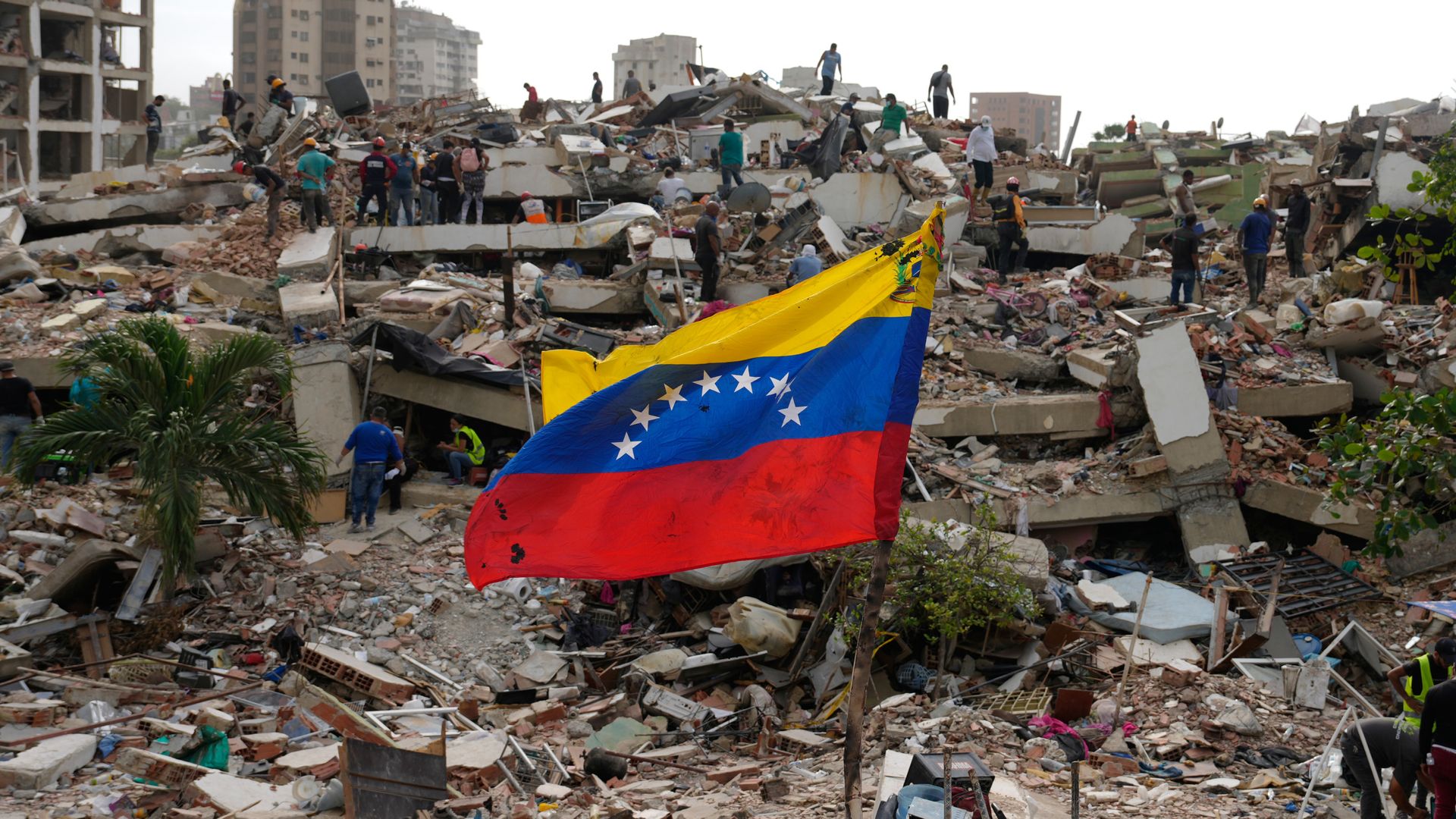
In high-consequence disasters, information integrity and state legitimacy share a direct causal link. When twin earthquakes measuring 7.2 and 7.5 magnitude struck Venezuela, the immediate administrative friction was not merely tectonic, but systemic. The newly established, U.S.-backed interim administration led by Acting President Delcy Rodríguez faced a critical optimization problem: balancing acute resource scarcity against a highly polarized information ecosystem.
The public pushback from state officials labeling local and international reporting as "disgraceful misinformation" reflects a classic defense mechanism deployed during state capacity failures. Rather than viewing this friction as a simple political dispute, an analytical breakdown reveals how infrastructural deficits, structural integrity failures in state housing, and digital information anomalies converge to challenge government authority.
The Information Asymmetry Model
State legitimacy during a humanitarian crisis depends heavily on the speed and verification of casualty data. In Venezuela, a widening gap has emerged between official government registries and crowdsourced data tracking models.
While the official state count verified 2,295 fatalities, the political opposition deployed an independent web-based portal that aggregated over 38,000 unique reports of missing persons. This stark divergence highlights a systemic bottleneck in data processing.
[State Registry Process]  ---> Rigorous Verification ---> Slow Output (2,295 Dead)
                                                                 ▲
                                                                 │ (Data Disconnect)
                                                                 ▼
[Crowdsourced Portal]     ---> Unverified Reports   ---> Rapid Scale (38,000 Missing)
The administration's communication strategy operates on a strict verification model. The objective is to limit speculative panic by releasing numbers only after absolute administrative confirmation. This protocol, however, creates an informational vacuum.
Under conditions of zero official state communication regarding missing persons, independent entities fill the void using unverified web registries. The structural consequence is a bifurcated narrative: a conservative, slow-moving official count versus a hyper-inflated, rapid-scaling crowdsourced metric. The administration's choice to label external metrics as "propaganda" misdiagnoses an architectural data collection failure as intentional subversion.
The Operational Bottleneck in First Response
Criticism regarding a sluggish 48-hour initial response window stems from a fundamental mismatch between military training profiles and civil defense requirements. Over the past fifteen years, domestic policy shifted military procurement priorities toward internal security and crowd control. The strategic allocation of capital favored crowd-dispersal assets over heavy rescue machinery, creating an immediate operational constraint when the earthquakes hit.
The logistical impact of this asset allocation strategy manifests as follows:
- Sensing and Specialized Equipment Shortages: First responders lacked acoustic sensors, thermal imaging equipment, and hydraulic cutters required to breach structural concrete safely within the critical 72-hour survival window.
- Decentralized Citizen Response: Because formal state assets were concentrated around regime-stability corridors in Caracas, peripheral zones like La Guaira experienced a total absence of organized search-and-rescue during the first two days. Survivors were forced to clear debris manually.
- The 72-Hour Survival Drop-off: The probability of extracting live survivors decreases exponentially after 72 hours due to dehydration and crush syndrome. The survival of a 43-year-old security guard extracted after eight days represents a rare statistical outlier rather than an indicator of system-wide operational efficiency.
The administration conceded that local citizens were the primary actors during the initial 48 hours, yet framed this as a natural consequence of proximity rather than a structural failure of deployment velocity.
Structural Vulnerability and Policy Path Dependency Structural failures across La Guaira highlighted the long-term risk of subsidized construction programs that bypass rigorous engineering oversight. A significant percentage of the collapsed infrastructure comprised signature social housing blocks built during the Hugo Chávez administration.
When a state subsidizes mass housing without independent structural verification, it introduces structural vulnerabilities into high-density urban zones. Independent structural engineers note that many of these projects utilized standard "pancake" designs lacking sufficient lateral reinforcement, rendering them highly vulnerable to shear failure during seismic events exceeding 7.0 magnitude.
The current administration attempted to deflect structural liability by asserting, without providing verifiable data, that approximately 80% of the collapsed inventory belonged to private developers. This defensive posture misses the broader systemic issue: whether public or private, the regulatory framework governing building code enforcement suffered multi-decade degradation. The institutional diversion of regulatory resources toward political alignment over architectural compliance ensured that high-density residential zones lacked the physical resilience to withstand the double-shock event.
Digital Manipulation and the Synthetic Threat Vector
Compounding the real-world operational friction is a heavily manipulated digital media landscape. Fact-checking organizations verified that social media channels were flooded with three distinct classes of synthetic or recycled media:
- Recycled Disaster Footage: Geolocation data confirmed that viral videos depicting tsunamis and collapsing skyscrapers were captured during prior seismic events in other geographic regions, including old South American and Asian disaster footage.
- AI-Generated Disinformation: Deepfake video segments and synthetic audio alarms simulating imminent blackout and dam failures were distributed across messaging networks, artificially amplifying civic panic.
- Algorithmic Arbitrage: Automated bots leveraged trending disaster hashtags to push hyper-sensationalized narratives, distorting the perceived scale of the crisis and further overwhelming the state's communication teams.
The presence of actual digital deception provides the administration with a convenient shield. By focusing on verifiable instances of synthetic media and recycled footage, state actors can systematically dismiss legitimate, ground-level documentation of slow rescue deployments as part of a synchronized propaganda campaign. This conflation of valid citizen critique with malicious disinformation serves to insulate the executive branch from accountability.
The Geopolitical Shift in Strategic Aid
A critical divergence from historical Venezuelan crisis management is the current administration's stance on international assistance. Following the devastating 1999 landslides, the executive branch rejected U.S. humanitarian aid, prioritizing ideological sovereignty over external resource injection. In contrast, the current interim leadership has altered its geopolitical calculation, accepting over $150 million in aid and actively welcoming rescue teams from the United States, regional allies, and countries with historically absent diplomatic relations, such as Israel.
This pivot is driven by two operational realities. First, the internal asset depletion caused by years of economic isolation left the state fundamentally incapable of managing a mass-casualty recovery internally. Second, the administration’s political mandate is highly time-sensitive. Operating under a strict 180-day interim mandate, the executive branch requires visible, high-velocity international backing to project competence and secure institutional continuity.
Rather than a pure humanitarian pivot, the open-door aid policy is a dual-use strategy designed to import essential rescue infrastructure while consolidating external political legitimacy.
Strategic Recommendation
To mitigate the accelerating trust deficit, the administration must shift from a defensive communication posture to an open-data framework. Denouncing reporting as misinformation yields diminishing returns when tens of thousands of citizens remain uncontactable.
The optimal play is to integrate independent, crowdsourced missing-persons databases directly into a unified state registry overseen by neutral international observers, such as the United Nations. By transparently classifying numbers into "verified fatalities," "confirmed rescues," and "active missing-person investigations," the state can neutralize weaponized digital media without suppressing legitimate civic reporting. This transition from narrative control to data transparency is the only viable mechanism to stabilize institutional credibility amid a catastrophic infrastructure collapse.