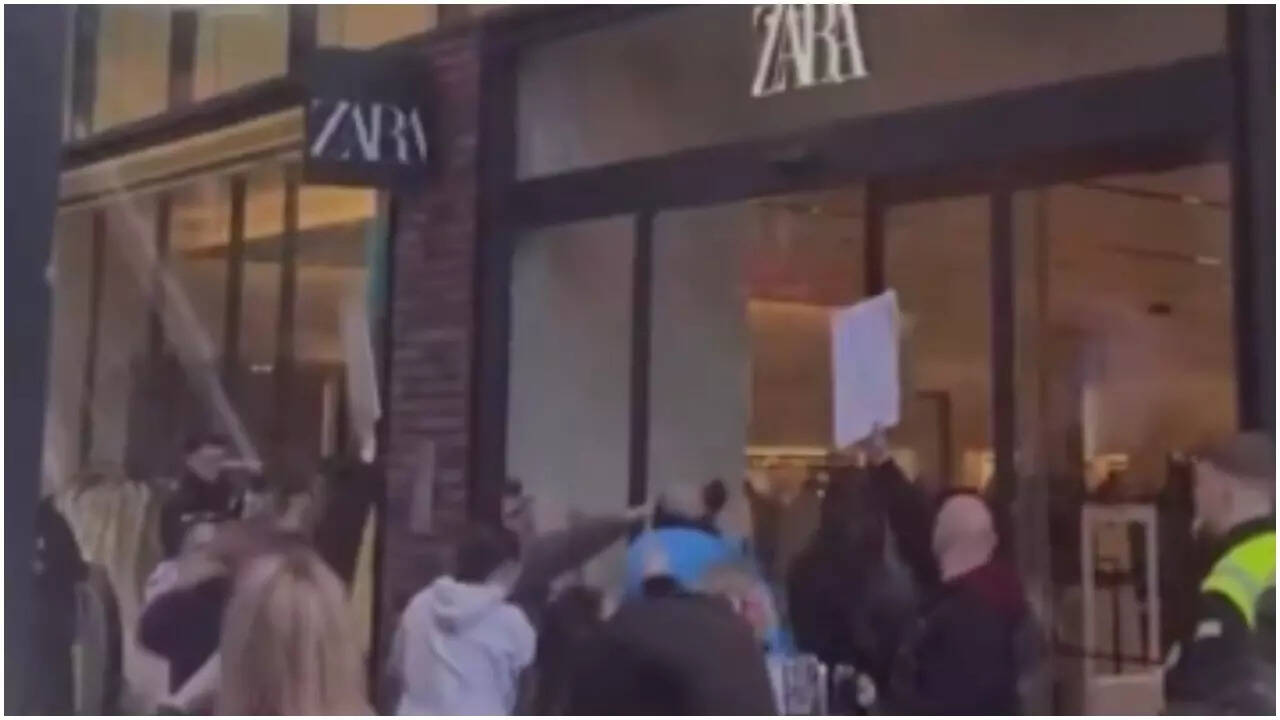
The intersection of localized violent crime and global retail operations creates a specific form of reputational contagion that most corporate crisis frameworks fail to quantify. When an incident—in this case, an assault on a minor in Bristol, UK—occurs in the immediate proximity of a high-value brand like Zara, the brand ceases to be a passive bystander and becomes a focal point for systemic grievance. This shift is not accidental; it is the result of a predictable mechanism where protesters leverage the physical and digital footprint of a multinational to amplify a localized failure of public safety.
The Proxy Targeting Mechanism
Protesters do not target global retailers because they believe the corporation committed the crime. They target them because the retailer represents the most accessible and "loudest" node in the local environment. This is a strategic calculation based on three variables:
- Visibility Density: A flagship store possesses a higher concentration of media and public attention than a local police station or government office.
- Brand Sensitivity: Corporations are perceived as more vulnerable to reputational damage than state institutions, leading to a belief that corporate pressure will accelerate state action.
- The Safety Vacuum: When the state fails to provide a "Safe Perimeter" around commercial zones, the commercial entity is forced to internalize the costs of that failure through lost foot traffic, physical damage, and brand erosion.
In the Bristol context, the "Shame on you" slogans directed at Zara function as a linguistic bridge. They attempt to transfer the moral culpability of the attackers onto the commercial entity for its perceived indifference or its role as a silent witness within the urban fabric.
Operational Friction and the Duty of Care Paradox
Retailers operate under a "Duty of Care" that is legally well-defined regarding customers inside the store but becomes analytically murky at the threshold of the property. The Bristol incident exposes a critical bottleneck in private security protocols: the hesitation to intervene in external violent escalations due to liability constraints.
The cost function of intervention for a retailer like Zara includes:
- Direct Liability: Risk of lawsuits if security personnel injure a third party outside the leasehold.
- Escalation Risk: The high probability that corporate intervention turns a localized assault into a wider riot or a coordinated boycott.
- Insurance Premiums: The correlation between active intervention and the reclassification of a store's risk profile, leading to higher opex.
This creates a "Bystander Equilibrium." The corporation calculates that the cost of non-intervention (short-term bad PR) is lower than the cost of active intervention (long-term legal and physical risk). However, this equilibrium ignores the Velocity of Social Media Contagion, where a 30-second clip of a brand’s security guards standing idle during an assault can devalue the brand's social capital by millions of dollars in a single afternoon.
Quantifying the Reputational Contagion
To understand why a protest outside a Zara is a significant business event, one must map the flow of sentiment from the physical site to the digital market. We can categorize this into the "Three Tiers of Impact."
Tier 1: Immediate Operational Disruption
This is the physical shutdown. The cost is the loss of daily revenue plus the "Security Surge" cost required to protect assets. In Bristol, the presence of protesters creates a physical barrier to entry, effectively devaluing the high-rent location to zero for the duration of the event.
Tier 2: Search Engine Sentiment Shifts
When a brand name is indexed alongside terms like "attack," "protest," and "shame," the algorithmic association lingers long after the protesters leave. This degrades the Brand Equity Index (BEI). For a fast-fashion giant, the BEI is directly tied to "aspiration" and "safety." Associating the brand with urban decay or violence creates a cognitive dissonance that drives consumers toward e-commerce competitors where the physical environment is not a factor.
Tier 3: Institutional Pressure
Large-scale retailers are often tenants of massive REITs (Real Estate Investment Trusts). Prolonged protests signal to landlords and investors that the location is no longer "Prime." This can lead to downward pressure on property valuations and upward pressure on the "Safety Premium" demanded by staff, making recruitment and retention more expensive.
The Failure of the Neutrality Strategy
The standard corporate response—a brief statement of sympathy followed by a return to "business as usual"—is increasingly ineffective. This "Neutrality Strategy" assumes that the public distinguishes between the crime and the location. In a hyper-connected social environment, this distinction has collapsed.
The public now demands Active Civic Participation. This is not "woke" branding; it is a demand for the corporation to act as a private governor of the space it occupies. If the state cannot provide security in a shopping district, the dominant commercial entity is expected to fill the void. When Zara remains silent or purely defensive, it is viewed as a "Parasitic Tenant"—extracting value from the community without contributing to its fundamental safety.
Structural Recommendations for Urban Retailers
To mitigate the fallout from localized violence and subsequent protests, a shift from defensive PR to Integrated Urban Security is required.
- The Intelligence Loop: Corporations must integrate local crime data into their store management systems. If a specific "hot zone" for youth violence is identified within a 500-meter radius of the store, the security posture must shift from loss prevention (stopping shoplifters) to perimeter stabilization.
- The Rapid Response Fund: Instead of waiting for a protest to occur, brands should have pre-allocated community grants for victim support in the immediate vicinity of their flagship stores. This changes the narrative from "shame" to "stewardship" within hours of an incident.
- Security Decentralization: Security personnel must be trained in "Good Samaritan" protocols that allow for de-escalation and intervention at the store's threshold, backed by a corporate indemnity fund. This removes the "Liability Hesitation" that leads to the viral "bystander" videos that fuel protests.
The Bristol protest is a symptom of a larger trend: the privatization of public grievances. As trust in state institutions (police, local councils) wanes, the public will increasingly look to the most powerful entities in their visual field to provide accountability. For Zara, the challenge is no longer just selling clothes; it is managing the sociopolitical volatility of the streets they occupy. The brand must choose between being a fortress that the community resents or a stakeholder the community protects. Failure to make this choice proactively ensures that the next localized assault will once again turn their storefront into a theatre of public condemnation.
Implement a "Buffer Zone" strategy that coordinates private security with local community leaders to manage the space between the store entrance and the public sidewalk, ensuring that the brand is seen as a protector of the local ecosystem rather than a silent observer of its decline.