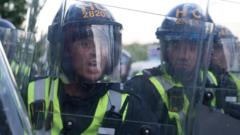
The expansion of state criminal prosecution following civil disturbances functions as a lagging indicator of systemic breakdowns in institutional trust. In Southampton, the expansion of the charging registry to eleven individuals following protests over the murder of Henry Nowak provides a precise case study in how localized tactical errors generate widespread macro-level friction. Civil unrest does not manifest spontaneously; it operates on a predictable causal chain fueled by information asymmetry, perceived institutional betrayal, and the weaponization of ideological narratives.
Analyzing the escalation sequence from a localized criminal act to a distributed public order threat requires dissecting the specific operational failure points, the communication dynamics of law enforcement agencies, and the structural responses deployed by the state judicial apparatus.
The Causal Chain of Institutional Friction
The underlying friction that precipitated the Southampton disorder can be modeled as a multi-stage structural failure. The initial vector was a violent criminal act: the murder of eighteen-year-old student Henry Nowak by Vickrum Digwa. However, criminal acts alone rarely trigger systemic urban unrest. The critical catalyst occurs when the state apparatus is perceived to validate the malice of the perpetrator or display gross incompetence during the immediate crisis-response phase.
[Initial Criminal Shock]
       │
       ▼
[Tactical Deception by Perpetrator]
       │
       ▼
[Institutional Compliance via Confirmation Bias]
       │
       ▼
[Information Asymmetry / Latent Resentment]
       │
       ▼
[Post-Trial Video Release] ──► [Systemic Flashpoint & Civil Unrest]
This structural failure evolved through three distinct phases:
- Tactical Deception and Confirmation Bias: Upon the arrival of emergency services, Digwa fabricated a narrative asserting he was the victim of a racially motivated assault. Responding officers accepted this frame without sufficient rapid verification, immediately placing the mortally wounded victim in handcuffs. This created an operational inversion where the state active-response asset inadvertently protected the aggressor while incapacitating the victim.
- Information Deprivation: For the duration of the judicial process, from the December incident to the June sentencing, details surrounding the arrest mechanics remained insulated within legal privilege. This created a period of latent stability where public awareness was detached from the operational realities of the initial police response.
- The Transparency Shock: The release of police body-worn video footage post-sentencing acted as an unmitigated transparency shock. The visual confirmation that officers ignored Nowak's statements regarding respiratory distress, combined with the delayed revelation of the perpetrator's deception, transformed a closed judicial outcome into an open institutional grievance.
This sequence demonstrates that public order is highly sensitive to perceived procedural injustice. When the state suppresses or delays highly sensitive operational data, the eventual dissemination of that data does not stabilize the environment; instead, it rapidly accelerates civil volatile action.
The Cost Function of Public Disorder Operations
When latent public grievance transitions into kinetic action, the strategic posture of law enforcement moves from preventative policing to containment and deterrence. In Southampton, this shift manifested as a rapid decentralization of violence, transitioning from a localized demonstration outside the central police infrastructure to mobile, distributed targets within commercial and residential sectors.
The operational impact on state resources can be quantified across three distinct vectors:
Physical Asset Degradation
The deployment of kinetic crowds resulted in direct capital destruction, including the fracturing of logistics infrastructure, glass breakage across commercial zones, and the deployment of improvised projectiles such as bricks and waste receptacles. This tactical pattern forces law enforcement to divert personnel from strategic containment to static asset protection.
Human Capital Compromise
The engagement resulted in the injury of eleven operational officers and an associated service animal. When personnel sustain physical trauma, the immediate capacity of the shift decreases, driving up overtime expenditure and reducing the operational resilience of subsequent deployments.
Information Warfare and Digital Attrition
A critical friction point emerged within the digital operational theater. The Hampshire Police Federation observed targeted data mining operations utilizing automated scripts to compromise the personally identifiable information (PII) of serving officers. This digital doxxing campaign forced the complete suspension of the federation’s public communication nodes to mitigate the risk of extra-judicial retaliatory targeting against personnel in their private residences.
The interaction of these factors creates an acute operational bottleneck. As physical threats escalate on-street, the internal administrative and digital security infrastructure faces parallel saturation, compounding the total cost function of the state response.
Judicial Deterrence Frameworks and Velocity of Prosecution
The state response to structural public order breakdown relies on the rapid deployment of judicial deterrence. The Crown Prosecution Service (CPS) utilizes statutory instruments—specifically charging individuals under the Public Order Act 1986 for violent disorder—to disrupt the coordination mechanics of crowds.
The strategy depends heavily on processing velocity. By accelerating the timeline between detention and formal arraignment, the state aims to break the momentum of ongoing mobilization. The demographic distribution of the eleven individuals charged reveals a highly localized, male-dominated participant pool spanning a wide age range (eighteen to fifty years old). This disproves theories that contemporary civil unrest is exclusively driven by youth demographic bulges; instead, it indicates a cross-generational alignment along shared socio-political grievances.
| Defendant | Age | Jurisdiction of Origin | Core Charges |
|---|---|---|---|
| Kevin Reeves | 31 | Southampton | Violent Disorder |
| Andrew Riddett | 38 | Southampton | Violent Disorder |
| Harry Varney | 34 | Southampton | Violent Disorder |
| Dillon Crawford | 29 | Southampton | Violent Disorder |
| Andrew Summerhayes | 38 | Romsey | Violent Disorder, Offensive Weapon Possession (x2) |
| Taylor Grundy | 22 | Gosport | Violent Disorder |
| Daniel Frost | 44 | Southampton | Violent Disorder, Offensive Weapon Possession (Guilty) |
| Connor Bishop | 24 | Southampton | Violent Disorder (Guilty) |
| Reece Robinson | 21 | Havant | Violent Disorder (Guilty) |
| Noah Etherington | 18 | Havant | Violent Disorder (Guilty) |
| Matt Styler | 50 | Gosport | Assault on an Emergency Worker (Not Guilty) |
The high ratio of immediate guilty pleas (Frost, Bishop, Robinson, Etherington) during preliminary appearances at Southampton Magistrates’ Court reflects the strategic utility of uncontestable bodycam and surveillance evidence. When the evidentiary threshold is absolute, the legal defense infrastructure collapses, permitting the state to achieve swift punitive outcomes that function as macroeconomic disincentives for potential future participants.
Geopolitical Contagion and Narrative Exploitation
Localized civil friction does not exist in an information vacuum. In highly interconnected digital ecosystems, domestic disruptions are immediately integrated into broader geopolitical narrative frameworks. The Southampton incident demonstrates how a localized operational failure can be co-opted by external political actors to advance macro-level strategic objectives.
The intervention of external political figures, including public commentary from US political leaders attributing the homicide to unregulated migration flows, highlights the vulnerability of domestic incidents to international narrative manipulation. This process follows a systematic exploitation matrix:
- Decontextualization: The specific, highly nuanced operational errors committed by local law enforcement are stripped away to present a simplified binary narrative of state negligence vs. public self-defense.
- Amplification: International digital channels leverage algorithmic distribution networks to broadcast localized footage to global audiences, amplifying the perceived instability of the target state.
- Domestic Polarization: The external validation of local grievances hardens the positions of domestic factions. This forces central government executives into defensive political posturing, altering the focus from local structural reform to national security stabilization.
The state’s counter-strategy relies on aggressive rhetorical containment. Direct denunciations from Downing Street regarding democratic interference, coupled with appeals from the victim’s surviving kin for civil calm, represent a coordinated effort to de-escalate the emotional resonance of the narrative. This tier of strategic communication aims to isolate the radicalized actors from the broader, moderate civic population, reducing the recruitment pool for ongoing civil disobedience.
Strategic Interventions for Institutional Stabilization
Mitigating the systemic vulnerabilities exposed by the Southampton unrest requires an immediate shift in operational doctrine across both law enforcement and municipal governance. Relying solely on lagging judicial deterrence is insufficient to prevent the replication of this friction model in other urban centers.
First, law enforcement agencies must implement immediate modifications to field-triage protocols. When handling multi-party violent encounters, field officers must utilize mandatory objective verification parameters before applying physical restraints to individuals displaying clinical signs of severe trauma, regardless of initial verbal accounts provided by third parties at the scene. This mitigates the risk of catastrophic tactical deceptions that undermine institutional legitimacy.
Second, the structural handling of body-worn video assets requires systematic reform. Rather than containing highly volatile operational footage until the absolute conclusion of long-term judicial proceedings, independent oversight bodies must deploy proactive, controlled data releases accompanied by objective procedural commentary. Managing the narrative cadence before a complete transparency shock occurs dampens the eventual force of the disclosure and prevents external actors from filling the information vacuum with hyper-polarized interpretations.
Finally, municipal and state authorities must establish dedicated digital defense frameworks for operational personnel. The vulnerabilities identified within police federation platforms indicate that tactical entities are currently ill-equipped to counter automated data-harvesting and doxxing campaigns. Establishing central state cyber-protection protocols for frontline staff is a critical prerequisite for maintaining operational continuity during active, high-intensity public sphere disruptions.