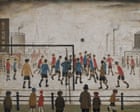
The prevailing critical consensus categorizes L.S. Lowry as a "naive and uncultured" painter of uniform industrial crowds—a regional anomaly detached from the broader trajectory of 20th-century modernism. This classification is analytically flawed. It mistakes deliberate stylistic reduction for a lack of technical capability and confuses thematic focus with intellectual isolation. The upcoming exhibition L.S. Lowry: The Theatre of Life at Milton Keynes Gallery serves as a corrective case study, demonstrating how institutional misinterpretation creates a distorted market and critical caricature of an artist's total output.
To understand how this myth sustained itself for half a century after the artist's death in 1976, we must analyze the structural mechanics of Lowry’s practice, his true position within the institutional art ecosystem, and the economic forces that commodified his signature industrial landscapes at the expense of his broader portfolio.
The Three Pillars of Stylistic Reduction
The label "naive" implies an artist operates without formal training, structural awareness, or historical context. Lowry’s actual output relies on a calculated system of constraints that align closely with early 20th-century modernist principles rather than uneducated instinct. His technical framework rests on three distinct operational pillars.
First, the formal academic foundation. Lowry did not emerge fully formed from the industrial landscape of Lancashire. He spent over a decade in rigorous formal training at the Manchester Municipal College of Art and the Salford School of Art, studying under Adolphe Valette. His early portfolio consists of precise anatomical charcoal drawings and academic life studies—the exact antithesis of the self-taught primitive archetype.
Second, strict palette limitation. Lowry restricted his industrial oil paintings to exactly five pigments:
- Ivory black
- Vermillion
- Prussian blue
- Yellow ochre
- Flake white
This choice was an active strategy of chromatic compression. By refusing to use green or violet, and by mixing these raw tones strictly on the canvas or palette, Lowry achieved a unified tonal temperature that mirrored the soot-heavy atmosphere of the industrial North West.
Third, the technical manipulation of the ground layer. Following advice from critic and tutor Bernard Taylor around 1915, Lowry began painting on a pure flake white base layer. Over years of drying, the oil absorbed upward, causing the white ground to turn chalky and luminous. This created a stark backdrop against which his sharp, shadowless silhouettes could achieve maximum contrast. This technique was not naive; it was a deliberate, long-term technical calculation.
The Curation Bottleneck and Market Distortion
The secondary market and major public galleries have historically created a feedback loop that reinforces a narrow caricature of Lowry's work. By isolating his industrial scenes, institutions artificially restricted the public’s understanding of his stylistic breadth.
The mechanism driving this distortion is commercial and institutional risk aversion. Industrial crowd scenes generate the highest transaction values at auction. For example, Going to the Match commanded £7.8 million in 2022. Because public institutions like the Tate Britain historically focused their limited curation windows on these high-profile industrial landscapes—such as their 2013 retrospective featuring 90 works—the broader public was starved of exposure to his alternative genres.
[Market Demand for Industrial Motifs]
       │
       ▼
[Institutional Curation Bias (Tate 2013)]
       │
       ▼
[Critical Caricature: "The Naive Industrial Painter"]
       │
       ▼
[Suppression of Alternative Genres (Portraits/Seascapes)]
The Milton Keynes exhibition attempts to break this bottleneck by presenting 140 works that establish a balanced distribution across Lowry's total thematic output. When these less-frequent works are integrated alongside the industrial pieces, the "uncultured" narrative collapses under the weight of three overlooked categories:
- The Social Subtext of Leisure: Rather than depicting a population entirely subjugated by industrial labor, works like the rarely seen 1932 painting A Football Match—on public display for the first time in nearly 85 years—document the emergence of working-class leisure, including seasides, festivals, and amateur sports.
- Anomalous Realism: While the majority of Lowry’s industrial works are composite, psychological architectures built from multiple observations, specific pieces capture singular, real-time historic events, showing a capacity for direct journalistic reportage.
- Surrealist and Grotesque Compositions: His late-career works feature sparse, haunting figures and stark, vacant seasides that abandon the industrial motif entirely, revealing a deep engagement with existentialism and surrealist isolation.
The Consumption Function of a Cultured Recluse
The myth of Lowry as an unrefined, isolated rent collector ignores his active consumption of high culture and modern art. A structural assessment of his personal economy reveals that his employment was not a barrier to culture, but a financial subsidization strategy that allowed him to protect his aesthetic autonomy from market pressures until his retirement in 1952.
Lowry used his financial independence to build a sophisticated private collection. He was an active patron of the arts, acquiring works by the Pre-Raphaelites, Lucien Freud, and Jacob Epstein. His regular attendance at the opera, ballet, and theatre further falsifies the narrative of a provincial worker painting blind to the cultural currents of his era. He was not disconnected from art history; he chose to reject its decorative conventions in favor of a starker, raw human geometry.
Strategic Recommendation
For curators, institutional collectors, and galleries seeking to rebalance the historical valuation of mid-century British modernism, the strategy must shift from sentimental biography to rigorous formal analysis.
Stop framing Lowry through the lens of regional novelty or class voyeurism. Instead, position his work within the broader European tradition of urban alienation, alongside figures like Edvard Munch or the New Objectivity painters of Weimar Germany. Only by treating his structural constraints, technical palette choices, and thematic diversions as deliberate modernist strategies can institutions permanently dismantle the reductive caricature that has clouded his legacy for fifty years.