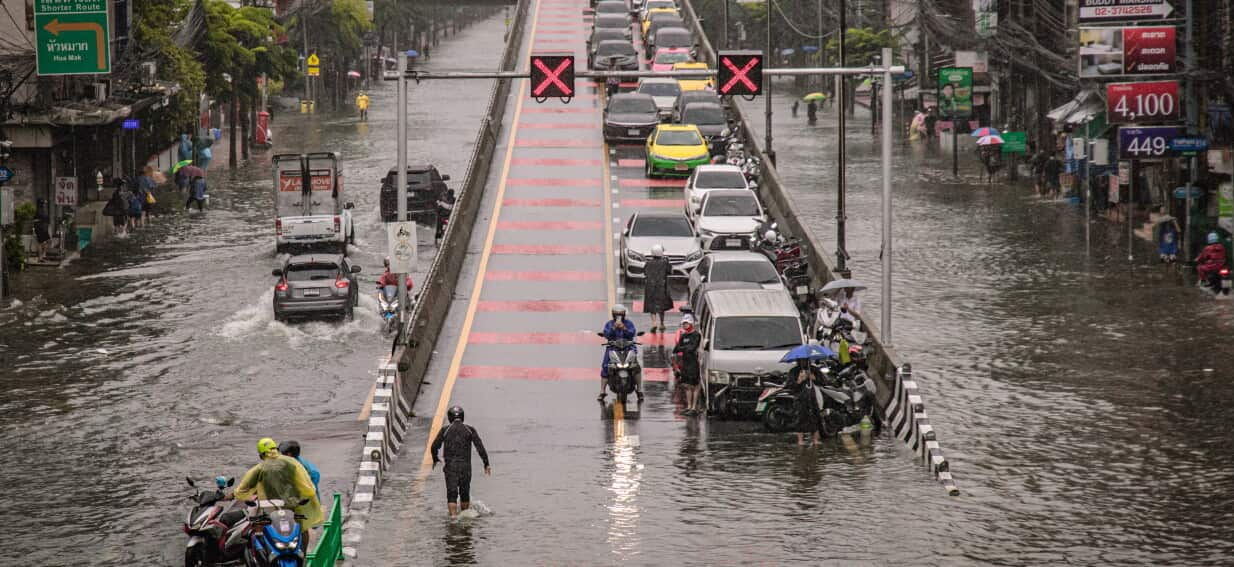
Water has a memory, and on that Tuesday, it remembered everything.
It started not with a crash, but with a heavy, suffocating stillness. The kind of quiet that settles over a tropical metropolis right before the sky decides to empty its lungs. For months, the monsoon had hovered at the edges of consciousness—a distant rumble over the Chao Phraya River, a humid inconvenience managed by umbrellas and hurried dashes between concrete overhangs. But nature does not negotiate with timetables. When the clouds broke, they did not rain. They fell.
More than 300 millimeters of water descended upon Bangkok in a single, unyielding deluge. To picture that number, imagine standing beneath a towering wall of water twelve inches deep, covering every single square inch of a sprawling, asphalt-bound megacity of over eleven million souls. Drainage systems designed for decades-old weather patterns simply vanished beneath the onslaught. Canals choked. Sewers reversed.
By mid-afternoon, the streets of Sukhumvit and Silom stopped being streets. They became grey, swirling canals, littered with drifting flip-flops, bobbing plastic bottles, and the quiet panic of a city brought to its knees by its own weight.
Consider Somchai, a motorcycle taxi driver whose family has lived in the low-lying Lad Phrao district for three generations. On ordinary days, Somchai navigates the chaotic motorcycle lanes with the practiced ease of an acrobat, threading his Honda through gridlock with a cigarette tucked behind his ear. But ordinary days ended at 2:00 PM.
Sitting on his stalled bike, water creeping steadily past the footpegs and up toward the engine block, Somchai didn't curse. He sighed. He had seen this before, yet every time it arrived, it felt like an eviction notice served by the sky.
"Water is patient," Somchai would tell you, wiping rain from his brow with a sodden sleeve. "It fills every mistake we make."
His mistake, and the mistake of millions, was building a concrete empire on a delta that was always meant to breathe. Bangkok sinks centimeters every year—a combination of excessive groundwater extraction, rising sea levels, and the sheer, crushing mass of high-rise skyscrapers planted precariously on soft clay. When 300mm of rain drops from the heavens onto a bowl-shaped city whose natural outlets are already swollen by seasonal tides, physics takes over. There is nowhere down. There is only up.
The government declared a flood disaster. Sirens wailed across districts. Emergency alerts buzzed on millions of smartphones, cutting through the din of gridlocked traffic and roaring pumps. But long before the official decree echoed from loudspeakers, the people already knew.
They knew because the floorboards of ground-floor shophouses began to glisten. They knew because the stray soi dogs had long since scrambled onto the tops of parked cars, watching the rising tide with ancient wisdom. They knew because the smell changed—that distinct, heavy urban aroma of damp earth, oil slick, and overwhelmed municipal infrastructure rolling through the damp air.
Urban flooding is rarely just a meteorological event. It is a mirror. It reflects the fault lines of modern infrastructure, exposing where asphalt triumphed over permeability, where zoning laws bowed to real estate expansion, and where the vulnerable always bear the heaviest burden of climate volatility.
While luxury high-rises in Sathorn rolled out deployable aluminum flood barriers and activated backup generators humming behind polished glass, neighborhoods like Khlong Toey watched the water seep into wooden doorways where families sleep mere inches from the ground. For them, a flood disaster is not a news headline to be scrolled past on a feed. It is ruined inventory, electrical hazards, ruined schoolbooks, and days of stagnant water breeding mosquitoes and disease.
Yet, amid the rising brown tide, something else happened. Something entirely human.
Down a narrow alley in Chinatown, where the water lapped against the threshold of a century-old herbal medicine shop, neighbors formed a human chain. No one asked them to. No one organized a committee via an app. An elderly shopkeeper stood on a stool handing out plastic crates, while teenagers in soaked school uniforms waded waist-deep to guide stalled delivery trucks away from open manholes—invisible hazards that turn flooded streets into lethal traps.
A vendor hauled his cart of sticky rice onto a makeshift wooden platform, continuing to sell wrapped banana leaves to stranded commuters who stood on tiptoe atop concrete planters. Resilience in Bangkok is not a grand political strategy. It is muscle memory. It is the quiet, stubborn refusal to let routine be entirely washed away by the storm.
By nightfall, the rain tapered off into a sullen drizzle, leaving behind a surreal landscape. The city’s neon lights fractured and bled across the mirror-like surfaces of flooded intersections. Skytrain stations were transformed into impromptu islands, packed shoulder-to-shoulder with weary office workers watching the dark currents swirl below.
Governments will debate the billions needed for new drainage tunnels, retention basins, and smarter zoning laws. Engineers will crunch the data on precipitation anomalies driven by shifting global temperatures. But down at street level, the immediate reality remained painfully simple: humanity adapting to a world where the old rules of weather no longer apply.
The water eventually recedes, of course. Gravity eventually wins, pulling the deluge back toward the Chao Phraya and out into the Gulf of Thailand, leaving behind a thick layer of slick, grey silt that coats everything it touched.
When the sun rises over Bangkok the next morning, the steam will lift from the asphalt, the traffic will choke the lanes once more, and life will resume its relentless pace. But underneath the tires and the concrete, everyone will walk a little lighter, carrying the quiet, unsettling knowledge of how fragile the boundary is between the dry land we claim and the water that waits below.


